Mindanao State University–Maguindanao (MSU–Maguindanao) promotes responsible scientific research, animal welfare, and biodiversity conservation through its Institutional Animal Care and Use Committee (IACUC) Manual, formally approved by the Mindanao State University Board of Regents under Resolution No. 108, Series of 2022, on March 21, 2022. Developed in accordance with the Animal Welfare Act of 1998, the manual establishes institutional guidelines for the humane care, ethical treatment, identification, monitoring, and protection of animals involved in University research and educational activities. It also incorporates national wildlife conservation regulations that support the responsible management of animal species, including threatened and protected wildlife.
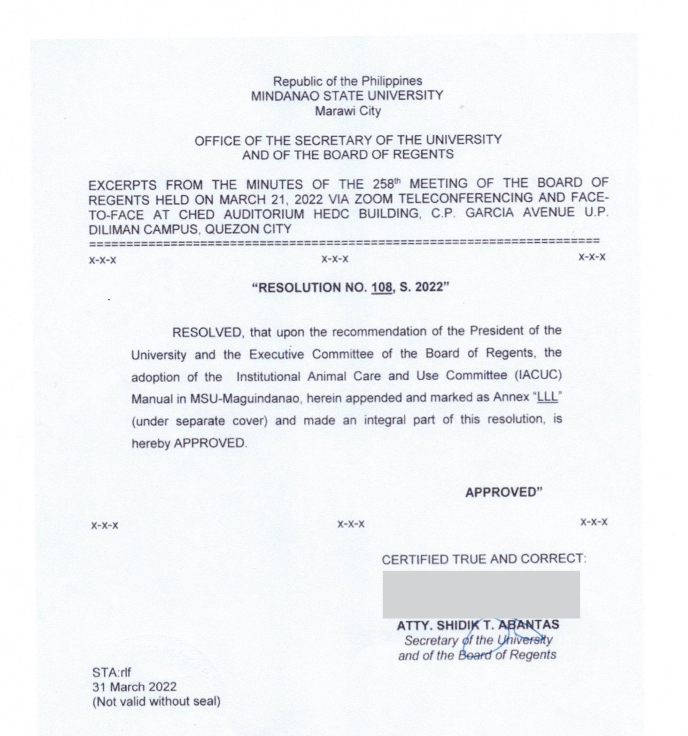
MSU Board of Regents Resolution No. 108, s. 2022 approving the Institutional Animal Care and Use Committee (IACUC) Manual in MSU-Maguindanao
The University established the Institutional Animal Care and Use Committee (IACUC) to oversee research activities involving animals, with institutional supervision under the Office of the Chancellor and the Office of the Vice Chancellor for Research, Extension and Development. Through the manual's provisions on animal care and management, the Committee is responsible for reviewing research protocols, evaluating animal housing and facilities, ensuring appropriate veterinary supervision, and monitoring adherence to established animal welfare standards. Under Operation and Administration, Section A.2.g (Animal Traceability), the manual requires the identification, tracking, and documentation of animals used in research. Furthermore, Section B.3.d (Field Studies) provides guidelines for research involving fish, amphibians, reptiles, birds, and mammals, including considerations for species selection, research locations, and methodologies.The manual also incorporates national biodiversity conservation frameworks under Appendix C, Policies and Governance of Biodiversity Conservation in the Philippines, particularly Republic Act No. 9147, or the Wildlife Resources Conservation and Protection Act, which provides legal measures for conserving wildlife species and their habitats. Complementing these provisions, Appendix B includes DENR Administrative Order No. 2009-01, establishing guidelines for wildlife marking and identification systems. These regulatory references provide guidance relevant to the identification, monitoring, and protection of threatened and nationally protected species while promoting responsible animal research.
Mindanao State University-Maguindanao also adopted the Mindanao Sulu Palawan Innovative Research and Development Consortium (MinSuPala-IRDC) Harmonized Protocol for Watershed Characterization for identifying, assessing, and monitoring IUCN Red-Listed and nationally listed conservation species, especially for research. The protocol establishes assessment procedures for trees, covering vegetation sampling, avian surveys, species identification, diversity assessment, documentation, and verification of conservation status. These procedures provide a systematic basis for identifying threatened and ecologically significant species, documenting their distribution and habitats, and supporting biodiversity monitoring and conservation efforts in areas covered by watershed research and management activities.
Rapid Assessment for Trees, Shrubs, Herbs and Grasses Protocol
Under the protocol's rapid assessment procedures, nine sampling quadrats are established across the upper, middle, and lower portions of a watershed, with three 20 m × 40 m quadrats in each portion. Nested sampling plots of 5 m × 5 m for shrubs and herbs and 1 m × 1 m for grasses are also established. These sampling sites are selected to represent the different vegetation types within the study area. Identified plant species are characterized and documented, with particular attention to their ecological and conservation status.
To verify species identification, distribution, and conservation classifications, the protocol references authoritative resources, including the IUCN Red List, DENR Administrative Order No. 2017-11 (Updated National List of Threatened Philippine Plants and their Categories), the Co's Digital Flora of the Philippines, and other recognized botanical databases. These references enable researchers to determine whether documented species are internationally or nationally recognized as threatened and identify those requiring conservation attention.
Protocol for Bird Identification and Assessment. For bird identification and assessment, researchers from MSU-Maguindanao refer to Birds of the Philippines by Desmond Allen (2020), the BirdLife International database, the Bird Identifier, and eBird by the Cornell Lab of Ornithology, and the IUCN Red List of Threatened Species. These references support the verification of bird species' identities, distribution, and conservation classifications. These resources provide reference information on species characteristics, scientific names, geographic distribution, and occurrence records. They complement field observations and photographic documentation in establishing the bird species inventory and assessing avian biodiversity within the watershed. The procedures provide a systematic basis for identifying threatened and ecologically significant species, documenting their distribution and habitats, and supporting biodiversity monitoring and conservation efforts in areas covered by watershed research and management activities.
Through these guidelines and protocols, MSU–Maguindanao strengthens ethical research practices, responsible animal management, and the conservation of biological diversity. The University remains committed to enhancing its animal care and research oversight mechanisms, promoting the protection of animal species and natural habitats, and advancing scientific research that contributes to sustainable ecosystem management and environmental stewardship.