The Sustainability Policy, approved through Board of Regents Resolution No. 358, series of 2023, for MSU system-wide application, serves as an institutional framework for the University in guiding and institutionalizing its commitment to environmental protection, biodiversity conservation, ecosystem restoration, and the sustainable management of natural resources.
The policy, specifically Article VII, Section 5 – Biodiversity and Green Spaces, establishes measures to preserve and expand green spaces through environmentally responsible landscaping and sustainable land management practices. These provisions provide an institutional framework for protecting terrestrial biodiversity, maintaining ecological integrity, and promoting the sustainable use of land resources associated with university operations.
The Sustainability Policy outlines specific measures supporting terrestrial ecosystem conservation and restoration. Article VII, Section 5(a) directs the University to “Incorporate sustainable use, conservation, and restoration of land in its Land Use Development and Infrastructure Plan,” while Section 5(c) provides for the establishment of in-house nurseries to raise native seedlings for campus planting, tree growing, and distribution to local communities. Furthermore, Section 5(d) promotes student participation in biodiversity conservation and sustainable landscaping initiatives through the National Service Training Program (NSTP). These provisions support the protection of natural habitats, restoration of vegetation, conservation of native plant species, and responsible management of terrestrial ecosystems within the University’s areas of influence.
Upholding the existing Sustainability Policy, and as an expression of shared responsibility, MSU-Maguindanao, in partnership with the Local Government Unit of South Upi, and with funding support from the Ministry of Science and Technology-BARMM, facilitated the formulation of the South Upi Forest Watershed Enhanced Protection and Management Plan, which was formally turned over to the local government to guide the protection, rehabilitation, and sustainable management of its forest and watershed resources. A corresponding policy brief was also prepared and provided to support local decision-making and promote the adoption of recommended conservation and management measures. These knowledge products strengthen the capacity of local government partners to implement evidence-based approaches to terrestrial ecosystem conservation and sustainable land management.
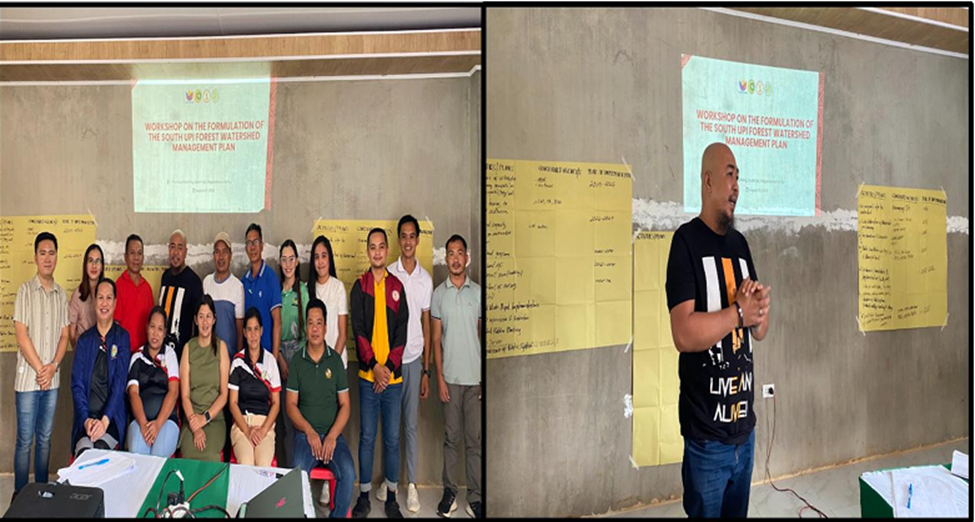
Researchers from MSU-Maguindanao and participants during the Workshop on the Formulation of the South Upi Forest Watershed for Enhanced Protection and Management Plan at the South Upi Municipal Hall on July 25, 2025
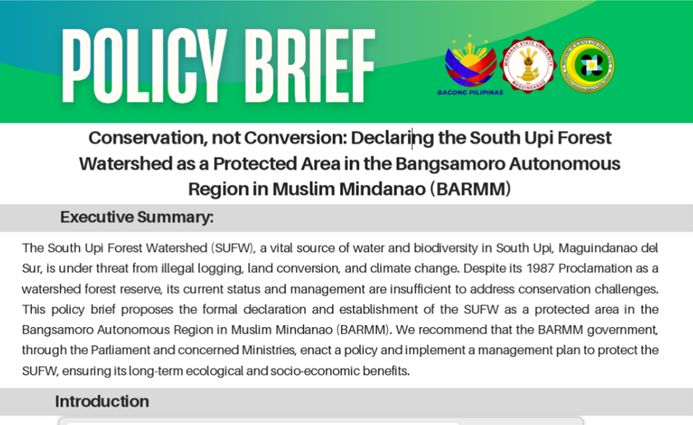
Policy Brief crafted based on the results of the study "Characterization of South Upi Forest Watershed cum Landslide Vulnerability Assessment: Basis for Enhanced Protection and Management Plan."
Through these institutional policies and collaborative initiatives, MSU-Maguindanao reinforces its commitment to biodiversity conservation, ecosystem restoration, sustainable land use, and environmental stewardship.