Mindanao State University–Maguindanao (MSU–Maguindanao) establishes institutional provisions for responsible waste management, including the handling and disposal of hazardous materials, through its Sustainability Policy, anchored in the MSU–Iligan Institute of Technology (MSU-IIT) Sustainability Policy, approved under Board of Regents Resolution No. 358, series of 2023, for MSU system-wide application.
The policy provides an institutional framework for minimizing waste generation, promoting proper waste segregation, handling, and environmentally responsible disposal practices, and mitigating potential risks to human health and the environment arising from university operations. Its scope encompasses students, faculty, administrative staff, outsourced service providers, and external parties operating within university premises, reinforcing shared institutional responsibility for environmental protection and sustainable waste management.
Specifically, Article VII, Section 1 – Waste Management and Recycling directs the University to adopt or continue implementing a comprehensive solid waste management program that reduces waste generation and disposal in landfills. More importantly, Section 1(e) explicitly requires the University to “Adopt and/or continue to implement guidelines on managing and handling e-waste, chemicals, chemical waste, and biohazardous waste.” This provision establishes a policy commitment to the responsible management of hazardous materials associated with academic, research, administrative, and other institutional activities. Complementary provisions under Section 1(d) promote university-wide waste education, while Section 1(l) requires waste segregation at source and appropriate waste containers across university offices and food concessionaires.
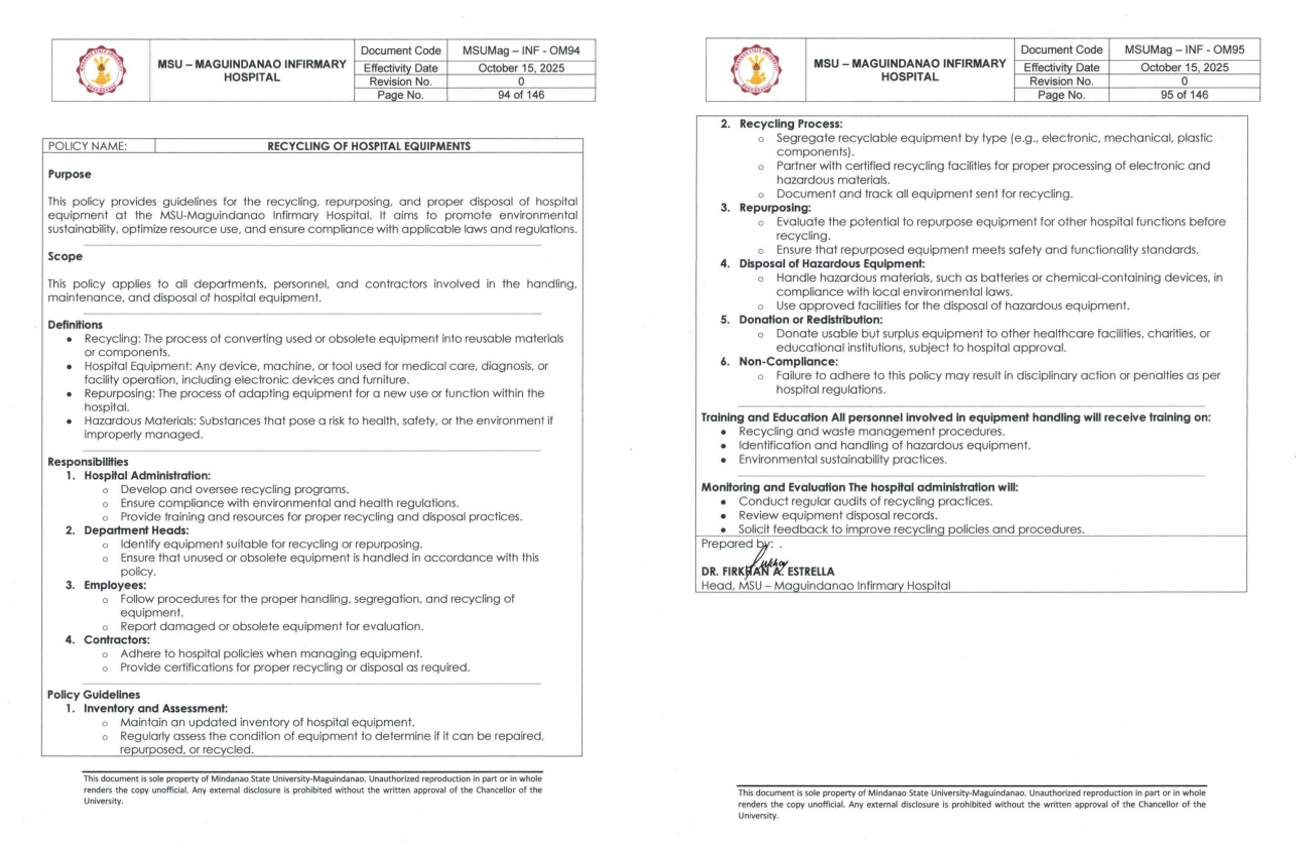
In concurrence with the policy and to promote environmental sustainability, optimize resource utilization, and ensure compliance with applicable environmental and health regulations, MSU-Maguindanao Infirmary Hospital crafted its Policy on Recycling of Hospital Equipment, which establishes guidelines for recycling, repurposing, handling, and proper disposal of hospital equipment. The policy establishes the following procedures:
- Inventory and Assessment. An updated inventory of hospital equipment is maintained, and regular assessments are conducted to determine whether equipment can be repaired, repurposed, or recycled.
- Recycling and Repurposing. A recycling and repurposing process is maintained to identify obsolete or unused equipment that can be converted into reusable materials or adapted for other hospital functions.
- Proper Handling and Disposal. Procedures for handling, segregating, and evaluating damaged, obsolete, or unusable equipment are maintained to ensure appropriate recycling or disposal.
- Institutional Accountability. A system of responsibility is maintained among hospital administrators, department heads, employees, and contractors to ensure compliance with the policy.
- Training and Compliance. Personnel training and resource support are maintained to ensure that employees follow appropriate procedures for equipment handling, recycling, and disposal.
Specifically, pages 94–95 of the MSU–Maguindanao Infirmary Hospital Operations Manual, under the policy titled “Recycling of Hospital Equipments,” delineate the University's institutional guidelines for the responsible recycling, repurposing, and disposal of hospital equipment. The policy establishes procedures for equipment inventory and assessment, segregation of recyclable materials, coordination with certified recycling facilities, and the safe disposal of hazardous equipment in accordance with applicable environmental regulations.
Through these provisions, MSU-Maguindanao reinforces its commitment to responsible hazardous waste management, environmental protection, and the health and safety of the university community.