Most marine pollution begins on land and travels to the sea through drains and rivers. The MSU Sustainability Policy, approved by the MSU Board of Regents through Resolution No. 358, s. 2023, commits MSU–Maguindanao to stopping it at the source. Article VII, Section 5(f) (Biodiversity and Green Spaces) directs the University to “support and implement initiatives to reduce marine pollution.”
The policy backs this commitment with measures against land-based pollution. Article VII, Section 1(b) requires a comprehensive solid waste management program “that reduces the volume of waste produced and sent to landfills”; Section 1(e) requires proper management of electronic waste, chemicals, chemical waste and biohazardous waste; Section 1(l) requires University units and food concessionaires to segregate waste at source; and Section 2(b) requires regular testing of water sources for heavy metals and other contaminants.
In practice, these provisions keep plastics, food waste, oils and chemicals from campus offices, classrooms, laboratories and canteens out of drainage systems and, ultimately, out of rivers and coastal waters. Approved in December 2023, the policy falls within the current review period and is reviewed every five years.
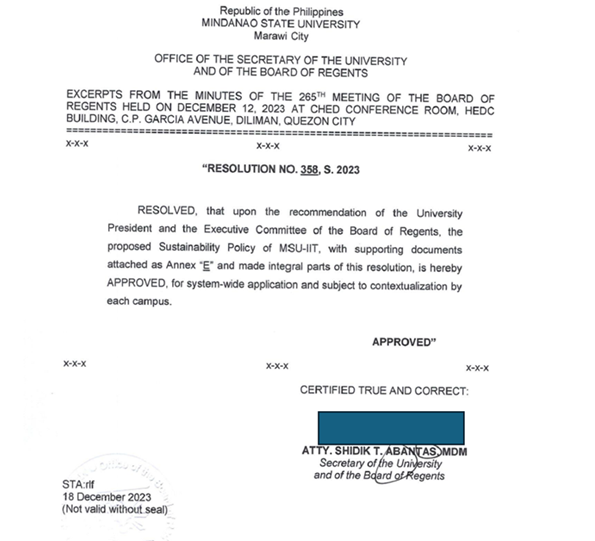
MSU Board of Regents Resolution No. 358, s. 2023, approving the Sustainability Policy for system-wide implementation.