Institutional Sustainability Policy and Commitment to Marine Pollution Prevention
Preventing and reducing marine pollution, particularly pollution originating from land-based activities, is an important part of the University's commitment to environmental protection and responsible resource management. The Mindanao State University System Sustainability Policy, adopted by Mindanao State University–Maguindanao (MSU–Maguindanao) under Board of Regents Resolution No. 358, series of 2023, provides institutional guidelines for minimizing pollution and protecting aquatic ecosystems. This policy remains applicable to the University from 2025 to the present and guides its continuing efforts to prevent waste and contaminants generated by campus activities from entering drainage systems, rivers, and other aquatic environments.
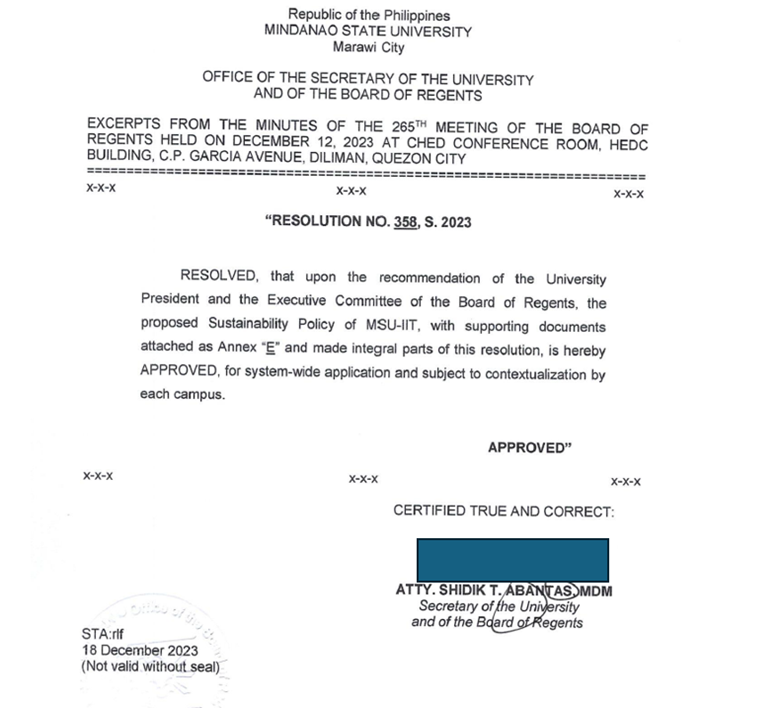
Official MSU System Board of Regents Resolution No. 358, Series of 2023, approving the MSU-IIT Sustainability Policy for system-wide implementation, subject to contextualization by each campus, establishing an institutional framework for strengthening environmental protection, sustainable resource management, and campus-wide sustainability initiatives.
Under Article VII, Section 5(f) – Biodiversity and Green Spaces, the policy explicitly directs the University to “Support and implement initiatives to reduce marine pollution.” This provision establishes the University's institutional commitment to protecting aquatic and marine ecosystems, conserving biodiversity, and minimizing environmental pollution resulting from human activities.
Waste Management and Water Quality Protection to Address Land-Based Pollution
The policy further addresses potential land-based sources of marine pollution through its provisions on waste management and water quality protection. Under Article VII, Section 1(b), the University is directed to “Adopt and/or continue to implement a comprehensive solid waste management program that reduces the volume of waste produced and sent to landfills.” Section 1(e) requires guidelines for the proper management and handling of electronic waste, chemicals, chemical waste, and biohazardous waste. Furthermore, Section 1(l) requires University units and food concessionaires to practice waste segregation at source, while Article VII, Section 2(b) – Water directs the University to “Regularly check water sources for heavy metals and other contaminants.”
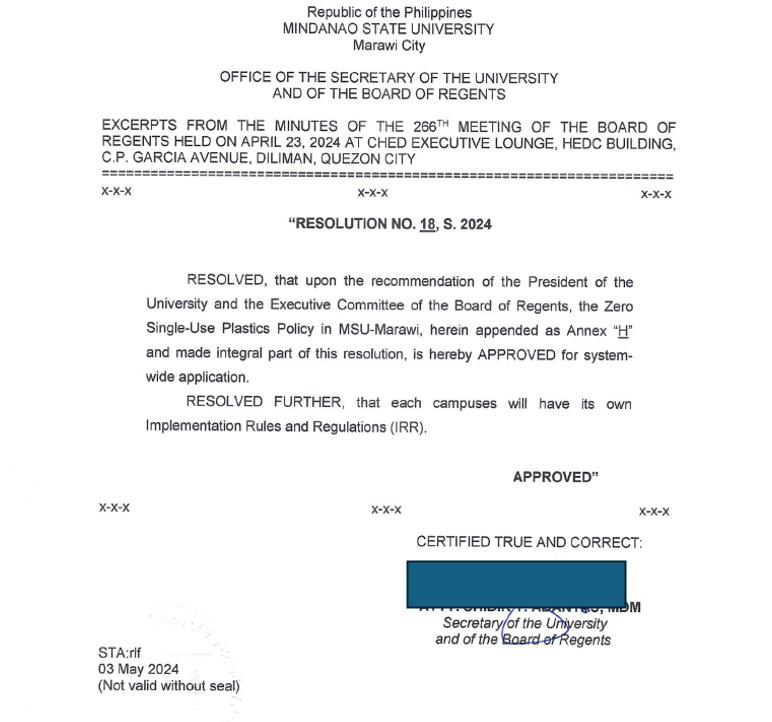
Official MSU System Board of Regents Resolution No. 18, Series of 2024, approving the Zero Single-Use Plastics Policy of MSU–Marawi for system-wide implementation and directing each campus to establish its own Implementing Rules and Regulations (IRR) to support the implementation of the policy.
Campus Implementation and Pollution Prevention Measures
In application, these policy provisions guide the University's continuing efforts to prevent land-based pollution through proper waste segregation, collection, storage, and disposal across campus offices, classrooms, laboratories, canteens, and other facilities. University units and food concessionaires are expected to minimize improperly discarded plastics, food waste, chemicals, and other materials that may enter drainage systems and eventually reach rivers and coastal waters. Laboratories and research facilities are also guided by proper procedures for handling chemical and biohazardous waste to prevent the release of potentially harmful substances into the environment. Water quality monitoring further supports the identification of possible contamination in campus water sources.
The University's marine pollution prevention efforts also involve promoting responsible consumption, reducing single-use plastics, and strengthening wastewater management practices. These measures help minimize the movement of solid waste, oils, chemicals, and other potential pollutants from campus activities into nearby waterways. Through proper waste management and pollution prevention, the University contributes to protecting aquatic habitats and reducing the environmental impacts of land-based activities.
Continuing Institutional Commitment to Protecting Aquatic Environments
The Sustainability Policy has continued to provide the institutional direction for preventing and reducing pollution associated with University operations. Its provisions guide campus offices, students, employees, and food concessionaires in observing responsible waste management and environmental protection practices. Through the continued application of these policies, the University strengthens its commitment to reducing marine pollution, protecting aquatic biodiversity, and promoting cleaner rivers, lakes, coastal environments, and other aquatic ecosystems.