SDG4
Weaving Peace Education, SDGs, and Women, Peace and Security (WPS) into University Syllabi for All Students
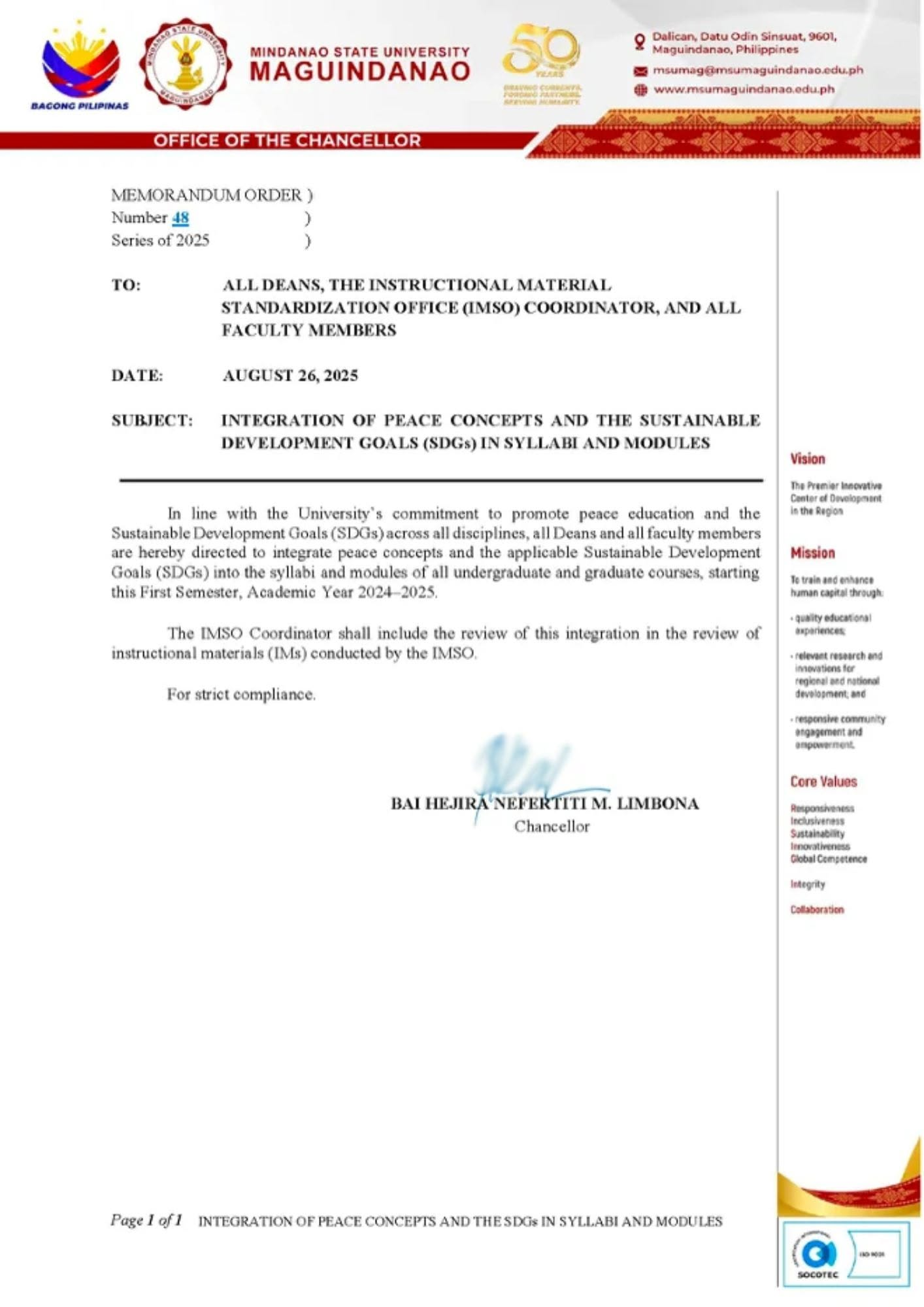
Integrating peace concepts and the Sustainable Development Goals into teaching is a mandatory part of instruction at Mindanao State University–Maguindanao, reflecting a university-wide commitment to meaningful education around sustainable development that is relevant and applicable to all students. The commitment is formalized in the Office of the Vice Chancellor for Academic Affairs’ guidelines for preparing instructional materials, which require the outcomes-based syllabi and modules of every degree program to include learning outcomes on peace, gender equality, and cultural diversity. In every topic, faculty members integrate the SDGs and peace concepts into the discussion or the class activities, so every student meets them, whatever the course.The commitment responds to the University’s setting. Its students come from communities across the Bangsamoro that have lived through decades of armed conflict, and many will work in a region still building its peace and its institutions. The University therefore treats peace, gender equality, cultural diversity, and inclusive participation as part of every student’s education, not only of a few specialized programs.Standardizing Peace IntegrationThe University is also standardizing how faculty carry out this integration. In Memorandum Order No. 48, s. 2025, issued on August 26, 2025, Chancellor Limbona directed the personnel of the DWPS and the Institute for Peace and Development in Mindanao to craft a Training Module on Peace Integration in Learning Materials and Assessment. The module will serve as the official reference for all workshops, orientations, and capacity-building sessions on peace integration, giving guidelines on embedding peace concepts, values, and perspectives in learning materials and assessment tools, consistent processes for faculty development, and alignment with the University’s mandate to advance peace, social cohesion, and inclusive education.Memorandum Order No. 48, s. 2025, directs all faculty members to integrate peace and SDGs in the syllabi and modules on August 26, 2025.Peace Concepts and the SDGs in Every SyllabusUnder this commitment, faculty members write peace concepts and the SDGs into the intended learning outcomes, lectures, classroom activities, and assessment questions of their courses, and link them to each student’s field of study. The outcomes-based syllabus template of the Office of the Vice Chancellor for Academic Affairs gives every course a column, “Integration of Institutional Goals, Peace Concepts, and SDGs,” beside each week’s learning outcomes, topics, activities, and assessment.An outcomes-based syllabus shows the column “Integration of Institutional Goals, Peace Concepts, and SDGs” beside each week’s lessons.Fundamentals of Peace Education for All First-Year StudentsThe commitment is backed by Fundamentals of Peace Education (FPE 101), offered through the Institute for Peace and Development in Mindanao (IPDM) and taken by all first-year students. The course takes learning beyond the classroom. On May 31, 2025, 37 FPE 101 students visited Camp Iranun and the historical residence of Ustadz Salamat Hashim in Barangay Tugaig, Barira, where they heard firsthand accounts from Mr. Alonto L. Simban and Ms. Maimana E. Marindeg, survivors of the All-Out War in Bombaran, and discussed youth participation and unity with the Bangsamoro Youth Commission, the 1st Marine Brigade, and community leaders.FPE 101 students learn from survivors of the All-Out War in Bombaran during their learning visit at Camp Iranun, May 31, 2025.Students trace the history of the Bangsamoro struggle at the historical residence of Ustadz Salamat Hashi, the late MILF leader, in Barangay Tugaig, BariraLooking AheadThese learning outcomes were achieved by all enrolled students. IPDM plans to build community-based learning visits into every cohort of FPE 101, and faculty will continue to integrate peace concepts and the SDGs into each new syllabus and module they prepare.
September 25, 2025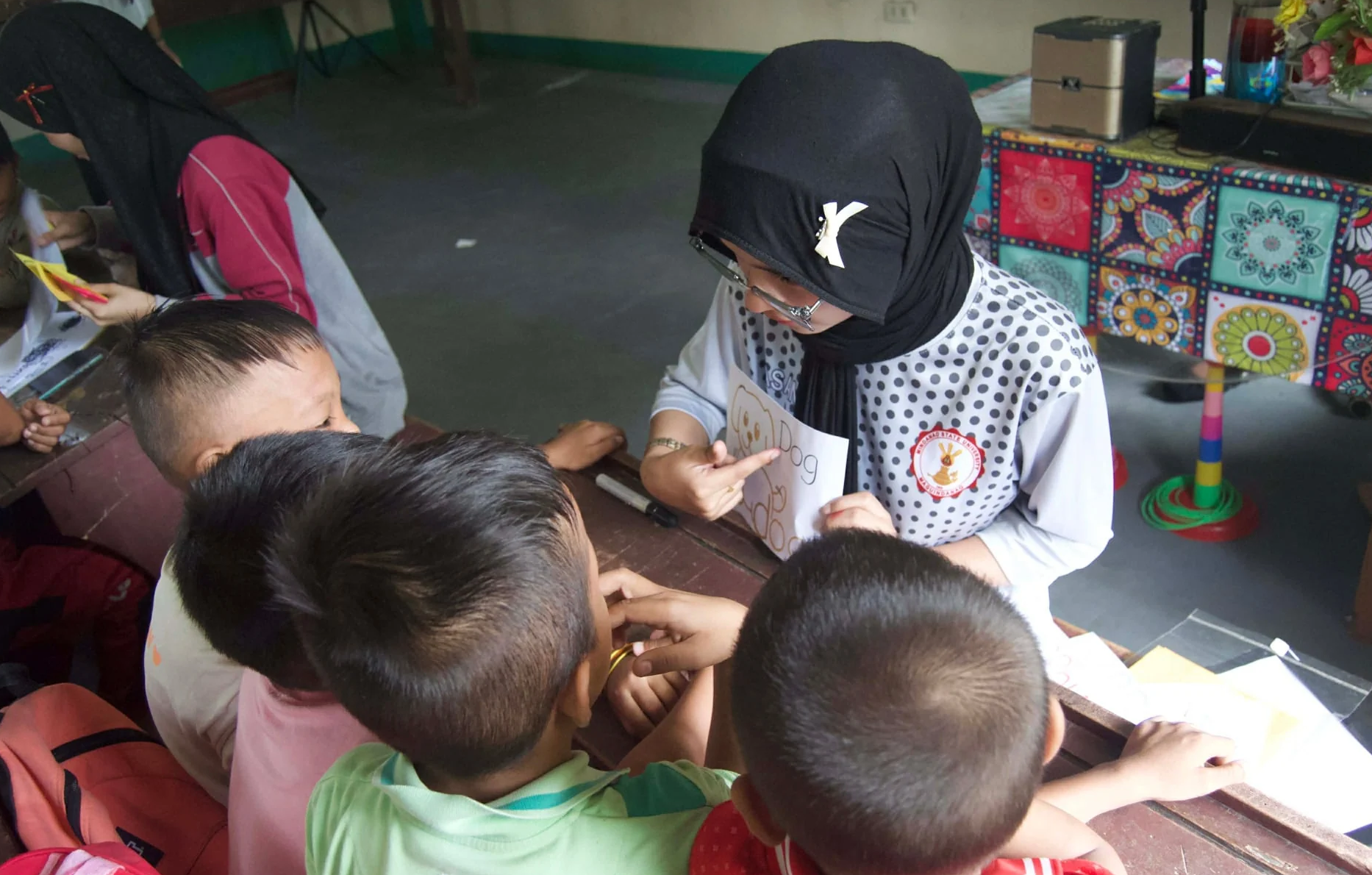
University-Led Literacy and Numeracy Outreach at Adaon Elementary School
Mindanao State University–Maguindanao, through its College of Education and National Service Training Program (NSTP) Office, conducted the Basic English (Reading and Writing) Literacy and Numeracy Programme in Barangay Adaon, Datu Anggal Midtimbang, Maguindanao del Sur. Implemented in partnership with Adaon Elementary School and Barangay Adaon, the initiative provided supplementary instruction to elementary pupils experiencing difficulties in reading, writing, and basic arithmetic.Initial assessments at Adaon Elementary School identified significant learning gaps among Grade 1 and Grade 2 pupils. Of the 28 pupils assessed, 26 (92.86%) were classified as non-readers or at the frustration level, with none demonstrating independent reading proficiency. Difficulties in writing and basic arithmetic were also observed. Based on the identified needs, the programme served 30 pupils requiring literacy and numeracy support.A Literacy Training Service (LTS) student-tutor guides pupils in phonics, word recognition, and basic reading exercises.Post-assessment results showed improvements in pupils' learning performance. Among the 28 pupils assessed in reading, 96.43% reached the instructional or independent reading levels, compared with none at the beginning of the programme. The reported results also showed that 74.19% attained Fair to Excellent ratings in writing, while 51.62% achieved Proficient or Advanced performance in arithmetic.To deliver the intervention, the University deployed 29 Literacy Training Service (LTS) students as tutors under the supervision of College of Education faculty members. The student-tutors conducted 21 instructional sessions covering phonics, word recognition, reading comprehension, spelling, sentence construction, number recognition, basic mathematical operations, and problem-solving. Teaching strategies included guided exercises, educational games, drills, and individualized learning assistance. A feeding programme was also conducted from April 18 to May 31, 2025, to support the pupils' participation.Led by Dr. Maeda L. Kadtong, NSTP Coordinator, the initiative involved College of Education faculty members, student-tutors, school personnel, and community partners. It also provided LTS students with supervised community teaching experience through lesson preparation, tutoring, and learner assessment.Through this community-based educational outreach, MSU–Maguindanao extended its instructional services to a local public elementary school while providing its NSTP students with opportunities to apply their teaching skills in an actual learning environment. The initiative demonstrated the University's contribution to improving foundational literacy and numeracy through direct engagement with local schools and communities.
July 30, 2025