A food waste assessment conducted at the University canteen of Mindanao State University–Maguindanao over 15 monitoring days in 2025 measured how much food waste the canteen generates and what that waste is made of. Carried out by BS Agricultural and Biosystems Engineering students in coordination with the canteen concessionaires, the assessment used direct weighing and waste composition analysis. After the vendors were oriented on their roles, food waste was collected using strainers at the two dishwashing areas of the canteen, weighed each afternoon, and classified into three categories: cooked-rice leftovers, fruit and vegetable peels, and fish and chicken bones.
The assessment recorded 90.76 kilograms of food waste over the 15 days, an average of 6.05 kilograms per monitoring day. Projected over a full year, this corresponds to an estimated 2,208.49 kilograms (2.21 metric tons) of food waste from the canteen. Cooked-rice leftovers made up the largest share at 82.08 percent, or about 1,812.83 kilograms a year, followed by fruit and vegetable peels at 16.21 percent (357.94 kilograms) and fish and chicken bones at 1.71 percent (37.72 kilograms).
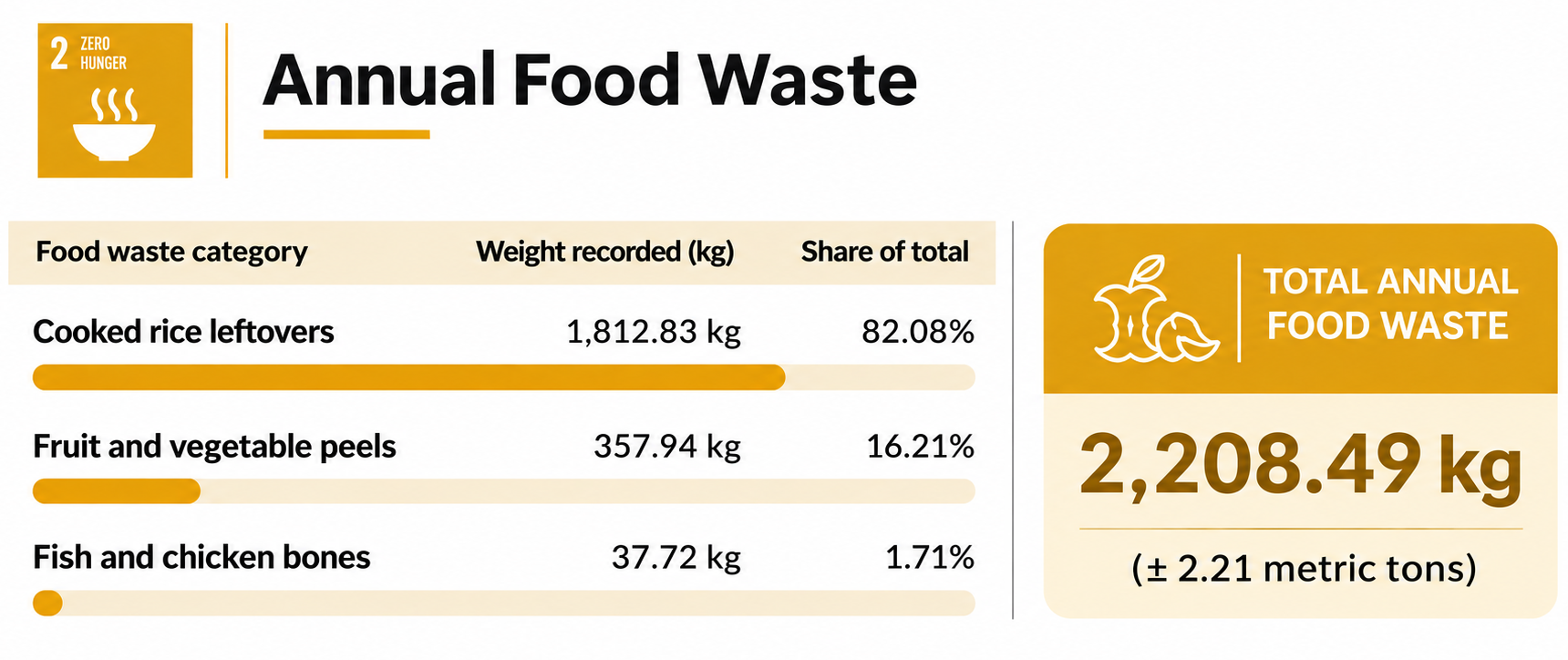
Annual food waste generated by University Cafeteria by Category, with total weight and equivalent in metric tons.
The dominance of cooked-rice leftovers points to serving portions, food preparation, and meal demand as the main sources of avoidable waste in the canteen. The relatively small overall volume also reflects existing food service arrangements, including the practice of some concessionaires bringing pre-processed or pre-cooked ingredients, which reduces preparation-related waste on campus, as well as students and personnel taking meals outside the canteen. Beyond establishing a baseline, the measured quantity and composition were used to determine the capacity of a biogas digester installed behind the canteen, and the collected food waste then served as feedstock to evaluate the digester's performance, linking waste measurement directly with an organic waste treatment option on campus.
The assessment supports the University's Sustainability Policy, which requires cafeteria operators and food establishments on campus to minimize food waste (Article VII, Section 1). The 2025 canteen food waste baseline gives MSU–Maguindanao a documented starting point for planning waste prevention measures, assessing treatment capacity, and comparing subsequent measurements to determine changes in food waste generation.