At least 87.68% of the students who answered the MSU–Maguindanao Sustainability Literacy Questionnaire (MSU–MSLQ) showed high to very high sustainability literacy in each of its five dimensions, as Mindanao State University–Maguindanao measures the sustainability literacy of its students directly rather than relying only on the courses, campaigns, and environmental activities it offers.
The Office of the Vice Chancellor for Research and Extension (OVCRE) developed the MSU–MSLQ, a structured 30-item assessment that experts reviewed before use, to give the University evidence for institutional planning, quality assurance, program development, and sustainability monitoring. The questionnaire covers five dimensions: knowledge and awareness of sustainable development, the SDGs, climate change, biodiversity, and responsible consumption; values and attitudes, such as environmental responsibility, protecting resources for future generations, social equity, and the role of universities in sustainable development; systems thinking, or seeing how environmental, social, and economic concerns connect; awareness of the environmental challenges facing Maguindanao and the Bangsamoro and of the University’s responsibility toward them; and sustainable practices such as waste segregation, reducing plastic use, conserving resources, and joining sustainability activities. Students rated each item on a four-point scale, from 4 (Very High) to 1 (Very Low). OVCRE administered the questionnaire online to all undergraduate and graduate students throughout November 2025. Participation was voluntary, and the questionnaire asked for no names or student numbers.
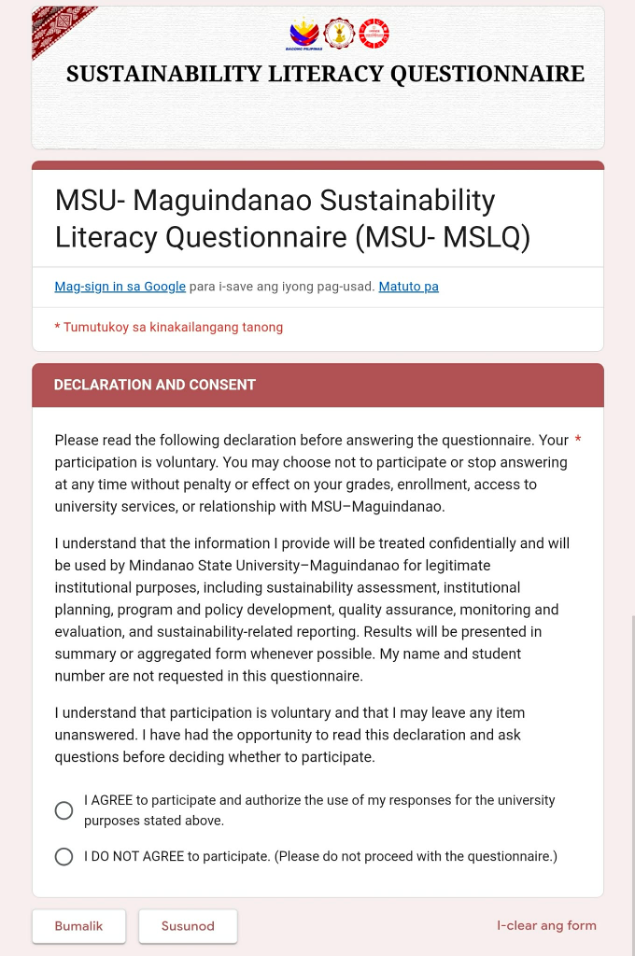
The MSU–MSLQ opens with a declaration and consent page assuring students that participation is voluntary and that no names or student numbers are collected.
Values and attitudes emerged as the strongest dimension, with 92.12% of respondents rating high or very high and 78.82% rating very high. Knowledge and awareness followed at 90.64%, local and institutional sustainability awareness at 90.15%, and systems thinking and sustainability application at 88.18%. Sustainable practices and behavioral engagement recorded the lowest share at 87.68%, and the smallest very high group at 52.71%, which shows that students’ values run ahead of their everyday habits.
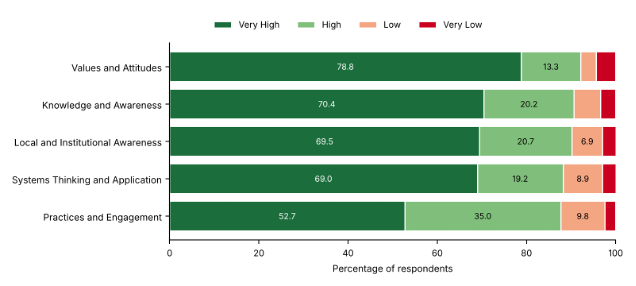
Most respondents rate high or very high in all five dimensions, with values and attitudes strongest and sustainable practices weakest.
The results, which are based on students’ own ratings, show that respondents see sustainability not only as an environmental concern but also as a matter of social equity, economic choices, institutional accountability, and community development. They give the University a baseline for each dimension and point to where its teaching and campus programs should focus next.
The University aims to use these results to strengthen the dimension where students lag, by building waste segregation, plastic reduction, and resource conservation into campus activities and classes, and to deepen systems thinking through interdisciplinary teaching, research, and community-based problem-solving. OVCRE will administer the questionnaire every year, which will show whether these efforts change how students act.