Articles
MSU–Maguindanao Conducts Maternal Healthcare Education and Medical Mission for 47 Community Participants in Parang
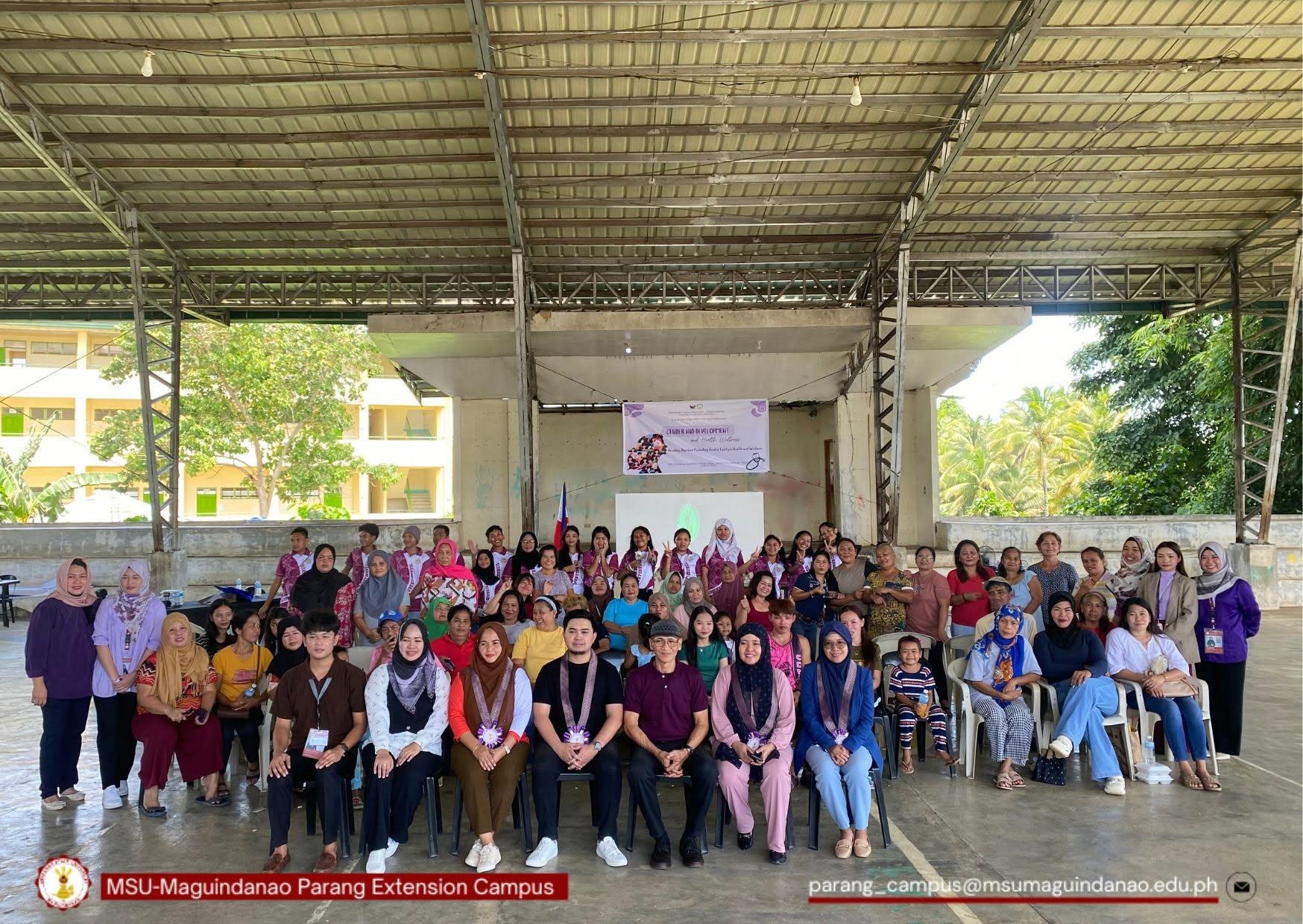
Mindanao State University–Maguindanao in Parang, conducted a Gender and Development and Health Wellness Program on June 9, 2025, at the Gymnasium of Sarilikha Village, Barangay Sarmiento, Parang, Maguindanao. With the theme “Breaking Barriers: Promoting Gender Equity in Health and Wellness,” the initiative engaged 47 participants through educational sessions on Women, Peace, and Security and Maternal Healthcare, followed by a medical mission that provided essential healthcare services to participants and community members.Community members participate in MSU–Maguindanao’s Gender and Health Wellness Program in Parang, MaguindanaoOrganized in collaboration with the University’s Gender and Development (GAD) Office and Infirmary, the program combined health education with community-based healthcare assistance. Associate Professor Bai Putri Morayah Ala Amil discussed Women, Peace, and Security, while Warda M. Abdullah, RN, facilitated the session on Maternal Healthcare. These sessions addressed women's health and participation in community life, while the subsequent medical mission provided participants and other community members with access to healthcare services.The initiative demonstrates how the University extends its health and wellness efforts beyond campus through coordinated community engagement. By bringing maternal healthcare education and medical services to Sarilikha Village, MSU–Maguindanao supported community health promotion and created opportunities for residents to engage with health-related information and services. The collaboration among the Parang Extension Campus, GAD Office, and University Infirmary also strengthened the University's approach to integrating health promotion and gender-responsive community outreach.Continued community-based health programs can help sustain access to healthcare information and services, particularly those addressing maternal health and women's well-being. Documenting the number of individuals served and the specific services provided in future activities would further help assess the initiative's contribution to community health and inform subsequent outreach programs.
October 11, 2025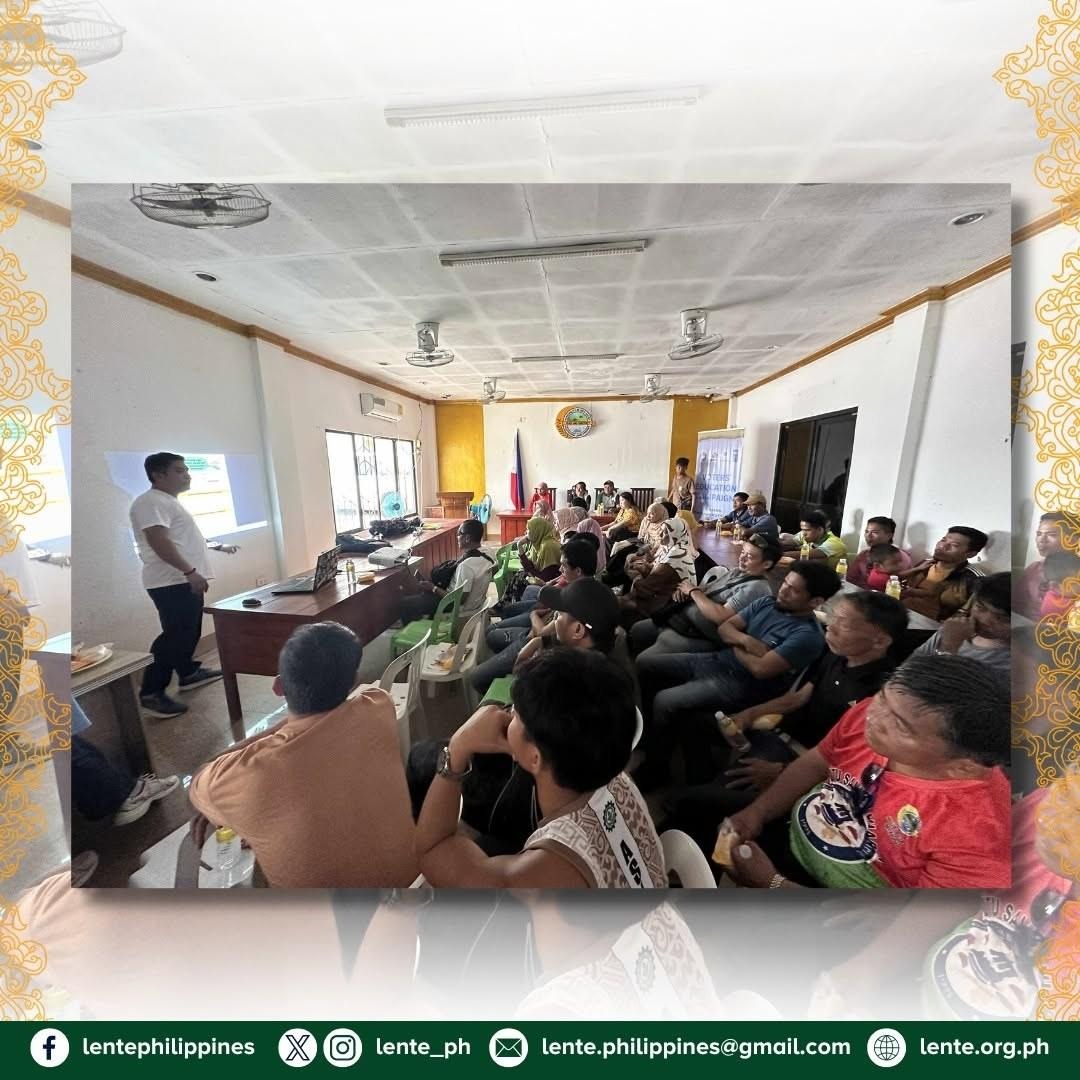
Mindanao State University–Maguindanao Faculty Serve as Voter Education Champions in 20 Barangays with LENTE, COMELEC, UNDP, MILG, and MPOS
Faculty members of the Political Science Department of Mindanao State University–Maguindanao served as Voter Education Champions in a voter education campaign in 20 barangays of Datu Salibo, Datu Anggal Midtimbang, and Datu Odin Sinsuat. The University carried out the campaign in partnership with the Legal Network for Truthful Elections (LENTE), the Commission on Elections (COMELEC), the United Nations Development Programme (UNDP), the Ministry of the Interior and Local Government (MILG), and the Ministry of Public Order and Safety (MPOS), to prepare communities for the first Bangsamoro Parliamentary Elections, then scheduled for October 13, 2025.The campaign responded to the need for an informed electorate in communities where access to civic education is limited and where the shift to a parliamentary system of government was new to most voters.An MSU–Maguindanao Voter Education Champion leads a barangay session with residentsThe campaign covered 20 barangays: ten in Datu Salibo, Maguindanao del Sur (Damablas, Pandi, Penditen, Pagatin, Butilen, Tee, Sambulawan, Magaslong, Buayan, and Liong); five in Datu Anggal Midtimbang, Maguindanao del Sur (Brar, Midtimbang, Mapayag, Adaon, and Nunangan); and five in Datu Odin Sinsuat, Maguindanao del Norte (Dalican, Makir, Kurintem, Bugawas, and Pinguiaman). Fifteen faculty members served as Voter Education Champions, leading community learning sessions in which they explained the Bangsamoro peace process that led to the creation of BARMM, how its parliamentary system of government works, and the official procedures for voting. The sessions were interactive and culturally responsive, giving residents room to ask questions about the new system and the voting process.By lending its faculty’s expertise to an election body, a United Nations agency, two regional ministries, and a civil society election watchdog, the University supports inclusive and participatory decision-making and helps build public understanding of, and trust in, the region’s democratic institutions. The campaign reached barangays that are often left out of formal civic education, so that more residents can take part in governance on an informed and equal footing.The Political Science Department will continue its partnership with LENTE and government agencies on civic and voter education and will make its faculty available as resource persons for future elections in BARMM.
October 8, 2025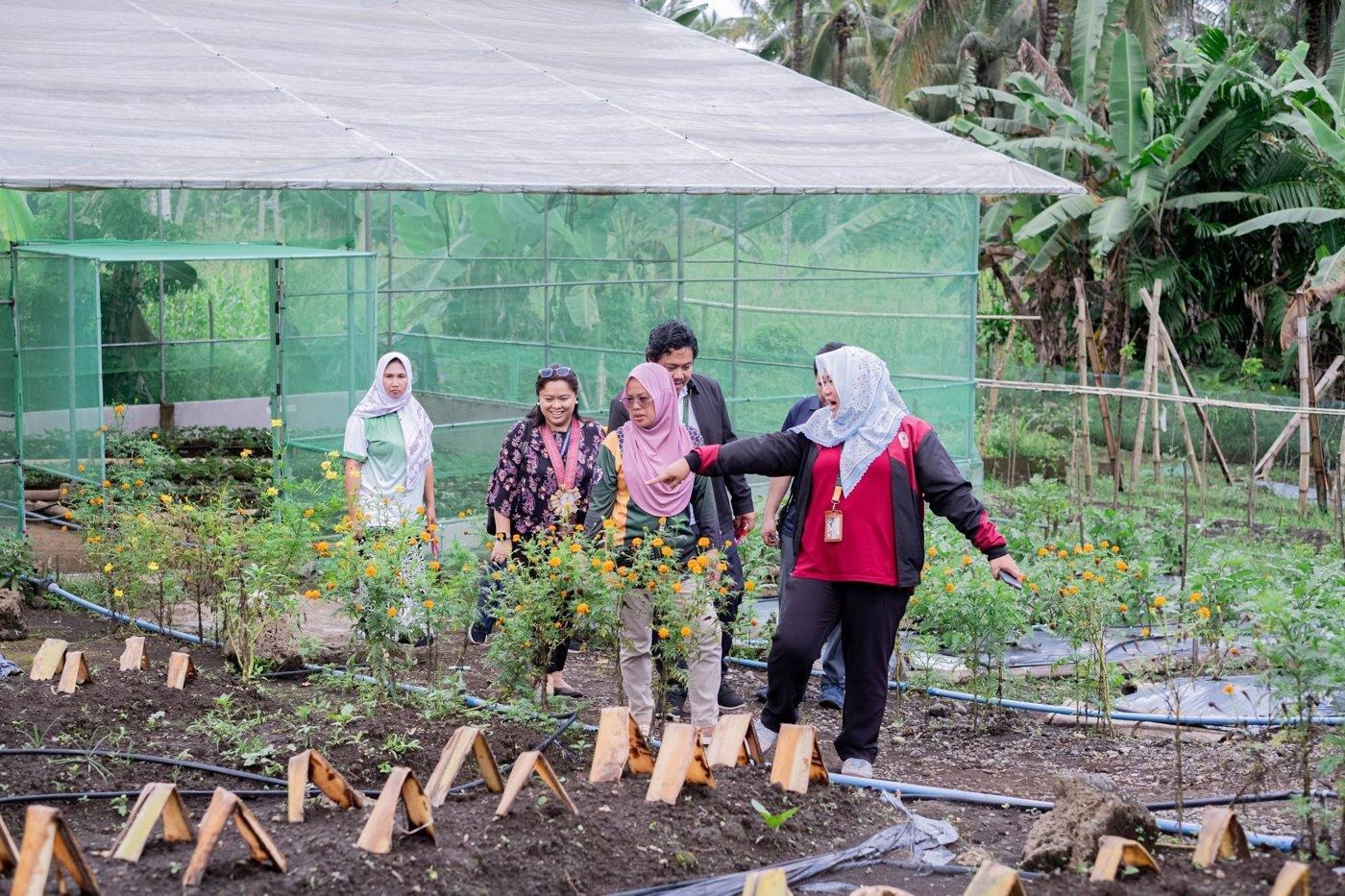
Livelihood Projects Reach 2,075 Beneficiaries in Camps Badre, Omar, and Abubakar as MSU–Maguindanao Extends Outreach Education to the Wider Community
Drip irrigation, halal goat raising, and cooperative management were among the skills taught in Camps Badre, Omar, and Abubakar, where livelihood projects of Mindanao State University–Maguindanao reached 2,075 beneficiaries, part of the University’s dedicated outreach educational activities for the wider community. The University also held voter education sessions in 20 barangays, ran a review program for Grade 12 learners from remote communities, and offered career guidance and a job fair for its alumni.For Local Residents of Camps Badre, Omar, and AbubakarUnder the peace agreement between the government and the Moro Islamic Liberation Front, the camps are being transformed into peaceful and productive civilian communities, and their residents, including former combatants and their families, need skills for new livelihoods. Under the camp transformation program funded by the Office of the Presidential Adviser on Peace, Reconciliation and Unity and coordinated with the Joint Task Forces on Camps Transformation, University teams led by Program Leader Dr. Raquel D. Santiago-Arenas reached 695 beneficiaries in Camp Badre and 720 in Camp Omar (₱10,182,314 each) and 660 in Camp Abubakar (₱12,000,000) from July 2024 to August 2025.In 2024, before any technical training, beneficiaries in the three camps first completed a Values Transformation Training, a ₱7,289,310 (about US$127,300) program funded by the Bangsamoro Development Agency that reached 500 beneficiaries. The technical training then covered drip irrigation, soil analysis, vermiculture and organic fertilizer, halal goat raising, native chicken production, fish farming, food processing, financial literacy, and cooperative management. The projects serve ten cooperatives and community organizations, three of them women’s groups. On June 18, 2025, the University and OPAPRU turned over the Camp Abubakar projects, including a newly constructed kitchen facility for the Calagan Women’s Marketing Cooperative and the Gawad Kalinga Village Togaig Farmer’s Marketing Cooperative, while the community kitchens in the other camps, completed in 2025, are scheduled for turnover. After the training, University teams hold Kamustahan sessions and follow-up check-ins with the cooperatives to monitor how the projects are doing. The projects now benefit 95 cooperative members, and each cooperative earns an average monthly income of ₱18,000 (about US$314). In Camp Abubakar, the new poultry house now yields at least 25 eggs a day. Hadja Farisah M. Abas, president of the Sigay Kutawaton RTW Women’s Marketing Cooperative in Camp Badre, said that income from organic vegetables now helps members cover their daily expenses and their children’s school allowance.The camp cooperatives now run their own farm and food enterprises, and the University plans to strengthen their value chains and markets in the next phases of the program.Cooperative members and University extension personnel inspect the climate-smart vegetable farm set up through the camp transformation program.Hadja Farisah M. Abas, president of the Sigay Kutawaton RTW Women’s Marketing Cooperative, attests to the income members now earn from organic vegetables.For local residents of Maguindanao barangaysAhead of the first Bangsamoro parliamentary elections, 15 Political Science faculty, with 13 BA Political Science students serving as the secretariat, held voter education sessions on September 27, 2025, in 20 barangays of Datu Salibo, Datu Anggal Midtimbang, and Datu Odin Sinsuat, explaining the peace process that created BARMM, the new parliamentary system, and how to vote. From August 23 to September 13, 2025, the University also ran a free SASE Review Program on four Saturdays for Grade 12 learners from disadvantaged and remote communities, covering Mathematics, Science, English, and Aptitude to prepare them for the University’s admission and scholarship examination.MSU–Maguindanao Voter Education Champions and LENTE gather with barangay residents after a Voters’ Education Campaign session on the BARMM parliamentary system, September 27, 2025University reviewers prepare Grade 12 learners from remote communities for the admission and scholarship examination, 2025.For alumniThe University held a one-day Job Fair and Career Guidance on June 13, 2025, at its Datu Odin Sinsuat Gymnasium with the Ministry of Labor and Employment (MOLE) of BARMM, organized through the Division of Student Affairs, for alumni, fresh graduates, graduating students, and other job seekers. The fair answered a persistent gap between finishing a degree and finding work, particularly for graduates from underserved communities who have few chances to meet employers close to home. A career guidance lecture prepared participants to choose career paths and meet employer expectations, and the Philippine Coast Guard, the Lamsan Group of Companies, 3ME Manpower Services, VXI Global Holdings, and SM SaveMore presented their vacancies, explained their qualifications and recruitment procedures, and met applicants on site. More than 200 job seekers took part, 66 of them alumni of the University.Alumni, fresh graduates, and other job seekers register for the Job Fair and Career Guidance with MOLE-BARMM, Datu Odin Sinsuat Gymnasium, June 13, 2025.Graduating students and job-seeking alumni register for the Job Fair and Career Guidance, University Gymnasium, June 13, 2025
October 5, 2025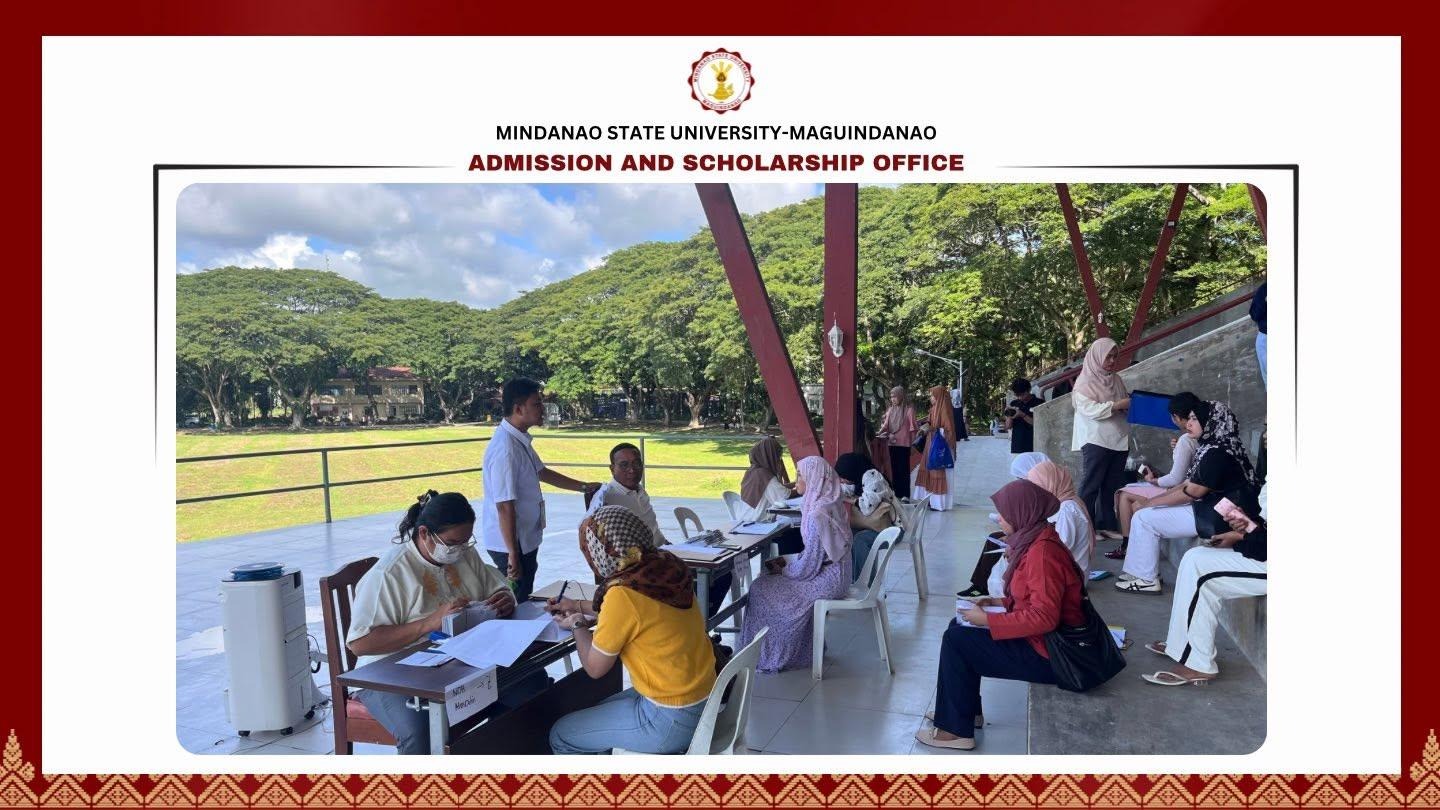
Tulong Dunong Program Extends Financial Support to 277 MSU–Maguindanao Students
The Admission and Scholarship Office of Mindanao State University–Maguindanao, in coordination with the Commission on Higher Education (CHED), distributed cash assistance to 277 qualified students under the Tulong Dunong Program–State Universities and Colleges (TDP-SUC) on August 11, 2025. The initiative provided financial aid to help beneficiaries manage education-related expenses and pursue their academic goals.Student beneficiaries during the distributionThe distribution was facilitated at MSU–Maguindanao, enabling qualified students to receive one-time financial assistance. Through its partnership with CHED, the University helped deliver government-supported educational assistance to eligible students, reinforcing its commitment to student welfare and access to higher education.The program helped ease some of the financial pressures faced by the 277 student beneficiaries and their families. By providing direct financial support, the initiative contributes to addressing economic barriers to education and creating opportunities for students to continue their studies and pursue better livelihood prospects.Moving forward, the institution seeks to strengthen its student assistance mechanisms and sustain partnerships with CHED to help qualified students overcome financial barriers and continue their higher education.
October 1, 2025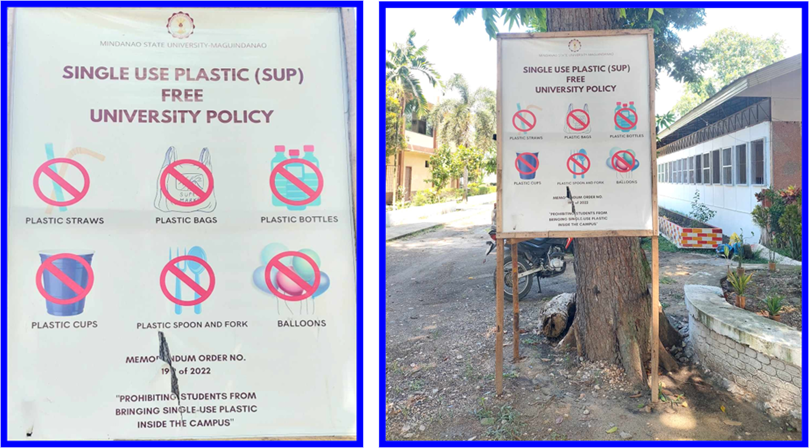
Toward a Single-Use-Plastic-Free Campus
MSU–Maguindanao acts on plastic waste through three instruments: the MSU Sustainability Policy (BOR Resolution No. 358, s. 2023), the Zero Single-Use Plastics Policy (BOR Resolution No. 18, s. 2024), and the Chancellor’s Memorandum Order No. 149, s. 2022.Article VII, Section 1 of the Sustainability Policy sets out the specific measures: reduce food and plastic waste from the campus food system (Section 1(f)); use reusable, renewable and recyclable food packaging (Section 1(g)); prohibit Styrofoam, single-use plastic bags and disposable food accessories (Section 1(h)); and promote “Bring your own tumbler/container/utensil” and “Clean as you go” (Section 1(i)). The Zero Single-Use Plastics Policy applies across the MSU System and requires each campus to set implementing rules for its own operations.Memorandum Order No. 149, s. 2022, issued on 21 October 2022, prohibits students from bringing single-use plastics onto campus and directs the Security and Investigation Office to check bags for compliance. Campus signage declares MSU–Maguindanao a single-use-plastic-free university, banning plastic straws, bags, bottles, cups, spoons and forks, and balloons.The action plan applies these rules to campus offices, canteens, concessionaires, meetings and events: eliminating Styrofoam and disposable food accessories, requiring reusable containers and utensils, promoting recyclable packaging, and strengthening waste segregation and disposal, supported by information campaigns and monitoring of compliance.Campus signage for MSU–Maguindanao’s Single-Use Plastic-Free University PolicyMemorandum Order No. 149, s. 2022, prohibiting single-use plastics on campus.
September 27, 2025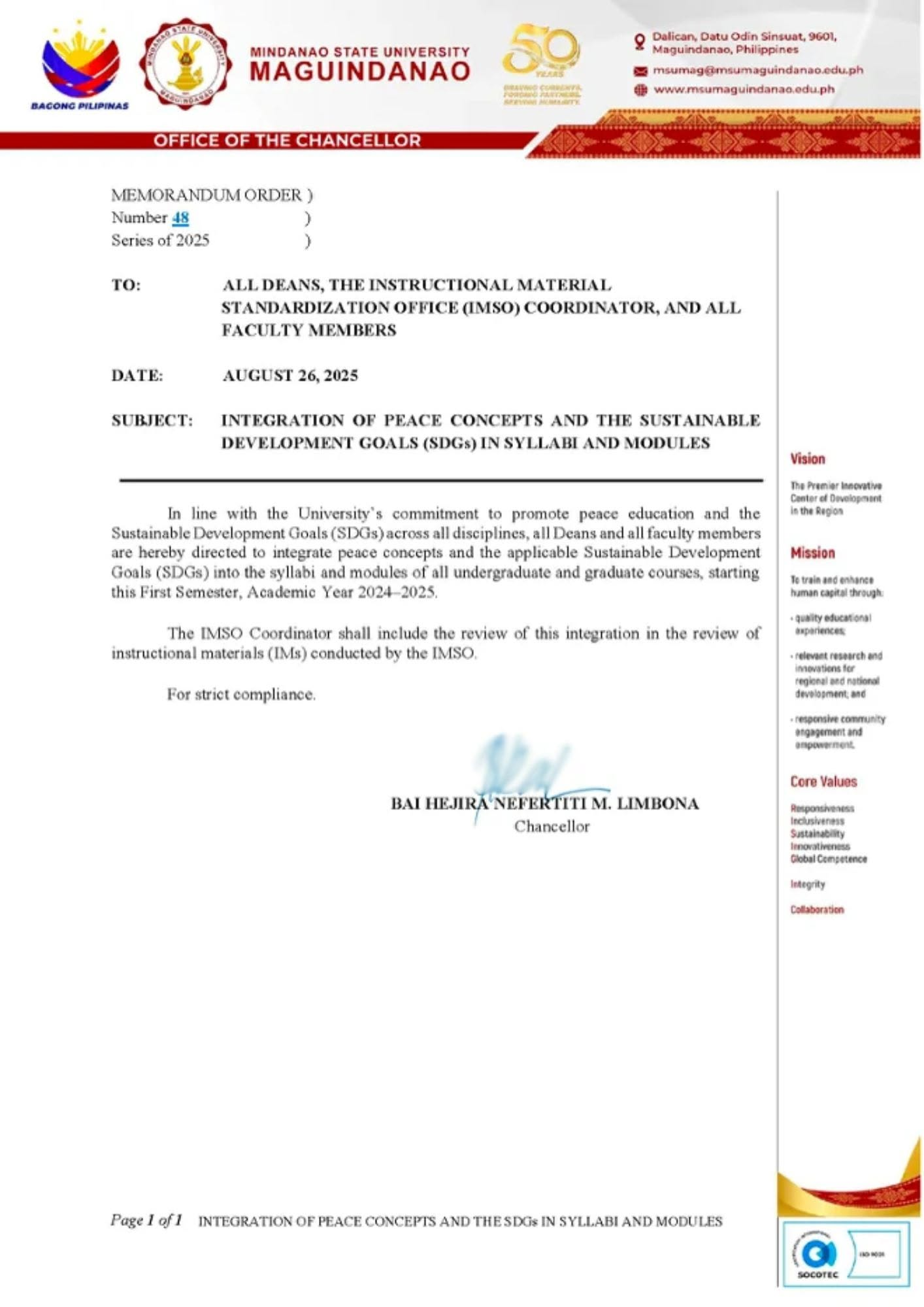
Weaving Peace Education, SDGs, and Women, Peace and Security (WPS) into University Syllabi for All Students
Integrating peace concepts and the Sustainable Development Goals into teaching is a mandatory part of instruction at Mindanao State University–Maguindanao, reflecting a university-wide commitment to meaningful education around sustainable development that is relevant and applicable to all students. The commitment is formalized in the Office of the Vice Chancellor for Academic Affairs’ guidelines for preparing instructional materials, which require the outcomes-based syllabi and modules of every degree program to include learning outcomes on peace, gender equality, and cultural diversity. In every topic, faculty members integrate the SDGs and peace concepts into the discussion or the class activities, so every student meets them, whatever the course.The commitment responds to the University’s setting. Its students come from communities across the Bangsamoro that have lived through decades of armed conflict, and many will work in a region still building its peace and its institutions. The University therefore treats peace, gender equality, cultural diversity, and inclusive participation as part of every student’s education, not only of a few specialized programs.Standardizing Peace IntegrationThe University is also standardizing how faculty carry out this integration. In Memorandum Order No. 48, s. 2025, issued on August 26, 2025, Chancellor Limbona directed the personnel of the DWPS and the Institute for Peace and Development in Mindanao to craft a Training Module on Peace Integration in Learning Materials and Assessment. The module will serve as the official reference for all workshops, orientations, and capacity-building sessions on peace integration, giving guidelines on embedding peace concepts, values, and perspectives in learning materials and assessment tools, consistent processes for faculty development, and alignment with the University’s mandate to advance peace, social cohesion, and inclusive education.Memorandum Order No. 48, s. 2025, directs all faculty members to integrate peace and SDGs in the syllabi and modules on August 26, 2025.Peace Concepts and the SDGs in Every SyllabusUnder this commitment, faculty members write peace concepts and the SDGs into the intended learning outcomes, lectures, classroom activities, and assessment questions of their courses, and link them to each student’s field of study. The outcomes-based syllabus template of the Office of the Vice Chancellor for Academic Affairs gives every course a column, “Integration of Institutional Goals, Peace Concepts, and SDGs,” beside each week’s learning outcomes, topics, activities, and assessment.An outcomes-based syllabus shows the column “Integration of Institutional Goals, Peace Concepts, and SDGs” beside each week’s lessons.Fundamentals of Peace Education for All First-Year StudentsThe commitment is backed by Fundamentals of Peace Education (FPE 101), offered through the Institute for Peace and Development in Mindanao (IPDM) and taken by all first-year students. The course takes learning beyond the classroom. On May 31, 2025, 37 FPE 101 students visited Camp Iranun and the historical residence of Ustadz Salamat Hashim in Barangay Tugaig, Barira, where they heard firsthand accounts from Mr. Alonto L. Simban and Ms. Maimana E. Marindeg, survivors of the All-Out War in Bombaran, and discussed youth participation and unity with the Bangsamoro Youth Commission, the 1st Marine Brigade, and community leaders.FPE 101 students learn from survivors of the All-Out War in Bombaran during their learning visit at Camp Iranun, May 31, 2025.Students trace the history of the Bangsamoro struggle at the historical residence of Ustadz Salamat Hashi, the late MILF leader, in Barangay Tugaig, BariraLooking AheadThese learning outcomes were achieved by all enrolled students. IPDM plans to build community-based learning visits into every cohort of FPE 101, and faculty will continue to integrate peace concepts and the SDGs into each new syllabus and module they prepare.
September 25, 2025MSU-Maguindanao Advances Sustainable Halal Livestock Farming Through Farmer Field School and Demo Farm Initiative
Mindanao State University–Maguindanao (MSU-Maguindanao), in partnership with the Food and Agriculture Organization of the United Nations (UN-FAO) and the Ministry of Agriculture, Fisheries and Agrarian Reform (MAFAR), formally launched the Conduct of Halal Livestock Farmer Field School and Management of Halal Livestock Demonstration Farm for Goat and Cattle on July 28, 2025, at the University campus. The initiative aims to strengthen the technical capacity of local farmers and agricultural technicians in Halal-compliant livestock production, animal welfare, biosecurity, and sustainable farm management. Through international and government collaboration, the program supports community-based agricultural development and promotes responsible livestock-raising practices in the Bangsamoro Autonomous Region in Muslim Mindanao (BARMM).The orientation benefited 100 farmers and agricultural technicians from Maguindanao del Norte and Maguindanao del Sur through practical learning on Halal-compliant livestock handling, animal welfare, disease prevention, biosecurity, and sustainable goat and cattle production. The field visit to livestock housing and demonstration facilities enabled participants to observe proper animal husbandry and farm management practices. Implemented in partnership with UN-FAO and MAFAR, the activity strengthened participants’ knowledge and skills to improve livestock health, reduce disease risks, and adopt environmentally responsible farming practices. Beyond the direct participants, the initiative is expected to benefit local agricultural communities through the wider adoption of improved livestock management techniques, promoting responsible use of land and agricultural resources and supporting the long-term sustainability of livestock-based livelihoods in Maguindanao.The initiative promotes sustainable management of land-based agricultural systems and responsible livestock production practices that help protect soil, pasture, and surrounding terrestrial ecosystems. Through farmer education on pasture management, livestock housing, animal waste management, and biosecurity, the program encourages responsible land use, minimizes environmental pressures associated with poorly managed livestock production, and supports the conservation of terrestrial resources. These practices contribute to healthier ecosystems and the long-term sustainability of livestock-based agricultural livelihoods in Maguindanao.MSU-Maguindanao will continue to strengthen its partnerships with agricultural agencies and development institutions, expand field-based extension opportunities, and promote the adoption of sustainable livestock management practices among local farming communities. Through these efforts, the University seeks to contribute to more resilient agricultural systems, healthier terrestrial environments, and sustainable rural development across BARMM.
September 19, 2025MSU–Maguindanao Faculty Presents in International Academic Collaboration on SDG Data Gathering, Measurement, and Monitoring in Education in 2025
Mindanao State University–Maguindanao (MSU–Maguindanao), through its College of Education, participated in an international academic engagement at the Education University of Hong Kong (EdUHK) from July 29 to August 1, 2025, providing opportunities for knowledge sharing, academic networking, and future institutional partnerships. The University was represented by three faculty members: Dr. Rolly James F. Cheng, Dr. Joel C. Arenas, and Assistant Professor Abdulmalik Manalao.The international engagement provided a platform for exchanging academic knowledge, exploring collaborative research opportunities, and strengthening institutional connections. Through these interactions, the University sought to establish foundations for future international collaboration on gathering and measuring data for the Sustainable Development Goals (SDGs), particularly through knowledge exchange, research cooperation, and the sharing of approaches to monitoring sustainable development progress.This initiative reflects the University's commitment to strengthening global partnerships for sustainable development through international cooperation, the mobilization and sharing of knowledge and expertise, and the promotion of effective institutional partnerships. It also supports opportunities for capacity-building in data collection, monitoring, and measurement, particularly in advancing the availability of high-quality, timely, and reliable data for assessing progress toward sustainable development.MSU–Maguindanao remains committed to expanding its international academic partnerships and transforming knowledge-sharing opportunities into collaborative research and data-driven initiatives. Through sustained international cooperation, the University aims to strengthen institutional capacity for gathering and measuring sustainable development data, support evidence-based monitoring, and contribute to the global partnership for achieving the Sustainable Development Goals.
September 5, 2025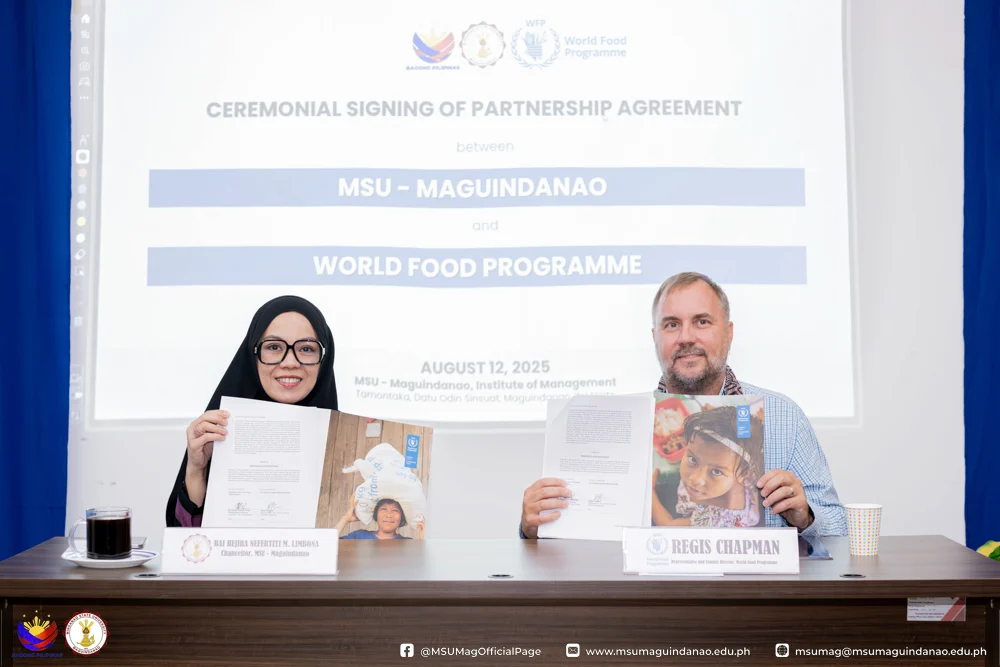
MSU–Maguindanao and WFP Strengthen Food Security and Climate Resilience in BARMM
The Mindanao State University–Maguindanao (MSU–Maguindanao) and the United Nations World Food Programme (WFP) formalized a partnership to strengthen food security, improve local livelihoods, and build climate-resilient communities across the Bangsamoro Autonomous Region in Muslim Mindanao (BARMM).The Memorandum of Agreement (MOA), signed at the MSU–Maguindanao Institute of Management by Chancellor Bai Hejira Nefertiti M. Limbona and WFP Representative and Country Director Regis Chapman, brings together the University’s research and academic expertise with WFP’s international experience in addressing hunger, nutrition, and climate-related challenges.Under their 2025–2027 cooperation work plan, the partners will support smallholder farmers through climate-smart agriculture training, promote food security and nutrition education, develop Local Climate Change Adaptation Plans (LCCAPs) in priority barangays, and strengthen watershed management, post-harvest loss reduction, agricultural value addition, and cooperatives. These initiatives build on earlier community-based planning activities that identified livelihood challenges and environmental pressures in Maguindanao del Sur and Maguindanao del Norte.The partnership recognizes that sustainable communities depend on reliable food supplies, resilient livelihoods, responsible natural resource management, and effective preparation for environmental risks. Its intended beneficiaries include smallholder farmers, agricultural cooperatives, rural households, and vulnerable communities whose livelihoods are affected by food insecurity and climate change.These efforts support the broader goals of Sustainable Development Goal 11 (SDG 11): Sustainable Cities and Communities, particularly strengthening resilience to disasters and reducing the environmental pressures that threaten communities. By equipping local communities with practical knowledge, improving agricultural practices, and supporting climate adaptation planning, the collaboration can help create safer, more inclusive, and more sustainable settlements.Chancellor Limbona emphasized the University's commitment to developing research-based solutions that respond to the needs of the Bangsamoro people, particularly vulnerable and underserved communities. WFP Representative and Country Director Regis Chapman likewise highlighted the value of combining global expertise with local knowledge to address hunger and strengthen community resilience.Through this partnership, MSU–Maguindanao and WFP aim to deliver lasting benefits by strengthening local capacities, supporting sustainable livelihoods, and helping communities prepare for future environmental challenges. The collaboration reinforces the University's role in advancing research, extension, and inclusive development toward a more resilient and sustainable BARMM.
September 4, 2025