As one of the state universities in the country, Mindanao State University–Maguindanao, through its College of Forestry and Environmental Studies offers two undergraduate degree programs: the Bachelor of Science in Forestry and the Bachelor of Science in Environmental Science, with students benefiting from free tuition and other school fees under Republic Act No. 10931, or the Universal Access to Quality Tertiary Education Act.
These programs prepare future foresters, environmental scientists, conservation practitioners, and natural resource management professionals by developing their knowledge and competencies in ecosystem assessment, biodiversity conservation, and sustainable resource management.
Both programs devote a focused set of courses to ecosystems and the wild plants and animals that live in them.
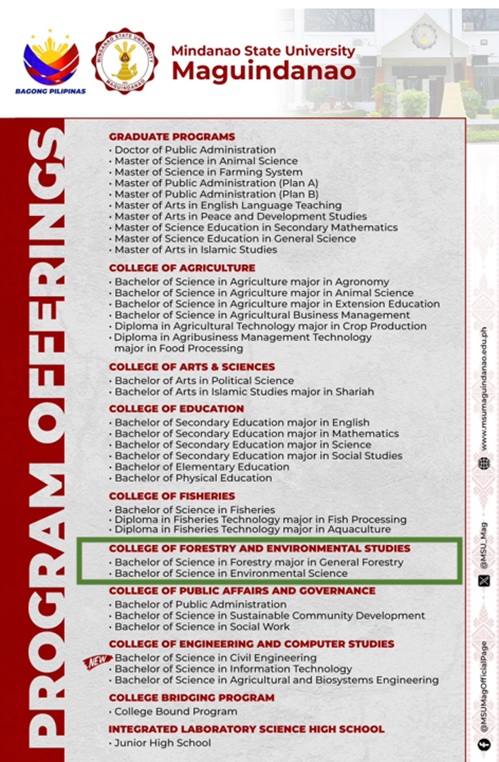
The list of Program offerings of MSU-Maguindanao includes 2 programs in the College of Forestry and Environmental Studies: Bachelor of Science in Forestry, major in General Forestry, and Bachelor of Science in Environmental Science (marked in green)
Bachelor of Science in Forestry, major in General Forestry. In this 177-unit program, students build their foundation in tree and plant identification through Morphology, Taxonomy, and Dendrology, and in ecological processes through Forest Ecology. They then move to the conservation and management of wild species and their habitats in Forest Wildlife and Biodiversity Conservation, Protected Area Management, and Watershed Management. Social Forestry and Community-Based Natural Resources Management prepares them to work alongside communities that depend on forest resources. Major electives such as Restoration of Degraded Ecosystems and Integrated Coastal Resources Management extend this training to damaged landscapes and coastal habitats.
Bachelor of Science in Environmental Science. The 164-unit program includes five courses, totaling 18 units, on ecosystems and wild species: Fundamentals of Ecology (4 units), Plant Taxonomy and Nomenclature (4 units), Animal Taxonomy and Nomenclature (4 units), Aquatic and Terrestrial Ecosystem Management (3 units), and Forest Wildlife and Biodiversity Conservation (3 units). Students first learn how organisms interact with their environment, then identify and classify wild plants and animals, and finally apply this knowledge to managing land and water ecosystems and conserving forest species and habitats.
The University extends ecosystem education beyond the classroom through its graduates, faculty-led research and extension initiatives, and published educational resources. Graduates of the BS Forestry and BS Environmental Science programs bring their competencies in species identification, biodiversity conservation, and ecosystem management into their professional practice in government agencies, environmental institutions, and community-based initiatives. Through these roles, they contribute to environmental education, conservation efforts, and the promotion of sustainable natural resource management.
Faculty members of the College of Forestry and Environmental Studies and other colleges also contribute to community knowledge through research and extension activities that document local biodiversity and promote ecosystem conservation. Among these educational resources are the published books, titled “Tree Species of the Sifaran Watershed” and “Bird Species of the Sifaran Watershed”, which document the flora and fauna found in one of the province's important watersheds. These publications provide valuable reference materials for understanding local plant and bird species and their ecological importance, making research-based knowledge more accessible to students, researchers, environmental practitioners, and local stakeholders.
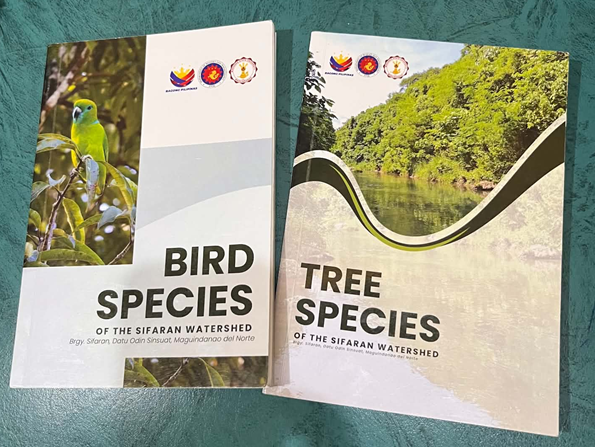
Published books of MSU-Maguindanao on Bird Species and Trees and Shrubs of Sifaran Watershed in Barangay Sifaran, Datu Odin Sinsuat, Maguindanao, del Norte, accessible for free at the Mindanao Palawan Sulu-Innovative Research and Development Consortium (MinSuPala-IRDC) Website
Through its academic programs, professional graduates, research, extension initiatives, and biodiversity publications, the University continues to make ecosystem knowledge accessible beyond its campus, promoting greater awareness and understanding of wild flora, fauna, and the importance of conserving local ecosystems.