SDG17
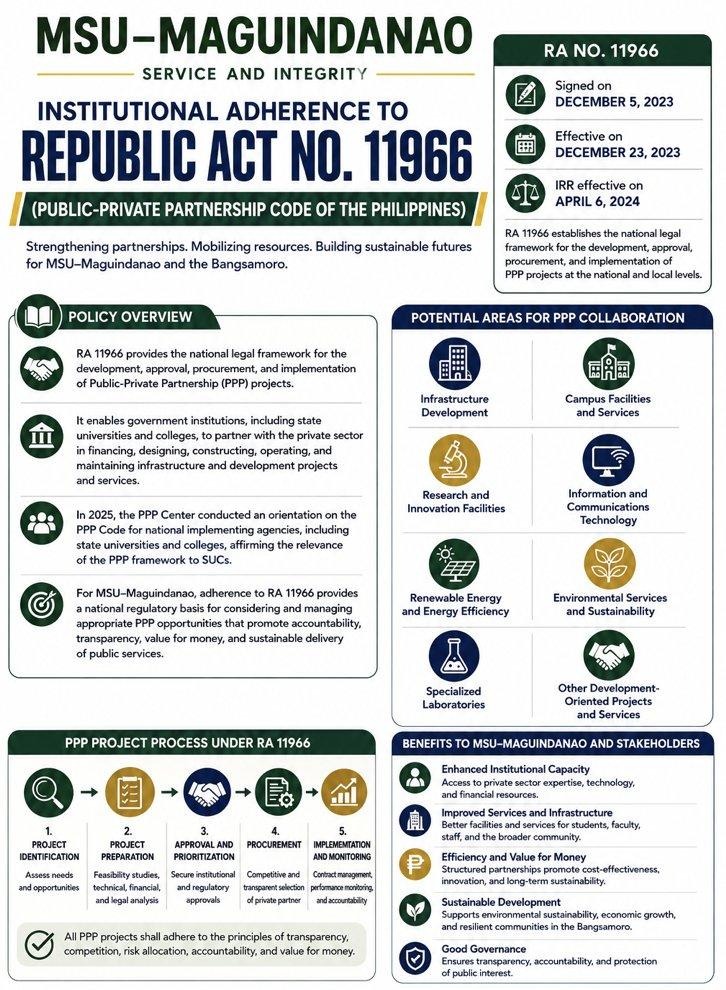
Institutional Adherence to Republic Act No. 11966
Mindanao State University–Maguindanao adheres to Republic Act No. 11966, the Public-Private Partnership (PPP) Code of the Philippines, as its framework for partnerships with the private sector. Signed on December 5, 2023, with its Implementing Rules and Regulations in effect since April 6, 2024, the law governs the development, approval, procurement, and implementation of PPP projects by government institutions, including state universities and college.Mindanao State University–Maguindanao institutional material on its adherence to Republic Act No. 11966, outlining potential areas for public-private collaboration and the PPP project processBefore pursuing a proposed private-sector partnership, University leadership and the offices responsible for planning and development, finance and administration, legal affairs, procurement, physical facilities, and research and innovation determine whether it qualifies as a PPP under the Code. Qualifying proposals undergo feasibility, technical, financial, legal, and environmental assessment before approval and remain under University oversight through implementation. Priority areas include campus infrastructure, research and innovation facilities, information and communications technology, renewable energy, and specialized laboratories.The University encourages effective public-private partnerships that draw on the experience and resourcing strategies of its partners and comply with the Code’s requirements for transparency, accountability, and value for money in the use of public resources. Such partnerships can expand quality, reliable, and sustainable infrastructure for teaching and research in the Bangsamoro. Public-Private Partnership Center of the Philippines reference page for Republic Act No. 11966 and its Implementing Rules and Regulations.Mindanao State University–Maguindanao is committed to applying the Code to future infrastructure, technology, and research partnerships and strengthening the capacity of its offices to manage them
December 31, 2025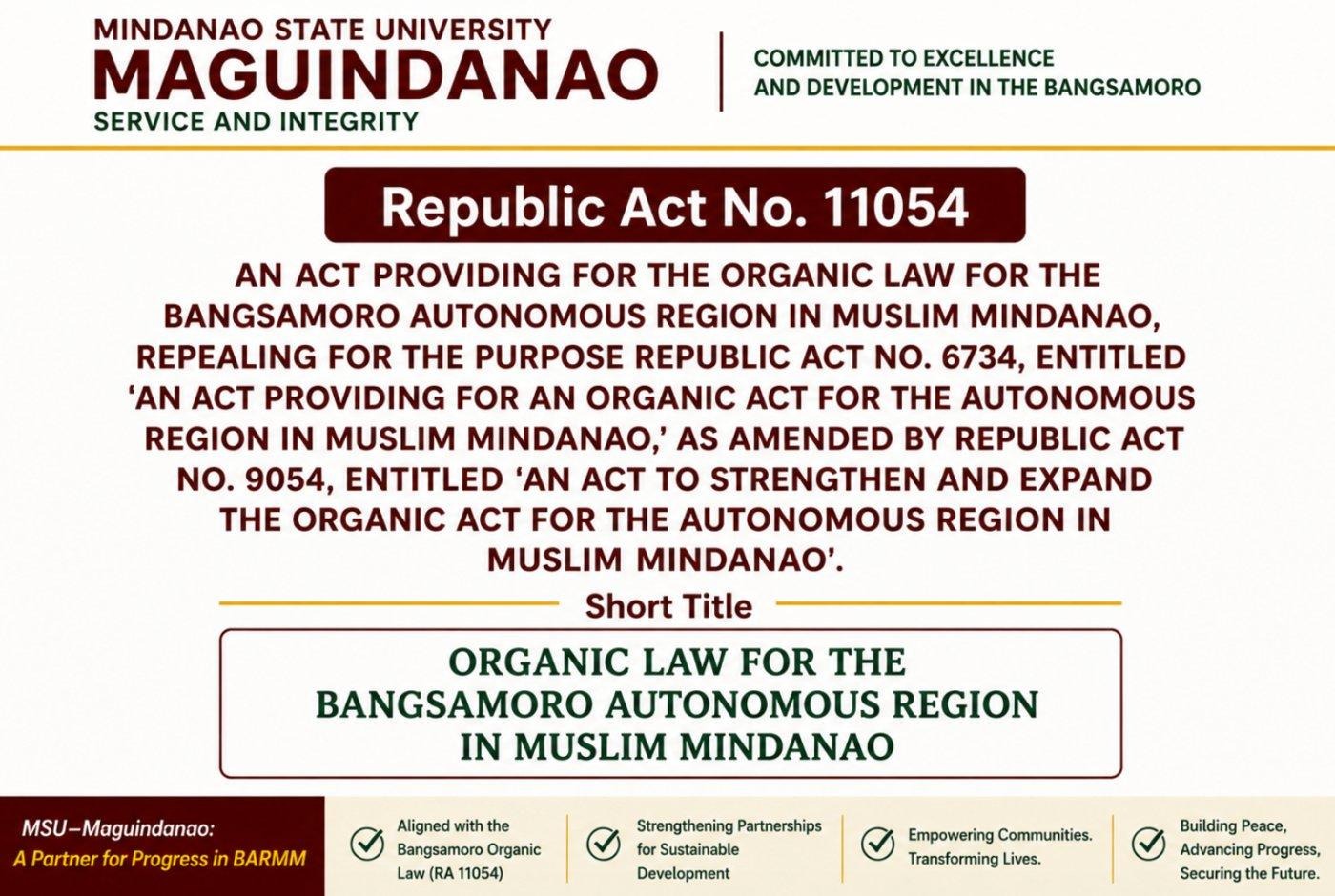
Institutional Alignment with Republic Act No. 11054 (Bangsamoro Organic Law)
Mindanao State University–Maguindanao upholds Republic Act No. 11054, the Organic Law for the Bangsamoro Autonomous Region in Muslim Mindanao, as a guiding framework for its instruction, research, extension, and partnerships. The law directs the National Government to continue to support, enhance, and strengthen the Mindanao State University System (Article IX, Section 16) and calls on the Bangsamoro Government to give priority to science, research, and technology education (Article IX, Section 21).Mindanao State University–Maguindanao institutional material on its alignment with Republic Act No. 11054, presenting the University as a partner for progress in BARMM.The University puts this commitment into practice through formal partnerships and joint work with national and regional institutions. In 2025, it turned over livelihood projects to ten cooperatives in Camps Omar, Abubakar, and Badre with the Office of the Presidential Adviser on Peace, Reconciliation and Unity in support of the Bangsamoro peace process; presented research-based policy recommendations to five Bangsamoro local governments through the MinSuPala–IRDC consortium; coordinated with the Ministry of Environment, Natural Resources and Energy on the 1,894-hectare South Upi Watershed Forest Reserve; and evaluated a regional assistance program with the Bangsamoro Planning and Development Authority.The University’s commitment to the Bangsamoro Organic Law strengthens public and civil society partnerships and promotes greater policy coherence between national and regional governments, contributing to more responsive, inclusive, and participatory decision-making in the region.Mindanao State University–Maguindanao will continue to align its programs and research priorities with the Bangsamoro Organic Law and expand its partnerships with BARMM ministries, local governments, and Indigenous Peoples communitie
December 31, 2025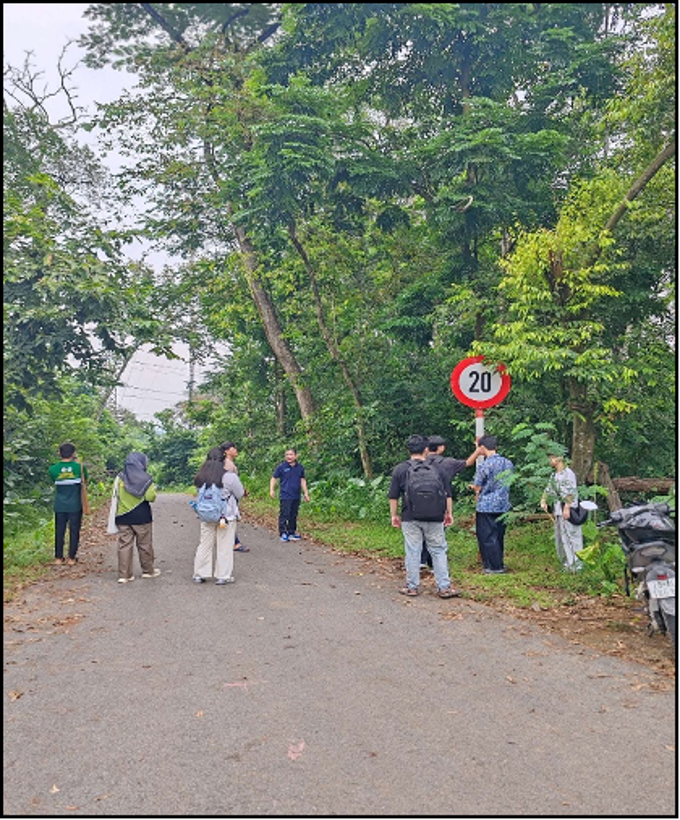
Collaboration with International Universities to Review Comparative Approaches and Develop Research-Based Best Practices for Sustainable Development
Five hundred Maguindanao residents surveyed with partners in Greece, 280 seaweed consumers interviewed with researchers in Türkiye and Malaysia, and biodiversity measurements shared at an international conference the University co-hosted show how Mindanao State University–Maguindanao participates in international collaboration on gathering and measuring data for sustainable development. Through joint research, international conferences, and exchange, its researchers collect field data in the Bangsamoro with international partners, measure it with shared methods, and make it available to the international scientific community.International Research CollaborationWith the Democritus University of Thrace in Greece, Peter Jan D. de Vera of MSU–Maguindanao measured how much the public values protecting the endangered long-tailed macaque, a primate that lives close to farms and settlements in Maguindanao. Conservation programs need to know whether residents will support protection, and how much they value it, before agencies can design and fund it. Working with Isshi Rayna Bel E. Paquingan and John Paul A. Catipay of Notre Dame University and Vasileios J. Kontsiotis and Vasilios Liordos of the Greek university, he surveyed 500 Maguindanao residents with approval from the MSU–Maguindanao Ethics Research Committee, asking how much each would be willing to pay every year to protect the species. The study, published in Environments (Vol. 12, Issue 12, Art. No. 467, 2025) with its dataset openly available, found an average willingness to pay of PHP 46.90 a year, or about PHP 10.5 million a year across the study area.A second collaboration, with researchers in Türkiye and Malaysia, gathered data on food and coastal livelihoods. Seaweed farming supports many families in Tawi-Tawi, but little had been recorded about how much seaweed local people eat and which species they use. Jonald C. Bornales of the College of Fisheries joined a 19-member team led by Albaris B. Tahiluddin that documented seaweed consumption in seven Tawi-Tawi municipalities: Bongao, Panglima Sugala, Simunul, Sitangkai, Sibutu, Tandubas, and South Ubian. Working under ethics approval OVCRE-ERC-004-2024-18 from the MSU–Maguindanao Research Ethics Committee, the team held 280 interviews and seven focus group discussions. It found that about 99 percent of respondents eat seaweed and identified 13 edible species (Phycology, Vol. 5, Issue 2, Art. No. 25, June 2025).The University also builds the skills to gather such data. Under a Memorandum of Understanding with the Vietnam National University of Forestry, the College of Forestry and Environmental Studies sent four BS Forestry students to Hanoi from August 11, 2025, when they were formally received by the university’s coordinators for international students, to October 5, 2025, for training in Natural Resources Ecology and Measurement and in Global Change Ecology: Impacts and Mitigation, learning field methods for ecological assessment that they can apply to forests in the Bangsamoro.BS Forestry students take part in a hands-on field activity during their exchange at the Vietnam National University of Forestry, Hanoi, August to October 2025.Co-hosting of Research ConferenceThe University also shares its measurements internationally. On July 23, 2025, it co-hosted the 4th Biennial Conference on Tropical Biodiversity with the Faculty of Forestry of Hasanuddin University in Indonesia, Tomsk Polytechnic University in Russia, Universiti Teknologi MARA in Malaysia, and the University of North Sumatra, held in Makassar and online. Ten University faculty researchers presented 13 studies, with field measurements of birds, epiphytes, tree species diversity, aboveground biomass and carbon stocks, the wood properties of native and fruit trees, and soil and water quality, along with assessments of land-use change, forest management for climate change, public attitudes toward conserving the Philippine brown deer, and residents’ willingness to pay for protecting two watersheds. The presenters were Sandra Samaon Akmad, Cindy Poclis, Kristine Joy Rendon, Adelene Lababo, Datulabi Untong Jr., Jayric Villareal, Mercedita Laurie, Peter Jan De Vera, Rolly James F. Cheng, and Rowena C. Benavides. One of these studies, a land use and land cover analysis of Datu Odin Sinsuat co-authored with researchers affiliated with Nanjing Forestry University in China, was published in IOP Conference Series: Earth and Environmental Science (Vol. 1553, 2025).MSU–Maguindanao faculty present biodiversity at the 4th Biennial Conference on Tropical Biodiversity, July 23, 2025.
December 29, 2025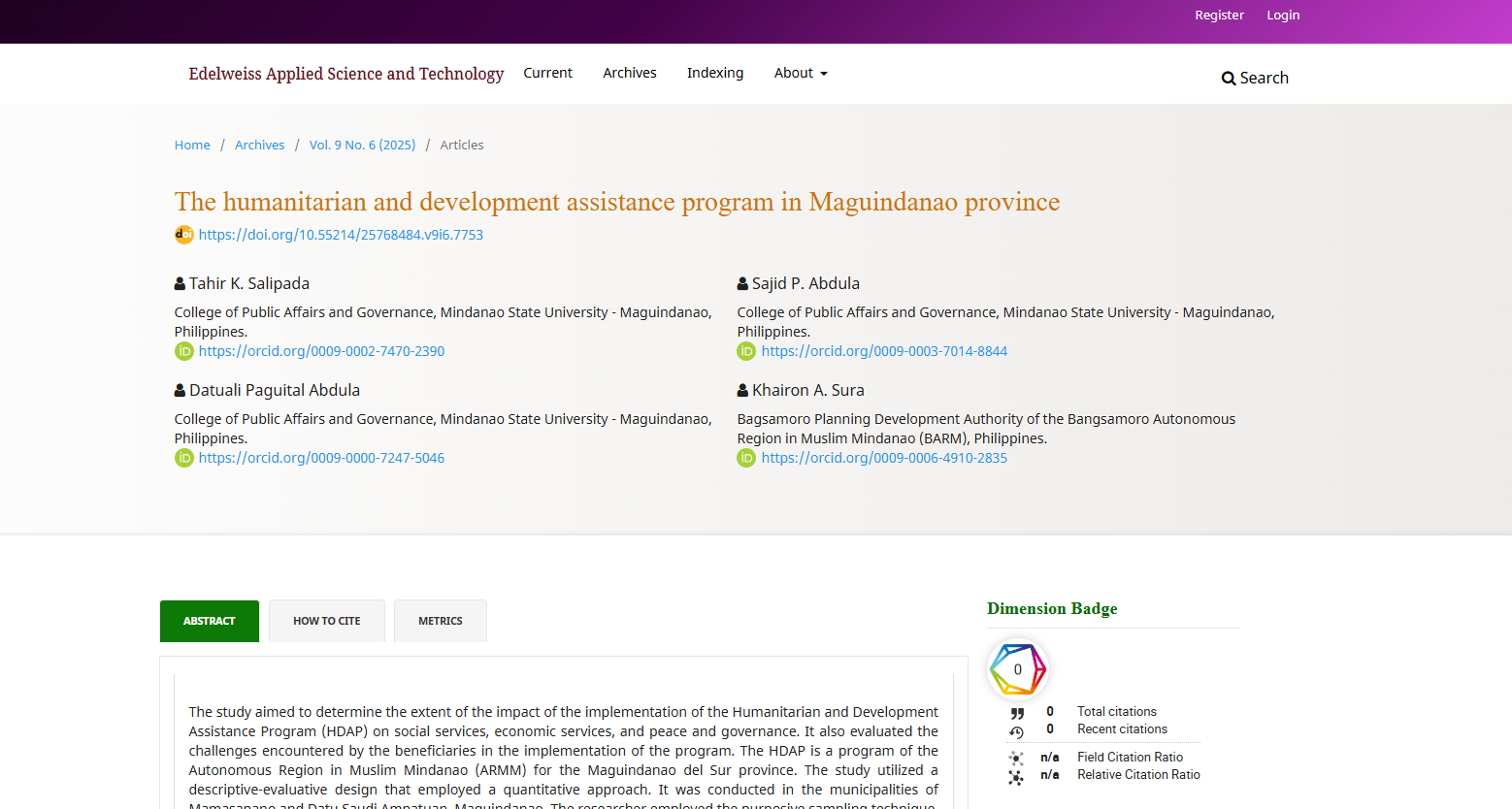
The Humanitarian and Development Assistance Program in Maguindanao Province
Tahir K. Salipada, Sajid P. Abdula, and Datuali Paguital Abdula of the College of Public Affairs and Governance of Mindanao State University–Maguindanao, with Khairon A. Sura of the Bangsamoro Planning and Development Authority (BPDA), published an evaluation of the Humanitarian and Development Assistance Program (HDAP) in Edelweiss Applied Science and Technology (Volume 9, Number 6, 2025).First page of the published article, showing the authors from Mindanao State University–Maguindanao and the Bangsamoro Planning and Development Authority.HDAP was established in 2016 to support war-affected municipalities through health, education, social welfare, infrastructure, livelihood, and peace and governance projects, and its unfinished projects passed to the BPDA after the transition to BARMM. The researchers surveyed 100 program beneficiaries, 50 each from Mamasapano and Datu Saudi Ampatuan.Beneficiaries rated the program’s impact on social services, economic services, and peace and governance as extensive, but reported delays in service delivery linked to local peace and order conditions.As a joint study by a university and a regional planning authority, the research promotes effective public partnerships. It gives decision-makers evidence for more responsive and accountable public services for conflict-affected and vulnerable communities.
December 25, 2025MSU–Maguindanao Collaborates with Non-Government Organizations to Tackle the Sustainable Development Goals through Education, Peacebuilding, Food Security, and Climate Resilience in 2025
In 2025, Mindanao State University–Maguindanao (MSU–Maguindanao) collaborated with international development organizations, non-governmental institutions, and academic partners to tackle the Sustainable Development Goals (SDGs) through inclusive education, peacebuilding, technical capacity development, food security, and climate resilience. These institutional engagements brought together academic expertise, development resources, and community-based approaches to address sustainable development challenges in the Bangsamoro Autonomous Region in Muslim Mindanao (BARMM).Through its collaboration with the United Nations Development Programme (UNDP) Philippines, supported by the British Embassy Manila and the Philippine Center for Islam and Democracy, the University participated in the International Learning Exchange on Women, Peace and Security held in Yogyakarta, Indonesia, on June 18–20, 2025. The initiative supported the University's Diploma in Women, Peace and Security through international knowledge sharing, institutional visits, and policy dialogues. It also facilitated academic agreements with three Indonesian universities, promoting women's leadership, gender-responsive education, inclusive participation in peacebuilding, and international cooperation for sustainable development.The University also entered into a Memorandum of Agreement with the Asian Center of Education, Research and Tutelage for Innovation (ACERT) and MSU–Tawi-Tawi College of Technology and Oceanography, announced on January 24, 2025, to develop an Indigenous Peoples Education Framework for BARMM. This collaboration established a foundation for advancing culturally responsive education, inclusive learning opportunities, recognition of Indigenous knowledge, and educational equity through partnerships between academic institutions and nongovernmental organizations.In engineering and technological education, MSU–Maguindanao engaged with Zuitt Learning Institute, Inc. through a consultative meeting reported on October 30, 2025. The engagement explored integrating applied technical training and industry-oriented learning into engineering laboratory courses. It aimed to strengthen technical and vocational skills, improve education-to-employment pathways, and support technological innovation and capacity development in BARMM.On August 12, 2025, the University formalized its partnership with the United Nations World Food Programme (WFP) through a Memorandum of Agreement focused on food security, nutrition, and climate resilience. The accompanying 2025–2027 cooperation work plan identified collaborative initiatives in smallholder farmer capacity-building, climate-smart agriculture, local climate change adaptation planning, watershed management, post-harvest loss reduction, and sustainable agricultural livelihoods. By combining research and extension expertise with international development cooperation, the partnership established a framework for addressing hunger, strengthening community resilience, and promoting sustainable food systems.These collaborations reflect MSU–Maguindanao's institutional commitment to sharing knowledge, expertise, technology, and resources through international cooperation, capacity-building, and multi-stakeholder partnerships. By connecting academic instruction, research, and community engagement with local and international development priorities, the University supports inclusive education, gender equality, peaceful and inclusive societies, sustainable agriculture, climate adaptation, and equitable socioeconomic development.MSU–Maguindanao will continue expanding partnerships with nongovernmental organizations, international development institutions, and academic networks to mobilize knowledge and resources, enhance capacity-building, and support the implementation of the Sustainable Development Goals through measurable, community-responsive initiatives that contribute to a more inclusive, resilient, and sustainable Bangsamoro.
December 24, 2025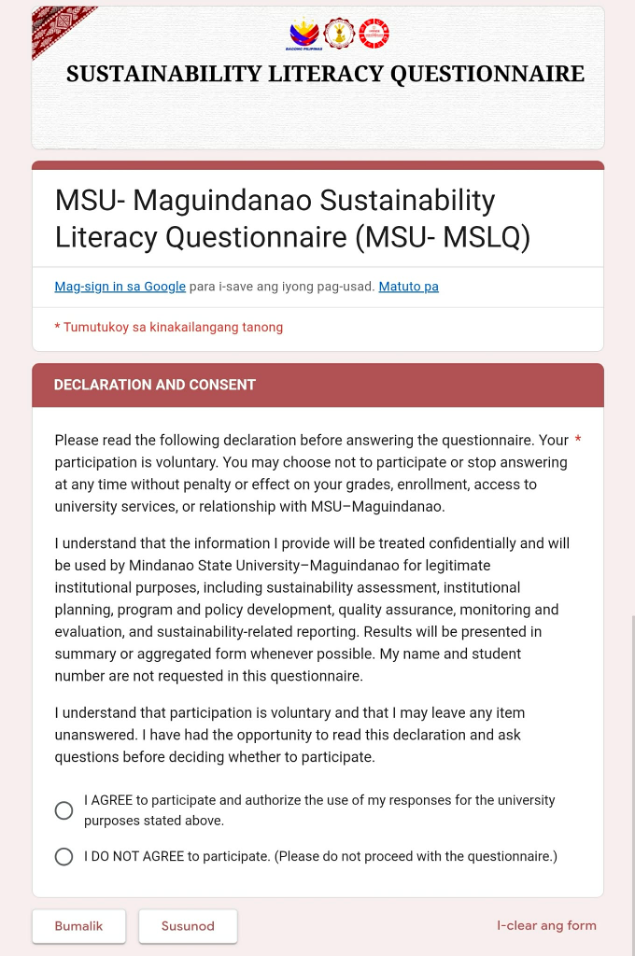
Measuring What Students Know, Value, and Do for Sustainability, a University-Wide Survey Sets the Baseline
At least 87.68% of the students who answered the MSU–Maguindanao Sustainability Literacy Questionnaire (MSU–MSLQ) showed high to very high sustainability literacy in each of its five dimensions, as Mindanao State University–Maguindanao measures the sustainability literacy of its students directly rather than relying only on the courses, campaigns, and environmental activities it offers.The Office of the Vice Chancellor for Research and Extension (OVCRE) developed the MSU–MSLQ, a structured 30-item assessment that experts reviewed before use, to give the University evidence for institutional planning, quality assurance, program development, and sustainability monitoring. The questionnaire covers five dimensions: knowledge and awareness of sustainable development, the SDGs, climate change, biodiversity, and responsible consumption; values and attitudes, such as environmental responsibility, protecting resources for future generations, social equity, and the role of universities in sustainable development; systems thinking, or seeing how environmental, social, and economic concerns connect; awareness of the environmental challenges facing Maguindanao and the Bangsamoro and of the University’s responsibility toward them; and sustainable practices such as waste segregation, reducing plastic use, conserving resources, and joining sustainability activities. Students rated each item on a four-point scale, from 4 (Very High) to 1 (Very Low). OVCRE administered the questionnaire online to all undergraduate and graduate students throughout November 2025. Participation was voluntary, and the questionnaire asked for no names or student numbers.The MSU–MSLQ opens with a declaration and consent page assuring students that participation is voluntary and that no names or student numbers are collected.Values and attitudes emerged as the strongest dimension, with 92.12% of respondents rating high or very high and 78.82% rating very high. Knowledge and awareness followed at 90.64%, local and institutional sustainability awareness at 90.15%, and systems thinking and sustainability application at 88.18%. Sustainable practices and behavioral engagement recorded the lowest share at 87.68%, and the smallest very high group at 52.71%, which shows that students’ values run ahead of their everyday habits.Most respondents rate high or very high in all five dimensions, with values and attitudes strongest and sustainable practices weakest.The results, which are based on students’ own ratings, show that respondents see sustainability not only as an environmental concern but also as a matter of social equity, economic choices, institutional accountability, and community development. They give the University a baseline for each dimension and point to where its teaching and campus programs should focus next.The University aims to use these results to strengthen the dimension where students lag, by building waste segregation, plastic reduction, and resource conservation into campus activities and classes, and to deepen systems thinking through interdisciplinary teaching, research, and community-based problem-solving. OVCRE will administer the questionnaire every year, which will show whether these efforts change how students act.
December 23, 2025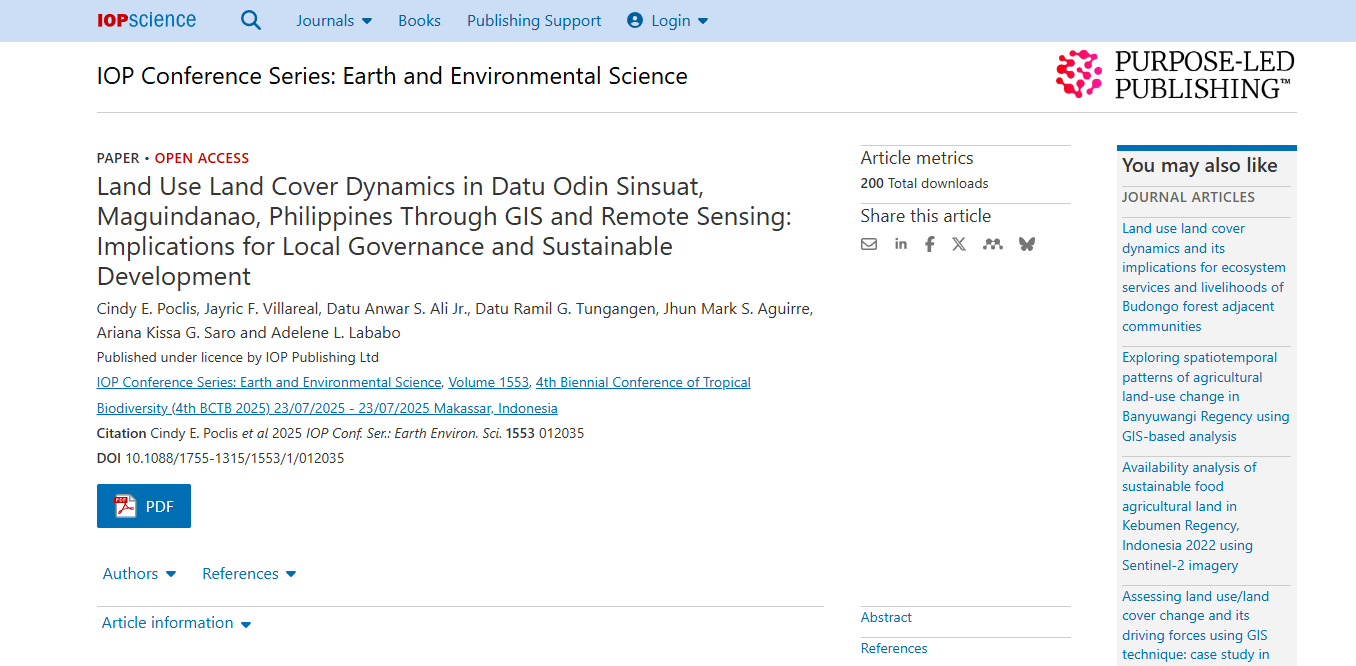
Land Use Land Cover Dynamics in Datu Odin Sinsuat, Maguindanao, Philippines Through GIS and Remote Sensing: Implications for Local Governance and Sustainable Development
Cindy E. Poclis and six fellow researchers from the College of Forestry and Environmental Studies at Mindanao State University–Maguindanao published a study mapping land-use change in Dalican Poblacion, Datu Odin Sinsuat, in IOP Conference Series: Earth and Environmental Science (Volume 1553, 2025). Poclis and co-author Jayric F. Villareal also hold affiliations with Nanjing Forestry University in China.Published article, showing the authors’ affiliations with Mindanao State University–Maguindanao and Nanjing Forestry University, China.From January to May 2025, the team combined land cover maps and boundary data from the Ministry of Environment, Natural Resources and Energy (MENRE-BARMM) with Landsat 8/9 satellite imagery processed in QGIS to produce a new 2025 land use map, and interviewed barangay officials on zoning and environmental compliance.Across the 452.17-hectare study area, perennial crops declined by 21.36 hectares between 2010 and 2020 while built-up areas expanded. The 2025 map now gives the local government a planning baseline, and the researchers recommend regular satellite-based monitoring and stronger community participation in land-use decisions.Through international research collaboration and the use of regional government data, the study strengthens cooperation on science, technology, and knowledge sharing across borders, while supporting participatory, sustainable land-use planning and the sustainable use of terrestrial ecosystems.
December 23, 2025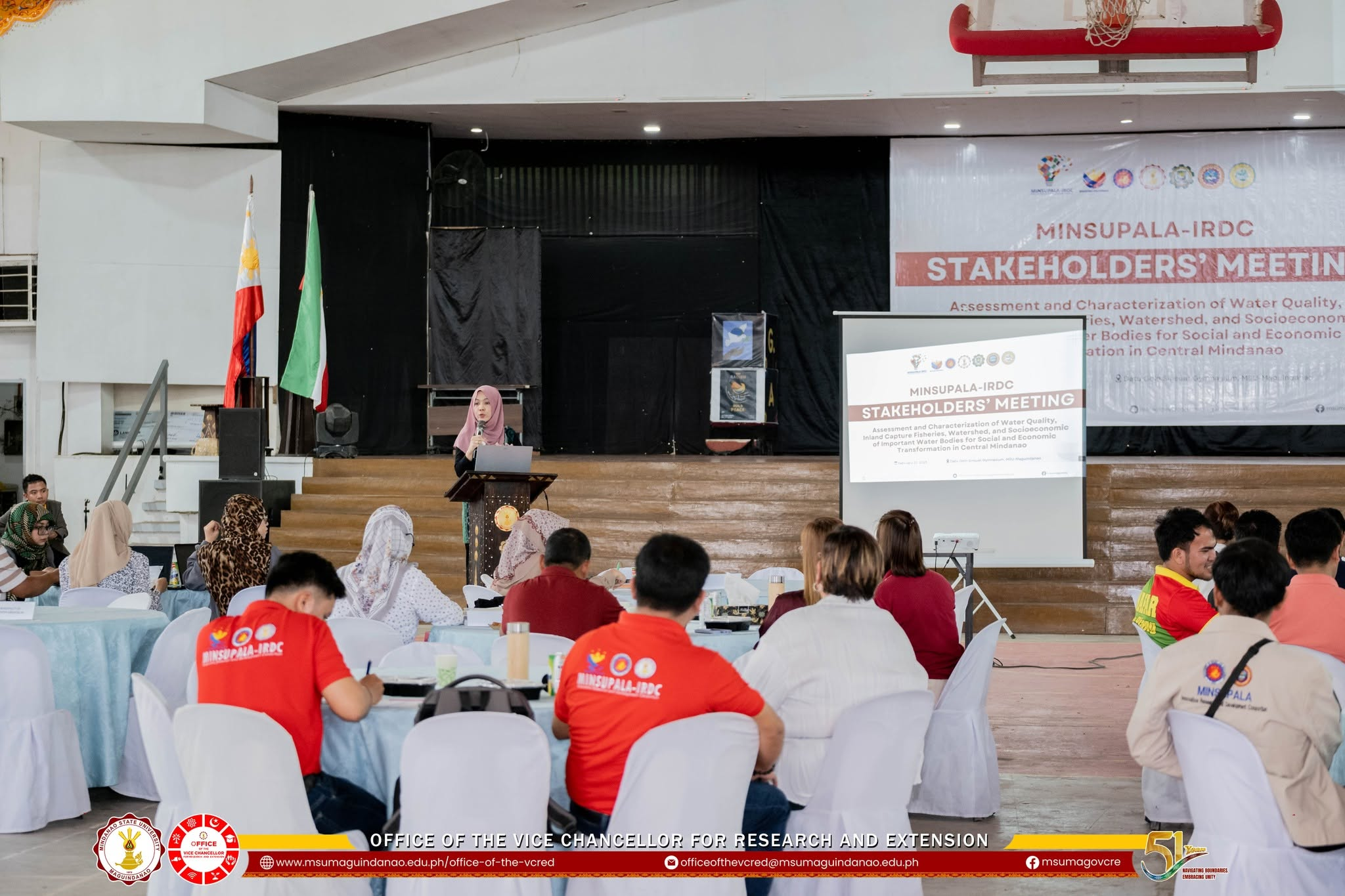
University Research Shapes Policy on Water, Peace Education, and Camp Livelihoods
Data on the water, fisheries, and livelihoods of 930 residents around Ligawasan Marsh became five policy recommendations that local governments validated in October 2025, as Mindanao State University–Maguindanao gave national and Bangsamoro government direct input into policy development on sustainable development, from identifying problems to monitoring interventions. Its research and extension teams helped the Department of Budget and Management (DBM), the Office of the Presidential Adviser on Peace, Reconciliation and Unity (OPAPRU), BARMM ministries, and local governments identify problems and challenges, develop policies and strategies, and monitor and report on interventions.Identifying Problems and ChallengesThe largest of these efforts runs through the Mindanao–Sulu–Palawan Innovative Research and Development Consortium (MinSuPala–IRDC), a network funded by the Department of Budget and Management (DBM) and led by MSU–Maguindanao. Local governments around the major water bodies of Central Mindanao had little local data on the condition of their rivers, marshes, and fisheries. In the consortium’s first phase, the University’s ₱5,000,000 (about US$87,300) component assessed water quality, inland capture fisheries, watershed conditions, and the livelihoods of 930 residents around Ligawasan Marsh, working with the Ministry of Environment, Natural Resources and Energy (MENRE), the Ministry of Agriculture, Fisheries and Agrarian Reform (MAFAR), and the local governments of Cotabato City, Kabuntalan, Northern Kabuntalan, Talitay, and Datu Piang, and produced five policy recommendations. The University then led Phase 2, “Establishment and Preservation of Indigenous Fish and Crop Products,” carried out by nine member institutions from January to December 2025. DBM funds each phase of the consortium’s work at ₱45,000,000 (about US$786,000), of which the University’s Phase 2 component received ₱10,000,000 (about US$174,700).The network itself has grown to reach more of the region. On November 13, 2023, at the Department of Budget and Management Region XI office in Davao City, MSU–Maguindanao and the existing members signed a Memorandum of Agreement admitting state universities and colleges in Sulu, Basilan, and Tawi-Tawi, extending the consortium’s research on the region’s waters and resources to the island provinces. The consortium now has 14 member state universities and colleges.The consortium first tested its findings with the agencies that would use them. On February 27, 2025, MSU–Maguindanao hosted the MinSuPala–IRDC Stakeholders’ Consultation, where research teams from MSU–Maguindanao, the University of Southern Mindanao–Kidapawan City Campus, Cotabato State University, and Adiong Memorial State College presented their assessments of water quality, fisheries, watershed conditions, and socio-economic conditions in Ligawasan Marsh, Lake Buluan, the Rio Grande de Mindanao, and Lake Lanao. Representatives of the Ministry of Agriculture, Fisheries and Agrarian Reform–BARMM, the Bangsamoro Planning and Development Authority, the Department of Science and Technology–PCAARRD, the Provincial Environment, Natural Resources and Energy Office of Maguindanao, environmental organizations, fisherfolk associations, and the local governments of Datu Piang, Talitay, Northern Kabuntalan, Cotabato City, Mangudadatu, and Sultan Kudarat discussed the findings, aligned them with local conservation and resource management plans, and helped shape the policy recommendations for conserving and managing these water bodies.Chancellor Limbona delivers her message to government agencies, local governments, and fisherfolk associations at the Stakeholders’ Consultation, Datu Odin Sinsuat Gymnasium, February 27, 2025.The University’s Phase 2 team is set out in Special Order No. 234, s. 2025, issued by Chancellor Bai Hejira Nefertiti M. Limbona on September 23, 2025. Dr. Raquel D. Santiago-Arenas serves as Project Coordinator over four projects: Nutritional Analysis, led by Asst. Prof. Always A. Germo; Market Potential and Value Chain Analysis, led by Asst. Prof. Irene S. Aquino; Agronomic Practices Assessment, led by Mr. Dominic B. Masecambo; and Establishment of Demo Farm and Knowledge Materials, led by Mr. John Louie C. Natan. Dr. Joel C. Arenas, Dr. Ramjie Y. Odin, and Engr. Bai Aljannah S. Macalandong served as a consultant.Developing Policies and StrategiesIn July 2025, the Phase 2 team led by Asst. Prof. Irene S. Aquino held coordination meetings with the five local governments and conducted key informant interviews with fisherfolk, farmers, and cooperatives to identify the native crops and fish most worth conserving. In October 2025, a team led by Mr. John Louie C. Natan, Study Leader of Inland Capture Fisheries, with technical support from Ms. Rhea Mae C. Talaron, presented the Phase 1 results and policy recommendations to each local government and its barangays. Cotabato City, under Mayor Mohammad Ali Matabalao, was represented by Agriculture Technologist Ms. Priyanka B. Saji-Sabpeten; Kabuntalan, under Mayor Datu Sharif Diocolano, by Municipal Administrator Mr. Efrel Oric Midtimbang; Datu Piang, under Mayor Victor Samama, by Executive Assistant Ms. Sherriejean S. Ampatuan; Talitay, under Mayor Sidik Amiril, by MAFAR Municipal Officer Mr. Dasib Mendato; and Northern Kabuntalan, under Mayor Datu Umbra Diocolano, by Administrator Mr. Allan Cando. Local officials, barangay representatives, and community members validated the findings and chose gabi (taro) and okra as priority crops, and haluan, native katipa, and popoyu as priority indigenous fish; each local government affirmed its readiness to work with the consortium on Phase 2.The MinSuPala–IRDC project page documents the DBM-funded work that MSU–Maguindanao leads with five Central Mindanao local governments, 2025The same steps, from identifying a problem to recommending a policy, guided a second project in the uplands. Funded by the Ministry of Science and Technology–BARMM with ₱1,199,418 (about US$20,950), it ran from June 2024 to July 2025 with MENRE and the LGU of Upi. The College of Forestry and Environmental Studies characterized the South Upi Forest Watershed and assessed its vulnerability to landslides, providing MENRE and the municipality with a watershed vulnerability map and policy recommendations for managing the area.Policy input also runs through national development agencies. On July 30, 2025, Chancellor Limbona, who chairs the consortium, and DBM Region XII Director Akmad J. Usman, its Executive Director, paid a courtesy visit to Secretary Leo Magno of the Mindanao Development Authority (MinDA) and held an exploratory meeting with Executive Director Janet M. Lopoz on working together on a Mindanao Forum on Waters and Natural Resources. MinDA Director III Olie B. Dagala of the Investment Promotions and Public Affairs Office and Chief Public Relations Officer Dr. Adrian Tamayo attended, with Vice Chancellor Raquel D. Santiago-Arenas and Ms. Aljannah Macalandong of the University. The meeting led to the 1st Mindanao Forum on Waters and Natural Resources in General Santos City from November 26 to 28, 2025, where the consortium turned over its Phase 1 reports and published books to Director Usman and DBM XII, moving its research from outputs to policy application.Chancellor Limbona and DBM Region XII Director Akmad J. Usman meet MinDA Secretary Leo Magno and Executive Director Janet M. Lopoz, July 30, 2025The University also gave the national legislature direct input on peace education policy. On September 16, 2025, Chancellor Limbona, with DWPS Technical Working Group Chairperson Grant Warren Lu and DWPS faculty members Dr. Arceli B. Naraga and Ms. Aljannah Macalandong, submitted the University’s position paper to the House Committee on Higher and Technical Education at its 2nd regular meeting, which deliberated on House Resolution No. 160 commending the MSU Board of Regents and MSU–Maguindanao for pioneering the Diploma in Women, Peace and Security. The position paper presented the program as a model of peace-oriented higher education that other institutions could replicate. Committee Chairperson Rep. Jude Acidre thanked the University for its work in peace education, and Vice Chairperson Rep. Eulogio R. Rodriguez sponsored the resolution for adoption. The resolution remains pending in the House.Chancellor Limbona submits the University’s position paper on the Diploma in Women, Peace and Security to the House Committee on Higher and Technical Education, September 16, 2025.Strategies also depend on the officials who carry them out. On August 12, 2025, at the Institute of Management, Chancellor Limbona and Regis Chapman, Representative and Country Director of the United Nations World Food Programme (WFP), signed a Memorandum of Agreement for a 2025–2027 partnership under which the University contributes experts in food systems, climate adaptation, and gender-responsive programming to help priority barangays prepare Local Climate Change Adaptation Plans and to strengthen farmer cooperatives, while WFP provides technical resources and exchange visits. Under this partnership, in September 2025, University extension staff Sarah Jane Mokamad, Lahmudin Abdulhadi, and Jona Fabay trained 30 MAFAR municipal officers and agricultural extension workers in a WFP-funded Training of Trainers. Each participant drafted a six-month action plan to strengthen farmer cooperatives in their municipality.Chancellor Bai Hejira Nefertiti M. Limbona and WFP Country Director Regis Chapman sign the 2025–2027 partnership on food security and climate resilience, Institute of Management, August 12, 2025.Monitoring and Reporting on InterventionsThe Humanitarian and Development Assistance Program (HDAP) was set up in 2016 under the former Autonomous Region in Muslim Mindanao to bring health, education, social welfare, infrastructure, livelihood, and governance projects to war-affected towns, and its unfinished projects passed to the Bangsamoro Planning and Development Authority (BPDA) after the transition to BARMM. College of Public Affairs and Governance faculty Tahir K. Salipada, Sajid P. Abdula, and Datuali Paguital Abdula evaluated the program with Khairon A. Sura of the BPDA. They surveyed 100 beneficiaries, 50 each in Mamasapano and Datu Saudi Ampatuan. They found that the program had an extensive impact on social services, economic services, and peace and governance, but that delivery was delayed by local peace and order conditions (Edelweiss Applied Science and Technology, Vol. 9, No. 6, 2025).For OPAPRU’s camp transformation program, part of the Normalization Track of the Comprehensive Agreement on the Bangsamoro, the University implemented ₱32.36 million (about US$565,200) in livelihood projects in Camps Badre, Omar, and Abubakar. In 2024, beneficiaries first completed a Values Transformation Training funded by the Bangsamoro Development Agency before their technical training. On June 18, 2025, with OPAPRU, the University turned over the Camp Abubakar projects, including a newly constructed kitchen facility for the Calagan Women’s Marketing Cooperative and the Gawad Kalinga Village Togaig Farmer’s Marketing Cooperative, supporting women-led enterprise and the reintegration of decommissioned combatants. Officials of the Office of the Special Assistant to the President, OPAPRU, and the Philippine Marine Corps, together with the municipal government of Barira and the Camp Abubakar MILF camp coordinators, witnessed the turnover. The community kitchens built in the other camps were completed in 2025 and are scheduled for turnover. After the training, the University holds Kamustahan sessions, follow-up check-ins with the cooperatives, as its mechanism for monitoring the projects, and it reports on them with OPAPRU and the Joint Task Forces on Camps Transformation. The newly turned over kitchen facility in Camp Abubakar, Barira, Maguindanao del Norte, on June 18, 2025.From Recommendations to Policy, and What Comes NextAs a result, five local governments now hold validated priorities for conserving their indigenous crops and fish, MENRE has a hazard map for the South Upi watershed, the regional planning authority has field evidence on why its assistance was delayed, and the House Committee on Higher and Technical Education has the University’s position on peace-oriented higher education. The consortium carries this work into Phase 3 in 2026, which will develop and market products from the priority crops and fish. Through its 2025–2027 partnership with WFP, the University will also continue to help priority barangays prepare local climate change adaptation plans, and its Kamustahan sessions will keep track of the camp livelihood projects so that they stay productive for the cooperatives that run them.
December 20, 2025MSU–Maguindanao Delivers Community Outreach and Livelihood Education to Conflict-Affected Communities in BARMM
In 2025, Mindanao State University–Maguindanao (MSU–Maguindanao) demonstrated its commitment to providing dedicated outreach and educational activities for the wider community, including local residents, displaced and conflict-affected populations, former combatants, farmers, and women's organizations, through its agricultural livelihood and camp transformation initiatives. Under the program “Sowing Hope, Reaping Peace: MSU–Maguindanao Agricultural Livelihood and Camp Transformation Program in Camps Omar, Abubakar, and Badre,” the University extended its academic expertise, technical knowledge, and community development services beyond the campus to support livelihood recovery, food security, economic reintegration, and sustainable peace in the Bangsamoro Autonomous Region in Muslim Mindanao (BARMM).Implemented in partnership with the Office of the Presidential Adviser on Peace, Reconciliation and Unity (OPAPRU), MILF Camps Transformation mechanisms, local government units, and community cooperatives, the initiative formed part of the Agricultural Livelihood Support Projects under the MILF Camps Transformation Plan and the Normalization Track of the Comprehensive Agreement on the Bangsamoro. Through community engagement, technical extension support, stakeholder consultations, knowledge sharing, and livelihood interventions, MSU–Maguindanao helped participating communities gain access to productive resources and practical opportunities for sustainable economic participation.On June 17, 2025, MSU–Maguindanao and OPAPRU conducted the turnover of agricultural livelihood projects for Camp Omar at the Datu Hoffer Municipal Training Center. The initiatives supported four community organizations through diversified livelihood activities involving vegetable production, goat raising, poultry production, and fish farming. These interventions connected agricultural knowledge and university extension services with community-based food production, livelihood diversification, and cooperative development, creating opportunities for local residents to strengthen household food security and economic self-reliance.On June 18, 2025, the University and OPAPRU formally turned over a kitchen facility in Camp Abubakar, Barira, Maguindanao del Norte, benefiting the Calagan Women's Marketing Cooperative and Gawad Kalinga Village Togaig Farmer's Marketing Cooperative. The facility provided productive infrastructure for cooperative-led food enterprises and community livelihoods, particularly supporting women's economic participation. The intervention also contributed to the socioeconomic reintegration of decommissioned combatants by creating opportunities for civilian livelihood development within communities transitioning from armed conflict.The University continued its community outreach through the turnover of agricultural livelihood support projects for Camp Badre on July 16, 2025, at the Datu Odin Sinsuat Gymnasium, MSU–Maguindanao. The initiative benefited four agricultural and marketing cooperatives, supporting organized farming communities through productive livelihood resources and agricultural development opportunities. Across the three camps, 10 community organizations and cooperatives directly benefited from the University's extension interventions, including women's organizations and farmer-led enterprises.These dedicated community outreach activities demonstrate how MSU–Maguindanao connects higher education with lifelong learning opportunities, practical skills development, poverty reduction, food security, sustainable agriculture, women's economic empowerment, productive employment, social inclusion, and community resilience. By supporting vulnerable and conflict-affected populations, the University contributes to reducing inequalities and promoting peaceful and inclusive societies. Its collaboration with government institutions, local communities, and cooperatives also reflects the importance of effective institutions, knowledge sharing, capacity-building, and multi-stakeholder partnerships in addressing sustainable development challenges.MSU–Maguindanao remains committed to expanding accessible, community-responsive outreach and educational opportunities for the wider community, strengthening technical knowledge transfer, and sustaining livelihood development initiatives that empower local residents and vulnerable populations. Through continued partnerships, participatory community engagement, and inclusive extension services, the University seeks to transform academic knowledge into lasting opportunities for self-reliance, equitable development, and sustainable peace throughout the Bangsamoro.
December 15, 2025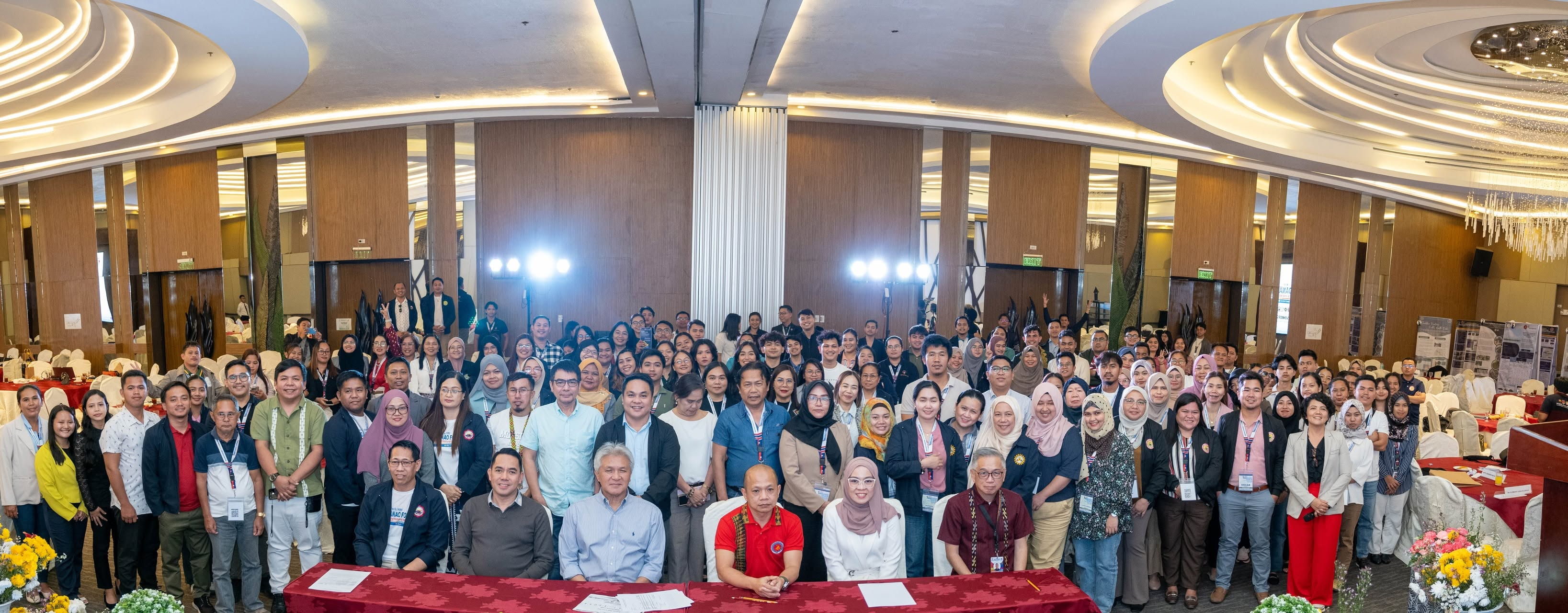
Cross-Sectoral Dialogues on Mindanao’s Waters and Women, Peace and Security Initiated and Joined with Government, NGOs, and Industry
Over 190 researchers, policymakers, and community leaders met at the 1st Mindanao Forum on Waters and Natural Resources, the largest of the conferences, forums, and workshops on sustainable development with government, non-government organizations, and industry that Mindanao State University–Maguindanao initiated or joined between January and November 2025. Together, these dialogues covered water governance, biodiversity, peace and security, elections and governance, education, and institutional planning.1st Mindanao Forum on Waters and Natural ResourcesThe University convened the forum at the Greenleaf Hotel in General Santos City from November 26 to 28, 2025. The University leads the Mindanao-Sulu-Palawan Innovative Research and Development Consortium (MinSuPala-IRDC), a network of state universities funded by the Department of Budget and Management to study Mindanao’s inland waters. Decisions about the region’s lakes, rivers, and marshes have often been made without reliable local data, and the forum was organized to put research findings in front of the officials who manage these resources. Held with the Mindanao Development Authority (MinDA) and the National Research Council of the Philippines under the theme “Empowering Mindanao through M.I.N.A.: Mobilized Collaboration, Integrated Knowledge, Nurtured Innovation, and Amplified Local Wisdom,” it brought these groups together with faculty experts, local government officials, and development partners.Chancellor Bai Hejira Nefertiti M. Limbona, as Consortium Lead, opened the forum by setting its purpose: to move from gathering data to producing policy solutions for Mindanao’s water basins. MinDA Executive Director Undersecretary Dr. Janet M. Lopoz delivered the keynote, and plenary speakers included Dr. Gisela P. Concepcion of the University of the Philippines Diliman, Dr. Rex Victor O. Cruz of the University of the Philippines Los Baños, and Cardinal Orlando B. Quevedo, OMI, of the Mindanao River Basin Management Council. Industry partners Shimadzu Philippines Corporation and Guill-Bern Corporation presented technology and laboratory innovations. Researchers presented findings on Lake Lanao, Ligawasan Marsh, Lake Buluan, Lake Sebu, the Rio Grande de Mindanao, and the Pulangi River, and the MSU–Maguindanao team presented five studies on Ligawasan Marsh and the Sifaran Watershed. Policy workshops then asked government and community participants to turn the findings into local conservation strategies; the Innovate for Mindanao Hackathon invited young people to design technology-based solutions; and the consortium turned over its Phase 1 reports to DBM Region XII Director Akmad J. Usman, CPA, CESO III. Delegates closed the program by planting 107 mangrove seedlings at the Baluan Mangrove Sanctuary.Participants for the 1st Mindanao Forum on Waters and Natural Resources, General Santos City, November 26-28, 2025.An MSU–Maguindanao poster shares water quality findings from Ligawasan Marsh with policymakers and fellow researchers.The forum built on a year of workshops with the people who manage these waters. On February 27, 2025, the University hosted the MinSuPala–IRDC Stakeholders’ Consultation, where four state universities and colleges presented findings on Ligawasan Marsh, Lake Buluan, the Rio Grande de Mindanao, and Lake Lanao to MAFAR–BARMM, the Bangsamoro Planning and Development Authority, DOST–PCAARRD, the provincial environment office, environmental organizations, fisherfolk associations, and six local governments, who helped turn them into policy recommendations. On July 30, 2025, the Chancellor and DBM Region XII Director Akmad J. Usman planned the forum with MinDA Secretary Leo Magno and Executive Director Janet M. Lopoz, and in October 2025 the University’s team held validation workshops with the local governments of Cotabato City, Kabuntalan, Northern Kabuntalan, Talitay, and Datu Piang.4th Biennial Conference on Tropical BiodiversityThe University also co-hosted an international scientific conference. On July 23, 2025, it joined the Faculty of Forestry of Hasanuddin University in Indonesia, Tomsk Polytechnic University in Russia, Universiti Teknologi MARA in Malaysia, and the University of North Sumatra as co-host of the 4th Biennial Conference on Tropical Biodiversity, held in Makassar and online under the theme “Mainstreaming Multidisciplinary Approaches to Biodiversity Studies for Sustainable Development.” Ten University faculty researchers presented 13 studies on biodiversity, forest management, watershed protection, carbon stocks, and climate change adaptation to researchers and practitioners from Indonesia, Russia, Malaysia, Germany, and the Philippines.MSU–Maguindanao faculty present their studies at the 4th Biennial Conference on Tropical Biodiversity, co-hosted with Hasanuddin University, July 23, 2025.Women, Peace and Security Dialogue at the Philippine ConferenceOn October 29, 2025, the University convened “From Classroom to Community: Localizing Women, Peace and Security through Education,” one of 20 side events of the 2025 Philippine Conference on Women, Peace and Security at Summit Hall 2 of the Philippine International Convention Center in Pasay City. University officials and faculty from planning, research and extension, and the Diploma in Women, Peace and Security (DWPS) Technical Working Group explained how the national Women, Peace and Security agenda is built into the University’s instruction, research, and extension, and how the DWPS curriculum draws on community knowledge, including the guidance of community elders. They also presented the University’s extension work with about 161 women in Camps Abubakar, Badre, and Omar. The session closed with the launch of the DWPS learning book “Dialogue Beyond Borders.” Its 18 participants came from government, civil society, the financial sector, BARMM institutions, and the DWPS alumni community. A University delegation led by Chancellor Limbona took part in the full conference from October 28 to 30, where the Chancellor shared the program’s materials with Solicitor General Darlene Berberabe.University officials and DWPS faculty lead a dialogue with government, civil society, and academic participants on Women, Peace and Security education, Summit Hall 2, PICC, October 29, 2025.Stakeholders’ ConsultationCloser to campus, more than 200 participants from local governments, civil society organizations, health and public works agencies, parents, and alumni joined the annual Stakeholders’ Consultation of the Office of the Vice Chancellor for Planning and Development on February 28, 2025, at the DOS Gymnasium, reviewing the University’s proposed 2026 programs and its draft Research, Extension, and Development Agenda 2025–2030.Students raise their questions with a resource person during the Stakeholders’ Consultation, February 28, 2025.Local government, health agencies, civil society, parents, and alumni review the University’s 2026 plans at the Stakeholders’ Consultation, February 28, 2025.Forums on Elections and GovernanceThe University also convened forums on elections and governance. On January 31, 2025, the Institute for Peace and Development in Mindanao and the Supreme Student Council, with the Bangsamoro Youth Commission (BYC), held the Voters’ Empowerment Forum for the Youth at the DOS Gymnasium for about 1,300 students. BYC Commissioner Nasserudin D. Dunding, COMELEC Election Officer III Bai Maceda L. Abo, Gerardo T. Concepcion III of the Speakers’ Bureau on the Bangsamoro Electoral Code, and Mr. Saiful Islam Gayak spoke on youth voting, the Bangsamoro Electoral Code of 2023 and the Bangsamoro Parliamentary Districts Act of 2024, election offenses, and a religious perspective on elections, and students practiced voting on an Automated Counting Machine. On November 14, 2025, the BA Political Science Program hosted the 1st PPSA President’s Lecture Forum with the Philippine Political Science Association, the professional association of the country’s political scientists, where Prof. Dennis C. Coronacion spoke on political dynasties, patronage, and corruption before students, faculty of Ateneo de Davao University, and Grade 12 learners from four public schools, and the two institutions signed a Memorandum of Understanding.COMELEC Election Officer III Bai Maceda L. Abo demonstrates the Automated Counting Machine to students at the Voters’ Empowerment Forum for the Youth, January 31, 2025.Chancellor Bai Hejira Nefertiti M. Limbona and PPSA President Dr. Reynold D. Agnes sign the partnership agreement after the forum.Dialogues with Government, International Agencies, and NGOsThe University also joined dialogues convened by others. On September 25, 2025, two student leaders joined the Third-Party Monitoring Team’s multi-sectoral youth dialogue on the implementation of the peace agreements between the Government of the Philippines and the Moro Islamic Liberation Front, in Cotabato City. On October 30, 2025, Vice Chancellor for Academic Affairs Dr. Marissa N. Parcon and the program chairs of the College of Engineering and Computing Sciences met the Japan International Cooperation Agency (JICA) and Zuitt Learning Institute under the Industry Development through Engineering Education in BARMM initiative to explore how industry-based training could be brought into the University’s laboratory courses. On October 6, 2025, Chancellor Limbona met Islamic Relief Philippines, a humanitarian non-government organization, to explore joint research, psychosocial assessments in flood-affected areas, livelihood and Halal food system training, and capacity-building for its beneficiaries, and the two agreed to hold a Training of Trainers for barangay officials and an internship for FPE 101 students.Students of MSU-Maguindanao sharing their insights on the implementation of the peace agreementsMSU–Maguindanao academic officials consult JICA and Zuitt Learning Institute on industry-aligned engineering education, October 30, 2025The University also brought an international non-government organization to campus. On October 11, 2025, the Division of Student Affairs and the Supreme Student Council, with Initiatives of Change, held the 3rd International Values Transformation Leadership Training at the University’s Training Center, where speakers from South Korea, Taiwan, India, and Lebanon discussed ethical leadership, values formation, and inner transformation with student leaders.Student Supreme Council members' discussions with the speakers during the 3rd International Values Transformation Leadership TrainingWhat the Dialogues AchievedThese dialogues produced concrete results. In October 2025, five local governments around Ligawasan Marsh validated the consortium’s findings and selected priority indigenous crops and fish for conservation. Stakeholder comments shaped the final research agenda, which the Board of Regents approved on June 10, 2025. The University, JICA, and Zuitt agreed on laboratory instruction as their first joint area of work. The consortium will carry the forum’s recommendations into its 2026 work, and the University plans to hold the forum regularly. The University will continue to convene and join such dialogues, using its annual Stakeholders’ Consultation and the consortium’s forums to bring the results of its research and planning back to the agencies, industries, and communities that use them.
November 29, 2025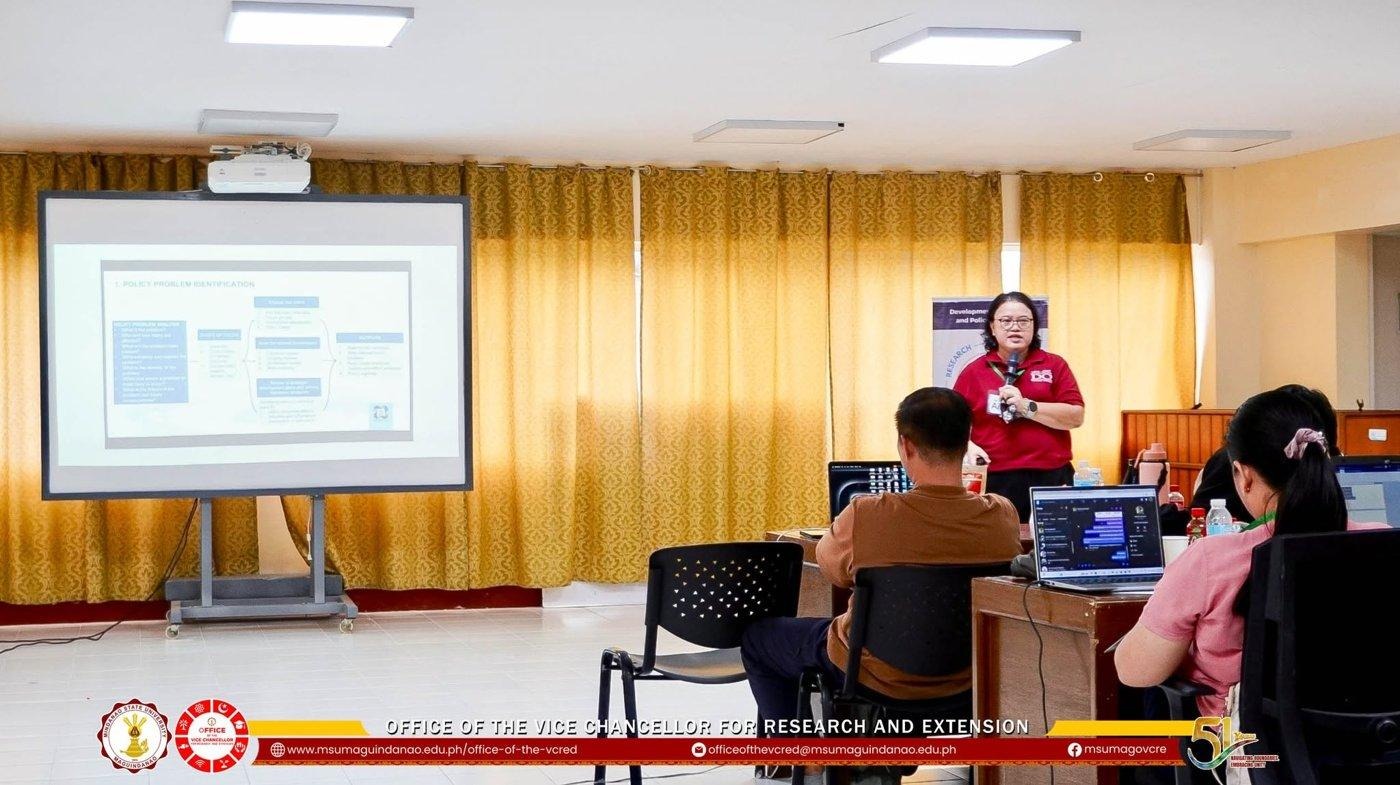
MSU–Maguindanao researchers complete DIP Lab policy research training and join six-team mentoring program
A Mindanao State University–Maguindanao (MSU–Maguindanao) research team completed a Training-Workshop on Policy Analysis and Research Proposal Development from September 1 to 4, 2025. The Development Innovations and Policy Laboratory (DIP Lab) organized the workshop with the University of Southern Mindanao Satellite Socio-Economic Research and Data Analytics Center (USM-SERDAC) and SOXAARRDEC, with experts from the University of the Philippines Los Baños (UPLB) serving as mentors.Led by the University’s Research Director, the team brought together faculty from the College of Public Affairs and Governance, the College of Fisheries, and the College of Agriculture, who developed concept notes on development issues in the Bangsamoro under the mentors’ guidance.A DIP Lab resource speaker delivers a session on policy analysis and research proposal development to MSU–Maguindanao researchers, September 2025.The MSU–Maguindanao team was then selected as one of six institutional teams accepted into DIP Lab’s continuing mentoring program. From September 2025 to January 2026, mentors worked with the researchers to refine their concept notes into full proposals for external research funding.MSU–Maguindanao researchers from governance, fisheries, and agriculture develop research proposals during the DIP Lab training-workshop.Through this collaboration with universities and research consortia, MSU–Maguindanao strengthens its capacity to generate evidence for development policy in BARMM and builds partnerships that share knowledge and expertise. The proposals address local challenges in governance, agriculture, and fisheries, supporting more responsive and evidence-based decision-making.The University aims to extend policy research mentoring to more colleges and turn the mentored proposals into funded research that informs policy in the Bangsamoro.
November 22, 2025MSU–Maguindanao Integrates Peace Education and Women, Peace and Security into Outcomes-Based Teaching and Learning in 2025
Mindanao State University–Maguindanao promotes meaningful and inclusive education through the integration of Peace Education and Women, Peace and Security (WPS) concepts into its Outcomes-Based Education (OBE) approach. This initiative reflects the University's commitment to providing students with learning experiences that go beyond academic knowledge by promoting peace, gender equality, cultural understanding, and social responsibility.As part of its teaching and learning practices, the University incorporates Peace Education and WPS objectives into outcomes-based course syllabi and instructional modules. Faculty members integrate these concepts into intended learning outcomes, lecture discussions, classroom activities, and assessment questions, allowing students to understand how peacebuilding, gender equality, and inclusive participation relate to their respective fields of study.Through this approach, peace education becomes part of everyday classroom learning rather than being discussed only during special programs or activities. Faculty members are encouraged to design lectures and learning tasks that connect academic concepts with real-life situations involving cultural diversity, peaceful conflict resolution, women's leadership, gender equality, and community development. Students are also given opportunities to examine social issues, share perspectives, and propose solutions that promote understanding, cooperation, and respect for others.The integration of Women, Peace and Security further emphasizes the important role of women in conflict prevention, peacebuilding, decision-making, and community development. By incorporating WPS-related objectives into instructional materials, the University helps students recognize the value of women's meaningful participation in building peaceful, safe, and inclusive communities.This educational practice is particularly relevant to the University's setting in the Bangsamoro Autonomous Region in Muslim Mindanao (BARMM), where peace, cultural diversity, and inclusive development are important considerations in education. Through classroom discussions and learning activities, students are encouraged to appreciate different cultural backgrounds, understand the challenges experienced by communities, and recognize their responsibilities in contributing to lasting peace and sustainable development.Through this continuing educational effort, MSU–Maguindanao seeks to develop graduates who are not only academically prepared and professionally competent but also socially responsible, culturally sensitive, and committed to promoting peace and sustainable development. The integration of these concepts into teaching and learning reinforces the University's role in preparing students to become positive contributors to their communities and society.
November 11, 2025