SDG2
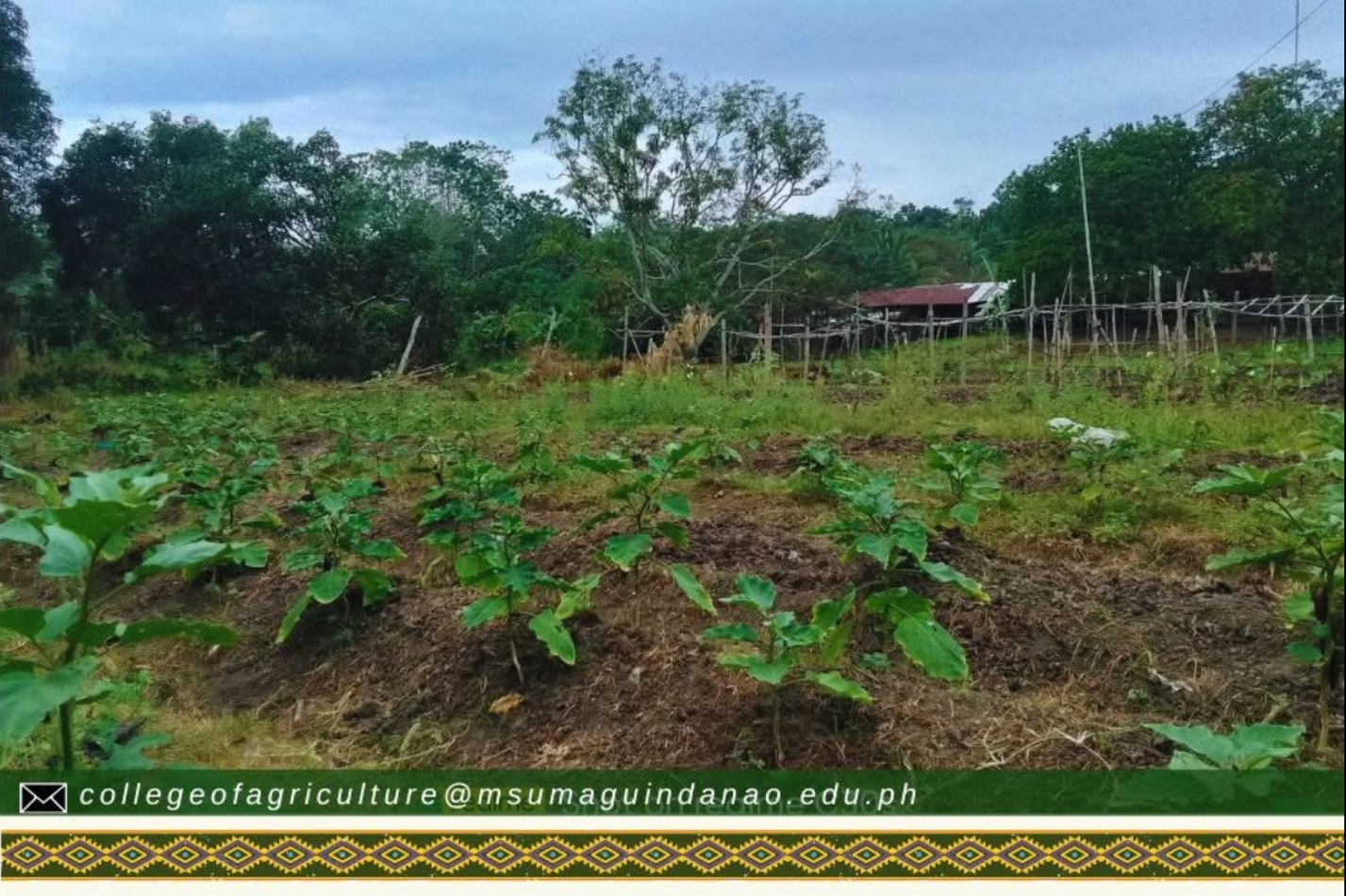
College of Agriculture Turns Campus Land into a Student Farm for Vegetable and High-Value Crop Production
MSU-MAGUINDANAO CAMPUS - The College of Agriculture of Mindanao State University-Maguindanao (MSU-Maguindanao) has designated a dedicated field laboratory and production area for Vegetable Production and High-Value Crops Production, giving students hands-on space to grow what they study in the classroom.Vegetable and production area within College of AgricultureThe initiative began with a coordination meeting led by College of Agriculture Dean Dr. Norhaya S. Tiago, together with University Income-Generating Project (IGP) Head Lemuel T. Embate, College Nursery Personnel Mohaimin Lumambas, and staff member Jemuel Sorbito, who identified potential sites and outlined how the areas would support instruction, research, extension, and production. A site validation and field inspection followed, led by Agriculture faculty member Nurjhon Subat and Horticulturist Ana Liza D. Latinang-Garcia, to assess land suitability before the areas were formally delineated for College use.The designated space now functions as a student field laboratory for Vegetable Production and High-Value Crops Production, giving students, faculty, and eventually nearby farmers access to a working site for crop production and applied research. Growing vegetables and high-value crops sustainably on these plots contributes to efforts to end hunger and ensure access to sufficient, safe, and nutritious food, while strengthening the productivity of small-scale food producers who can draw on the models and technologies the field laboratories are expected to generate.Rather than treat the land as passive infrastructure, MSU-Maguindanao is positioning it as a living laboratory that keeps producing competent graduates, applied research, and community-ready technologies well beyond this initial validation phase, carrying its impact from the classroom to farms across the region.
February 19, 2026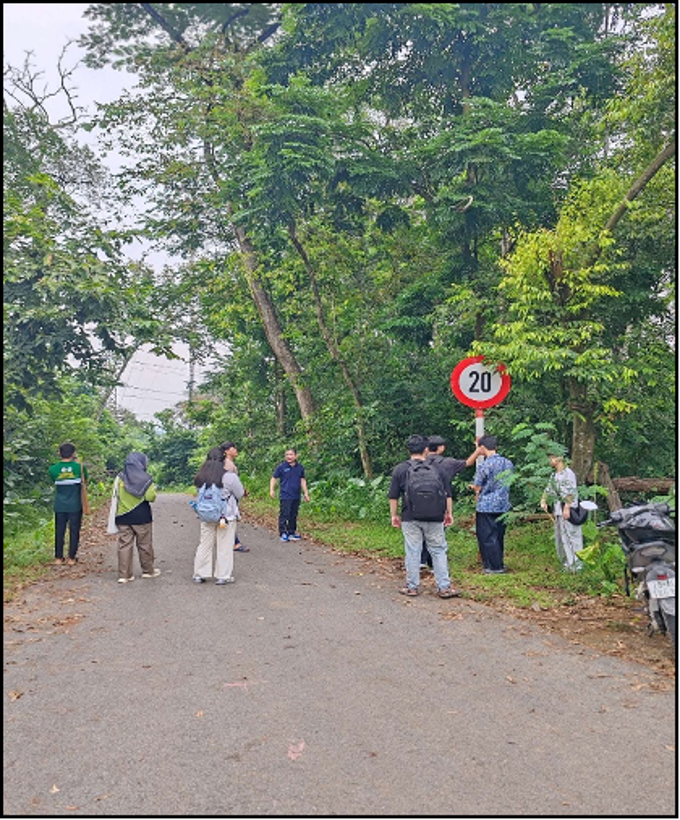
Collaboration with International Universities to Review Comparative Approaches and Develop Research-Based Best Practices for Sustainable Development
Five hundred Maguindanao residents surveyed with partners in Greece, 280 seaweed consumers interviewed with researchers in Türkiye and Malaysia, and biodiversity measurements shared at an international conference the University co-hosted show how Mindanao State University–Maguindanao participates in international collaboration on gathering and measuring data for sustainable development. Through joint research, international conferences, and exchange, its researchers collect field data in the Bangsamoro with international partners, measure it with shared methods, and make it available to the international scientific community.International Research CollaborationWith the Democritus University of Thrace in Greece, Peter Jan D. de Vera of MSU–Maguindanao measured how much the public values protecting the endangered long-tailed macaque, a primate that lives close to farms and settlements in Maguindanao. Conservation programs need to know whether residents will support protection, and how much they value it, before agencies can design and fund it. Working with Isshi Rayna Bel E. Paquingan and John Paul A. Catipay of Notre Dame University and Vasileios J. Kontsiotis and Vasilios Liordos of the Greek university, he surveyed 500 Maguindanao residents with approval from the MSU–Maguindanao Ethics Research Committee, asking how much each would be willing to pay every year to protect the species. The study, published in Environments (Vol. 12, Issue 12, Art. No. 467, 2025) with its dataset openly available, found an average willingness to pay of PHP 46.90 a year, or about PHP 10.5 million a year across the study area.A second collaboration, with researchers in Türkiye and Malaysia, gathered data on food and coastal livelihoods. Seaweed farming supports many families in Tawi-Tawi, but little had been recorded about how much seaweed local people eat and which species they use. Jonald C. Bornales of the College of Fisheries joined a 19-member team led by Albaris B. Tahiluddin that documented seaweed consumption in seven Tawi-Tawi municipalities: Bongao, Panglima Sugala, Simunul, Sitangkai, Sibutu, Tandubas, and South Ubian. Working under ethics approval OVCRE-ERC-004-2024-18 from the MSU–Maguindanao Research Ethics Committee, the team held 280 interviews and seven focus group discussions. It found that about 99 percent of respondents eat seaweed and identified 13 edible species (Phycology, Vol. 5, Issue 2, Art. No. 25, June 2025).The University also builds the skills to gather such data. Under a Memorandum of Understanding with the Vietnam National University of Forestry, the College of Forestry and Environmental Studies sent four BS Forestry students to Hanoi from August 11, 2025, when they were formally received by the university’s coordinators for international students, to October 5, 2025, for training in Natural Resources Ecology and Measurement and in Global Change Ecology: Impacts and Mitigation, learning field methods for ecological assessment that they can apply to forests in the Bangsamoro.BS Forestry students take part in a hands-on field activity during their exchange at the Vietnam National University of Forestry, Hanoi, August to October 2025.Co-hosting of Research ConferenceThe University also shares its measurements internationally. On July 23, 2025, it co-hosted the 4th Biennial Conference on Tropical Biodiversity with the Faculty of Forestry of Hasanuddin University in Indonesia, Tomsk Polytechnic University in Russia, Universiti Teknologi MARA in Malaysia, and the University of North Sumatra, held in Makassar and online. Ten University faculty researchers presented 13 studies, with field measurements of birds, epiphytes, tree species diversity, aboveground biomass and carbon stocks, the wood properties of native and fruit trees, and soil and water quality, along with assessments of land-use change, forest management for climate change, public attitudes toward conserving the Philippine brown deer, and residents’ willingness to pay for protecting two watersheds. The presenters were Sandra Samaon Akmad, Cindy Poclis, Kristine Joy Rendon, Adelene Lababo, Datulabi Untong Jr., Jayric Villareal, Mercedita Laurie, Peter Jan De Vera, Rolly James F. Cheng, and Rowena C. Benavides. One of these studies, a land use and land cover analysis of Datu Odin Sinsuat co-authored with researchers affiliated with Nanjing Forestry University in China, was published in IOP Conference Series: Earth and Environmental Science (Vol. 1553, 2025).MSU–Maguindanao faculty present biodiversity at the 4th Biennial Conference on Tropical Biodiversity, July 23, 2025.
December 29, 2025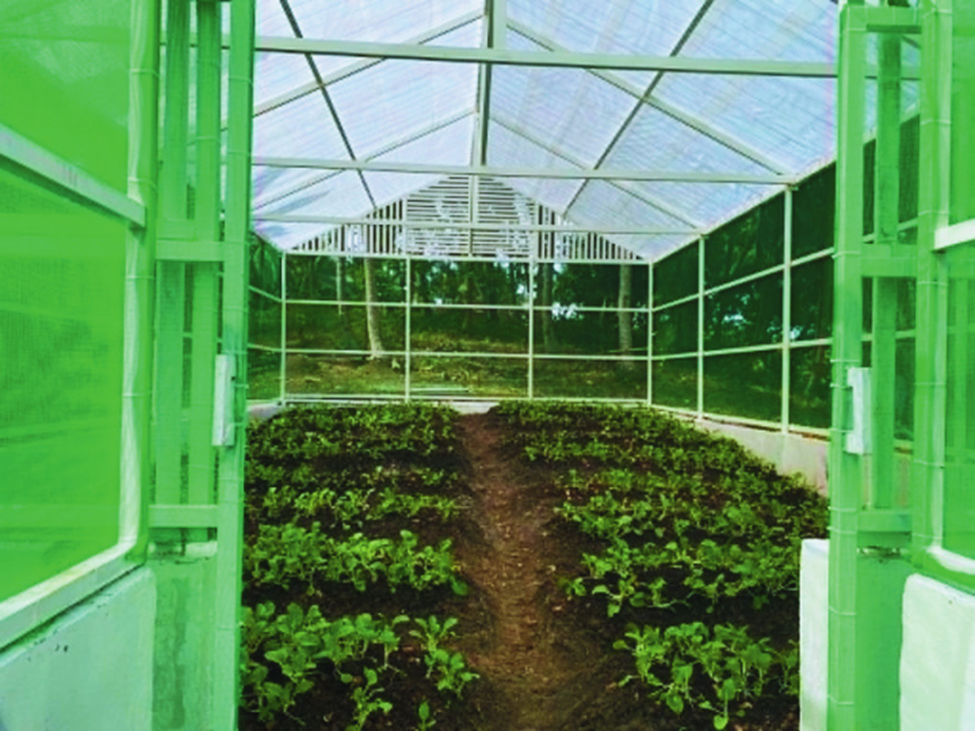
Seeds, Livestock and Farm Facilities Equip Camp Cooperatives for Sustainable Food Production
Partner-farmers in Camps Abubakar, Badre and Omar receive seedlings, soil test kits, livestock and agricultural technologies from MSU–Maguindanao. Greenhouses and livestock housing built within the camps complement these inputs, giving cooperatives access to production facilities at their community farming sites.The support forms part of an ongoing livelihood initiative funded by the Office of the Presidential Adviser on Peace, Reconciliation, and Unity (OPAPRU) under the MILF Camps Transformation Plan. Since July 2024, the initiative has reached 305 partner-farmers organized in cooperatives across Barira, Datu Odin Sinsuat and Datu Hoffer.The project is implemented by a multidisciplinary team of experts from the University’s College of Agriculture, College of Fisheries, College of Engineering and Computing Sciences, and College of Public Affairs and Governance. The team combines technical expertise with the provision of inputs, technologies and production facilities.Planting materials and crop production technologiesThe University supplies partner-farmers with seedlings, vegetable seeds, soil test kits, agricultural tools, organic fertilizers and other farm inputs. Distribution of agricultural inputs began in August 2024 and continued as the project developed production sites in the three camps.Vegetables grow inside the climate-smart greenhouse built for the Sigay Kutawato Women RTW Marketing Cooperative in Barangay Bugawas, Camp Badre.Project support included a climate-smart greenhouse for the Sigay Kutawato Women RTW Marketing Cooperative in Barangay Bugawas, Camp Badre, and another for the AL JAASUWS OFW Agri-Business Association in Camp Omar. Completed in March 2025, the Camp Omar greenhouse included hydroponics, vermibeds and a water system.In Camp Abubakar, the project reinforced the Calagan Women’s Marketing Cooperative’s greenhouse and established a nursery for strawberry seedlings. Partner-farmers have harvested eggplant, tomatoes, pechay, green chilies and cucumbers from the supported production sites.Livestock and facilities within the campsThe G.K. Village Togaig Farmers’ Marketing Cooperative in Camp Abubakar, Sif-Ku Producers Cooperative in Camp Badre, and Talibadok Kauyagan Farmers Marketing Cooperative in Camp Omar each received 10 goats and a climate-smart goat house. Pasture and forage areas complemented the livestock support, including one hectare planted with Napier grass and Madre de Agua in Camp Omar.A project official speaks (left) at the January 27, 2025 turnover of the climate-smart goat house for halal goat production built for the G.K. Village Togaig Farmers' Marketing Cooperative in Barangay Tugaig, Barira, Camp Abubakar, where the cooperative's goats are now housed on a slatted floor (right).The Matado Agrarian Reform Cooperative in Camp Badre and the Limpongo Women’s Organization in Camp Omar each received a climate-smart poultry house stocked with 100 ready-to-lay heritage chickens. The two Camp Abubakar cooperatives also received ready-to-lay heritage chickens and renovated poultry houses.Solar-powered incubators provided additional production technology, including a unit with a 216-egg setter delivered to Camp Badre in March 2025 to support local chick hatching.These inputs and facilities were provided free of charge through OPAPRU funding, allowing participating cooperatives to use them within their communities.Production outputs and access to University facilitiesFrom January to June 2025, the Limpongo poultry house averaged 30–40 eggs per day. Camp Abubakar flocks produced at least 25 eggs daily. These figures provide production data for monitoring the use and performance of the poultry facilities and livestock supplied.Members of the Limpongo Women's Organization and project officials cut the ribbon at the turnover ceremony of the climate-smart poultry house for halal poultry production, stocked with 100 ready-to-lay heritage chickens, in Barangay Limpongo, Camp Omar, January 2025.Alongside the facilities established in the camps, the University also provided access to its College of Agriculture goat and cattle facilities in Dalican. In 2025, farmers and agricultural technicians trained at these facilities through the FAO-funded Halal Livestock Farmer Field School and Demonstration Farm, extending access to University facilities for practical livestock learning.Planned follow-up support includes helping cooperatives establish feed banks for organic poultry feed and arranging regular animal health monitoring with veterinarians. These measures aim to sustain the livestock and production systems beyond the initial provision of inputs and facilities.
December 24, 2025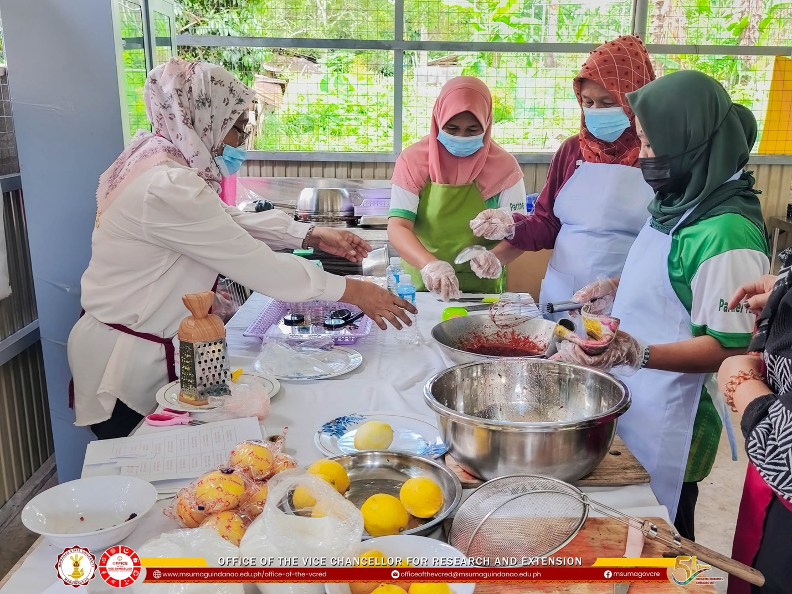
Women and Former Combatants Build Livelihoods through Farming and Food Processing in MILF Camps
For women’s cooperatives, former combatants, and their families in previously acknowledged Moro Islamic Liberation Front (MILF) Camps, livelihood support means having practical tools to grow food, process harvests, and manage community enterprises.In 2025, partner-farmers in Camps Abubakar, Badre and Omar received training, production facilities and farm inputs free of charge to support climate-smart crop, fish and livestock production. Through an Office of the Presidential Adviser on Peace, Reconciliation, and Unity (OPAPRU)-funded project implemented by MSU–Maguindanao, local farmers and food producers gained access to faculty expertise, practical skills and technologies for producing food and developing community enterprises.Ongoing since July 2024, the Agricultural Livelihood Support Project using science and technology-based mixed farming initiative has reached 305 partner-farmers in Maguindanao del Norte and Maguindanao del Sur, including women’s cooperative members and former combatants. Support combines agricultural and aquaculture training with food processing, branding, packaging, and cooperative management to help participants apply their skills across production and enterprise activities.Faculty members specializing in agronomy, animal science, and fisheries have provided training in climate-smart vegetable production, halal goat raising, organic poultry production, fish culture, and processing. Agricultural and biosystems engineering specialists have supported the development of production facilities, including greenhouses with drip irrigation, goat and poultry houses, fish cages and tanks, and solar-powered incubators. These facilities allow participants to put their training into practice.For women’s cooperatives, the support also creates opportunities to add value to agricultural products. Members have learned to prepare banana chips, sinamak, banana ketchup, strawberry jam, tilanggit, and Spanish-style hito. Training in branding and packaging complements food processing, helping members prepare products for sale.Women’s cooperative members in Partner Farmer aprons take part in a hands-on food processing session on jam making, part of the MSU–Maguindanao Agricultural Livelihood Support Project funded by OPAPRU.Faculty members in agribusiness management and sustainable community development have also provided financial and cooperative management training. These sessions help members understand how to manage funds, organize operations, and make decisions about sustaining their enterprises.Partner-farmers tend strawberry plants inside a net-covered greenhouse fitted with drip irrigation. The project built this facility so participants can practice climate-smart crop productionBy connecting farming, food processing, and cooperative enterprise, the project expands participants’ options for producing household food and developing sources of income within their communities.As the project moves into its scaling phase, continued technical assistance and production monitoring will support the cooperatives in strengthening operations, expanding facilities, and reaching wider markets.
December 23, 2025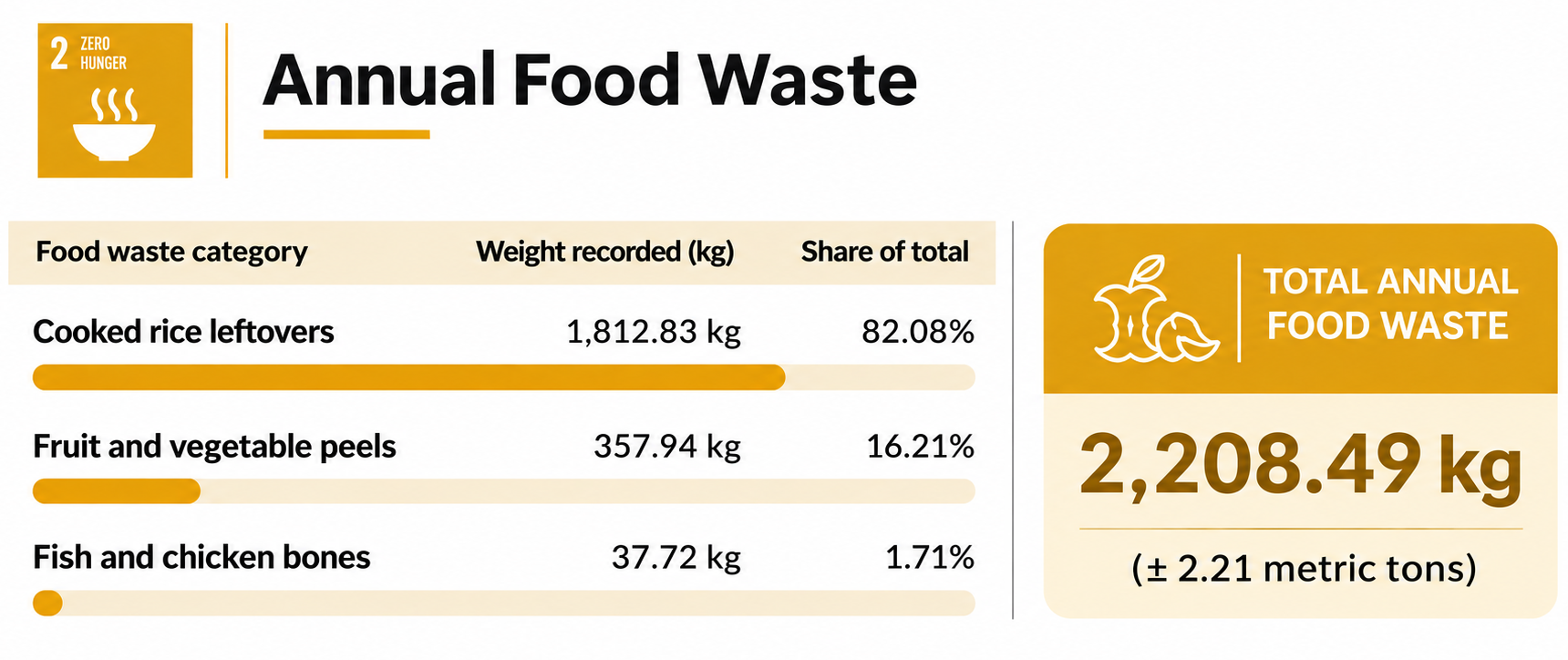
Annual Food Waste Assessment and Management at MSU-Maguindanao
A food waste assessment conducted at the University canteen of Mindanao State University–Maguindanao over 15 monitoring days in 2025 measured how much food waste the canteen generates and what that waste is made of. Carried out by BS Agricultural and Biosystems Engineering students in coordination with the canteen concessionaires, the assessment used direct weighing and waste composition analysis. After the vendors were oriented on their roles, food waste was collected using strainers at the two dishwashing areas of the canteen, weighed each afternoon, and classified into three categories: cooked-rice leftovers, fruit and vegetable peels, and fish and chicken bones.The assessment recorded 90.76 kilograms of food waste over the 15 days, an average of 6.05 kilograms per monitoring day. Projected over a full year, this corresponds to an estimated 2,208.49 kilograms (2.21 metric tons) of food waste from the canteen. Cooked-rice leftovers made up the largest share at 82.08 percent, or about 1,812.83 kilograms a year, followed by fruit and vegetable peels at 16.21 percent (357.94 kilograms) and fish and chicken bones at 1.71 percent (37.72 kilograms).Annual food waste generated by University Cafeteria by Category, with total weight and equivalent in metric tons.The dominance of cooked-rice leftovers points to serving portions, food preparation, and meal demand as the main sources of avoidable waste in the canteen. The relatively small overall volume also reflects existing food service arrangements, including the practice of some concessionaires bringing pre-processed or pre-cooked ingredients, which reduces preparation-related waste on campus, as well as students and personnel taking meals outside the canteen. Beyond establishing a baseline, the measured quantity and composition were used to determine the capacity of a biogas digester installed behind the canteen, and the collected food waste then served as feedstock to evaluate the digester's performance, linking waste measurement directly with an organic waste treatment option on campus.The assessment supports the University's Sustainability Policy, which requires cafeteria operators and food establishments on campus to minimize food waste (Article VII, Section 1). The 2025 canteen food waste baseline gives MSU–Maguindanao a documented starting point for planning waste prevention measures, assessing treatment capacity, and comparing subsequent measurements to determine changes in food waste generation.
December 22, 2025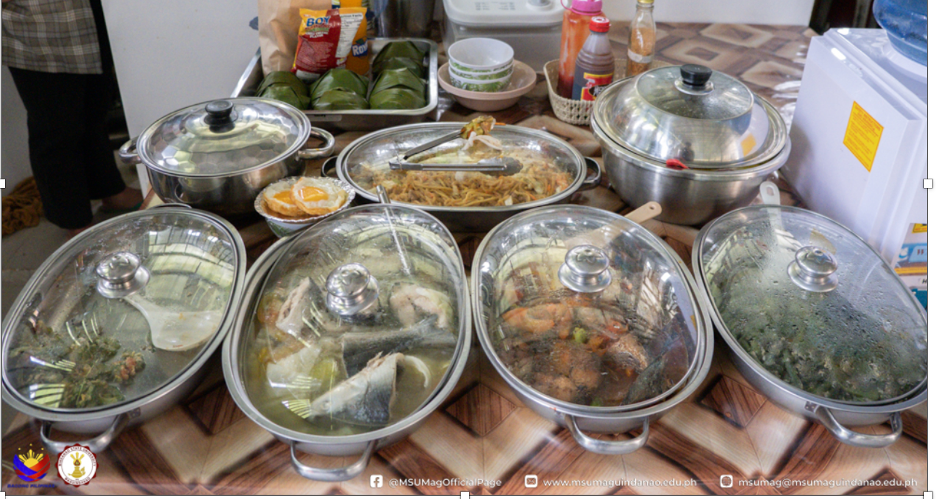
Budget-Friendly Canteen Meals Keep Healthy Food Within Reach
Every school day, eight canteen stalls at Mindanao State University–Maguindanao (MSU–Maguindanao) cook fresh meals for students, faculty, staff, and visitors, with a cup of rice at about ₱15 ($0.25) and a vegetable viand at about ₱25 ($0.42 USD), so a full meal costs around ₱40 ($0.68 USD). The University's Sustainability Policy directs it to "provide for affordable, healthy, and safe food options in canteens and cafes in the campus" (Article VII, Section 7), a rule that, under Article II, applies to every concessionaire operating on campus.Freshly cooked viands such as ampalaya with egg, fish, and noodle dishes are ready to serve at a campus canteen.Most meals are home-style dishes cooked daily: rice served with fried or stewed fish, vegetables, eggs, or chicken, and Maguindanaon favorites such as pastil. Pastil, steamed rice topped with shredded chicken or fish and wrapped in banana leaf, is one of the cheapest complete meals on campus, and both students and employees rely on it for a quick, filling meal between classes and work. Pastil, a traditional Maguindanaon meal consisting of steamed rice topped with seasoned shredded chicken, wrapped in banana leaves as a natural, biodegradable alternative to single-use plastic packaging.Snacks such as camote balls, turon, rice cakes, and siomai cost as little as ₱5 ($0.08) to ₱15($0.24). Prices are posted at the stalls, so diners know what a meal costs before they order.Because meals are cooked fresh each day and kept at low prices, students on tight budgets can eat a balanced, filling meal on campus instead of going hungry between classes.To make the healthiest choice on campus also the most affordable one, the University plans to work with its concessionaires on expanding fresh fruit and vegetable options at every stall.Article VII, Section 7 of the MSU–Maguindanao Sustainability Policy, which commits the University to uphold food security for students, faculty, and staff and to provide affordable, healthy, and safe food options on campus.
December 22, 2025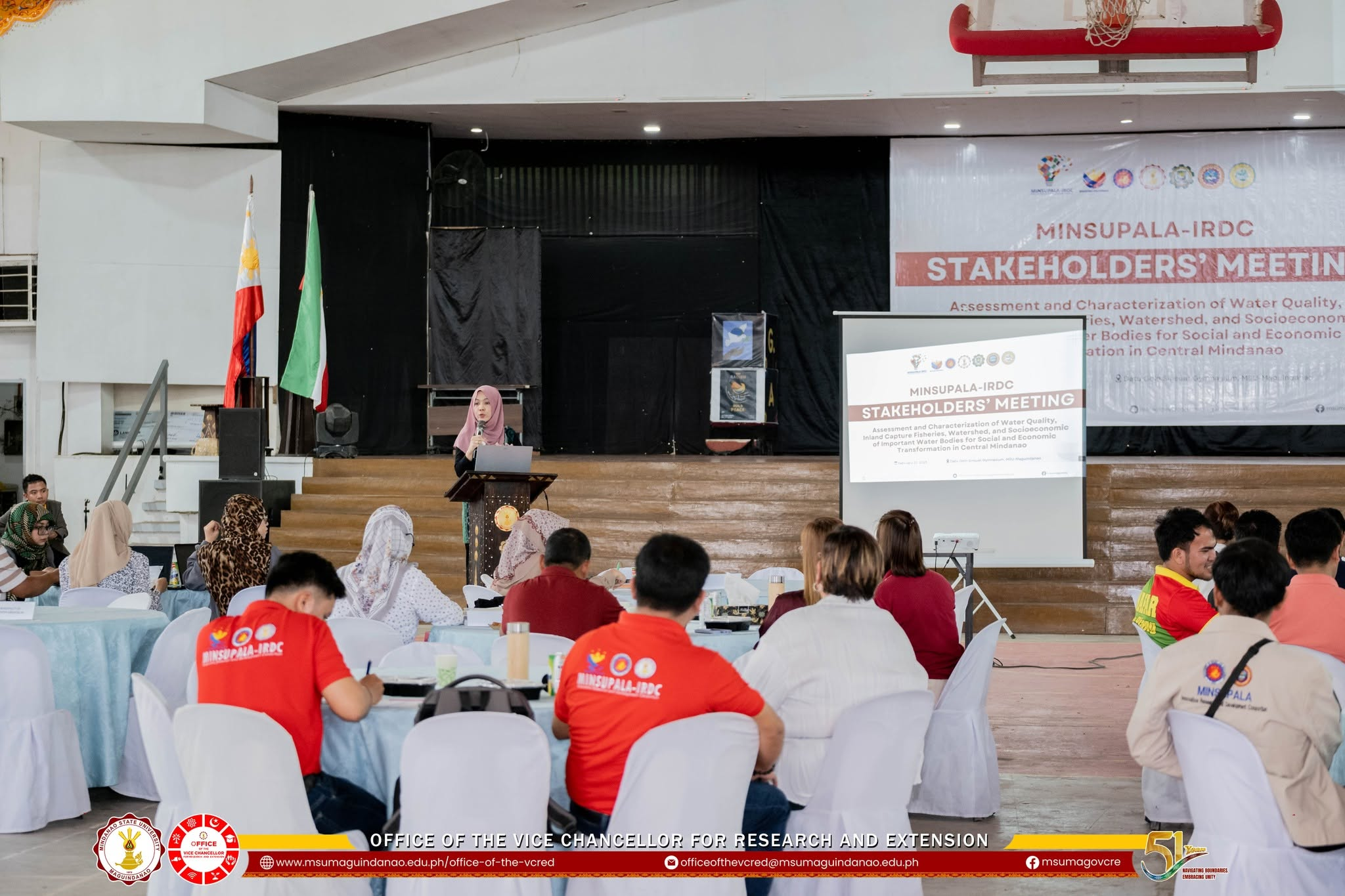
University Research Shapes Policy on Water, Peace Education, and Camp Livelihoods
Data on the water, fisheries, and livelihoods of 930 residents around Ligawasan Marsh became five policy recommendations that local governments validated in October 2025, as Mindanao State University–Maguindanao gave national and Bangsamoro government direct input into policy development on sustainable development, from identifying problems to monitoring interventions. Its research and extension teams helped the Department of Budget and Management (DBM), the Office of the Presidential Adviser on Peace, Reconciliation and Unity (OPAPRU), BARMM ministries, and local governments identify problems and challenges, develop policies and strategies, and monitor and report on interventions.Identifying Problems and ChallengesThe largest of these efforts runs through the Mindanao–Sulu–Palawan Innovative Research and Development Consortium (MinSuPala–IRDC), a network funded by the Department of Budget and Management (DBM) and led by MSU–Maguindanao. Local governments around the major water bodies of Central Mindanao had little local data on the condition of their rivers, marshes, and fisheries. In the consortium’s first phase, the University’s ₱5,000,000 (about US$87,300) component assessed water quality, inland capture fisheries, watershed conditions, and the livelihoods of 930 residents around Ligawasan Marsh, working with the Ministry of Environment, Natural Resources and Energy (MENRE), the Ministry of Agriculture, Fisheries and Agrarian Reform (MAFAR), and the local governments of Cotabato City, Kabuntalan, Northern Kabuntalan, Talitay, and Datu Piang, and produced five policy recommendations. The University then led Phase 2, “Establishment and Preservation of Indigenous Fish and Crop Products,” carried out by nine member institutions from January to December 2025. DBM funds each phase of the consortium’s work at ₱45,000,000 (about US$786,000), of which the University’s Phase 2 component received ₱10,000,000 (about US$174,700).The network itself has grown to reach more of the region. On November 13, 2023, at the Department of Budget and Management Region XI office in Davao City, MSU–Maguindanao and the existing members signed a Memorandum of Agreement admitting state universities and colleges in Sulu, Basilan, and Tawi-Tawi, extending the consortium’s research on the region’s waters and resources to the island provinces. The consortium now has 14 member state universities and colleges.The consortium first tested its findings with the agencies that would use them. On February 27, 2025, MSU–Maguindanao hosted the MinSuPala–IRDC Stakeholders’ Consultation, where research teams from MSU–Maguindanao, the University of Southern Mindanao–Kidapawan City Campus, Cotabato State University, and Adiong Memorial State College presented their assessments of water quality, fisheries, watershed conditions, and socio-economic conditions in Ligawasan Marsh, Lake Buluan, the Rio Grande de Mindanao, and Lake Lanao. Representatives of the Ministry of Agriculture, Fisheries and Agrarian Reform–BARMM, the Bangsamoro Planning and Development Authority, the Department of Science and Technology–PCAARRD, the Provincial Environment, Natural Resources and Energy Office of Maguindanao, environmental organizations, fisherfolk associations, and the local governments of Datu Piang, Talitay, Northern Kabuntalan, Cotabato City, Mangudadatu, and Sultan Kudarat discussed the findings, aligned them with local conservation and resource management plans, and helped shape the policy recommendations for conserving and managing these water bodies.Chancellor Limbona delivers her message to government agencies, local governments, and fisherfolk associations at the Stakeholders’ Consultation, Datu Odin Sinsuat Gymnasium, February 27, 2025.The University’s Phase 2 team is set out in Special Order No. 234, s. 2025, issued by Chancellor Bai Hejira Nefertiti M. Limbona on September 23, 2025. Dr. Raquel D. Santiago-Arenas serves as Project Coordinator over four projects: Nutritional Analysis, led by Asst. Prof. Always A. Germo; Market Potential and Value Chain Analysis, led by Asst. Prof. Irene S. Aquino; Agronomic Practices Assessment, led by Mr. Dominic B. Masecambo; and Establishment of Demo Farm and Knowledge Materials, led by Mr. John Louie C. Natan. Dr. Joel C. Arenas, Dr. Ramjie Y. Odin, and Engr. Bai Aljannah S. Macalandong served as a consultant.Developing Policies and StrategiesIn July 2025, the Phase 2 team led by Asst. Prof. Irene S. Aquino held coordination meetings with the five local governments and conducted key informant interviews with fisherfolk, farmers, and cooperatives to identify the native crops and fish most worth conserving. In October 2025, a team led by Mr. John Louie C. Natan, Study Leader of Inland Capture Fisheries, with technical support from Ms. Rhea Mae C. Talaron, presented the Phase 1 results and policy recommendations to each local government and its barangays. Cotabato City, under Mayor Mohammad Ali Matabalao, was represented by Agriculture Technologist Ms. Priyanka B. Saji-Sabpeten; Kabuntalan, under Mayor Datu Sharif Diocolano, by Municipal Administrator Mr. Efrel Oric Midtimbang; Datu Piang, under Mayor Victor Samama, by Executive Assistant Ms. Sherriejean S. Ampatuan; Talitay, under Mayor Sidik Amiril, by MAFAR Municipal Officer Mr. Dasib Mendato; and Northern Kabuntalan, under Mayor Datu Umbra Diocolano, by Administrator Mr. Allan Cando. Local officials, barangay representatives, and community members validated the findings and chose gabi (taro) and okra as priority crops, and haluan, native katipa, and popoyu as priority indigenous fish; each local government affirmed its readiness to work with the consortium on Phase 2.The MinSuPala–IRDC project page documents the DBM-funded work that MSU–Maguindanao leads with five Central Mindanao local governments, 2025The same steps, from identifying a problem to recommending a policy, guided a second project in the uplands. Funded by the Ministry of Science and Technology–BARMM with ₱1,199,418 (about US$20,950), it ran from June 2024 to July 2025 with MENRE and the LGU of Upi. The College of Forestry and Environmental Studies characterized the South Upi Forest Watershed and assessed its vulnerability to landslides, providing MENRE and the municipality with a watershed vulnerability map and policy recommendations for managing the area.Policy input also runs through national development agencies. On July 30, 2025, Chancellor Limbona, who chairs the consortium, and DBM Region XII Director Akmad J. Usman, its Executive Director, paid a courtesy visit to Secretary Leo Magno of the Mindanao Development Authority (MinDA) and held an exploratory meeting with Executive Director Janet M. Lopoz on working together on a Mindanao Forum on Waters and Natural Resources. MinDA Director III Olie B. Dagala of the Investment Promotions and Public Affairs Office and Chief Public Relations Officer Dr. Adrian Tamayo attended, with Vice Chancellor Raquel D. Santiago-Arenas and Ms. Aljannah Macalandong of the University. The meeting led to the 1st Mindanao Forum on Waters and Natural Resources in General Santos City from November 26 to 28, 2025, where the consortium turned over its Phase 1 reports and published books to Director Usman and DBM XII, moving its research from outputs to policy application.Chancellor Limbona and DBM Region XII Director Akmad J. Usman meet MinDA Secretary Leo Magno and Executive Director Janet M. Lopoz, July 30, 2025The University also gave the national legislature direct input on peace education policy. On September 16, 2025, Chancellor Limbona, with DWPS Technical Working Group Chairperson Grant Warren Lu and DWPS faculty members Dr. Arceli B. Naraga and Ms. Aljannah Macalandong, submitted the University’s position paper to the House Committee on Higher and Technical Education at its 2nd regular meeting, which deliberated on House Resolution No. 160 commending the MSU Board of Regents and MSU–Maguindanao for pioneering the Diploma in Women, Peace and Security. The position paper presented the program as a model of peace-oriented higher education that other institutions could replicate. Committee Chairperson Rep. Jude Acidre thanked the University for its work in peace education, and Vice Chairperson Rep. Eulogio R. Rodriguez sponsored the resolution for adoption. The resolution remains pending in the House.Chancellor Limbona submits the University’s position paper on the Diploma in Women, Peace and Security to the House Committee on Higher and Technical Education, September 16, 2025.Strategies also depend on the officials who carry them out. On August 12, 2025, at the Institute of Management, Chancellor Limbona and Regis Chapman, Representative and Country Director of the United Nations World Food Programme (WFP), signed a Memorandum of Agreement for a 2025–2027 partnership under which the University contributes experts in food systems, climate adaptation, and gender-responsive programming to help priority barangays prepare Local Climate Change Adaptation Plans and to strengthen farmer cooperatives, while WFP provides technical resources and exchange visits. Under this partnership, in September 2025, University extension staff Sarah Jane Mokamad, Lahmudin Abdulhadi, and Jona Fabay trained 30 MAFAR municipal officers and agricultural extension workers in a WFP-funded Training of Trainers. Each participant drafted a six-month action plan to strengthen farmer cooperatives in their municipality.Chancellor Bai Hejira Nefertiti M. Limbona and WFP Country Director Regis Chapman sign the 2025–2027 partnership on food security and climate resilience, Institute of Management, August 12, 2025.Monitoring and Reporting on InterventionsThe Humanitarian and Development Assistance Program (HDAP) was set up in 2016 under the former Autonomous Region in Muslim Mindanao to bring health, education, social welfare, infrastructure, livelihood, and governance projects to war-affected towns, and its unfinished projects passed to the Bangsamoro Planning and Development Authority (BPDA) after the transition to BARMM. College of Public Affairs and Governance faculty Tahir K. Salipada, Sajid P. Abdula, and Datuali Paguital Abdula evaluated the program with Khairon A. Sura of the BPDA. They surveyed 100 beneficiaries, 50 each in Mamasapano and Datu Saudi Ampatuan. They found that the program had an extensive impact on social services, economic services, and peace and governance, but that delivery was delayed by local peace and order conditions (Edelweiss Applied Science and Technology, Vol. 9, No. 6, 2025).For OPAPRU’s camp transformation program, part of the Normalization Track of the Comprehensive Agreement on the Bangsamoro, the University implemented ₱32.36 million (about US$565,200) in livelihood projects in Camps Badre, Omar, and Abubakar. In 2024, beneficiaries first completed a Values Transformation Training funded by the Bangsamoro Development Agency before their technical training. On June 18, 2025, with OPAPRU, the University turned over the Camp Abubakar projects, including a newly constructed kitchen facility for the Calagan Women’s Marketing Cooperative and the Gawad Kalinga Village Togaig Farmer’s Marketing Cooperative, supporting women-led enterprise and the reintegration of decommissioned combatants. Officials of the Office of the Special Assistant to the President, OPAPRU, and the Philippine Marine Corps, together with the municipal government of Barira and the Camp Abubakar MILF camp coordinators, witnessed the turnover. The community kitchens built in the other camps were completed in 2025 and are scheduled for turnover. After the training, the University holds Kamustahan sessions, follow-up check-ins with the cooperatives, as its mechanism for monitoring the projects, and it reports on them with OPAPRU and the Joint Task Forces on Camps Transformation. The newly turned over kitchen facility in Camp Abubakar, Barira, Maguindanao del Norte, on June 18, 2025.From Recommendations to Policy, and What Comes NextAs a result, five local governments now hold validated priorities for conserving their indigenous crops and fish, MENRE has a hazard map for the South Upi watershed, the regional planning authority has field evidence on why its assistance was delayed, and the House Committee on Higher and Technical Education has the University’s position on peace-oriented higher education. The consortium carries this work into Phase 3 in 2026, which will develop and market products from the priority crops and fish. Through its 2025–2027 partnership with WFP, the University will also continue to help priority barangays prepare local climate change adaptation plans, and its Kamustahan sessions will keep track of the camp livelihood projects so that they stay productive for the cooperatives that run them.
December 20, 2025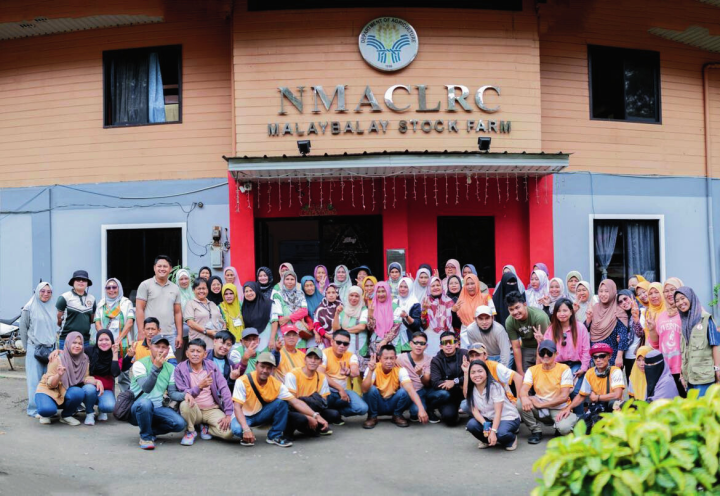
Farm Visits and Trade Fairs Open New Paths to Markets for Bangsamoro Farmers
Camp farmers in three former MILF camps have been learning as much from one another as from experts. Through dialogue sessions, farm-to-farm learning visits, and trade fairs, Mindanao State University–Maguindanao (MSU–Maguindanao) brings farmers and food producers from Camp Abubakar, Camp Badre, and Camp Omar together with fellow growers, specialists, and buyers. These gatherings are part of the University's Agricultural Livelihood Support Project for the MILF Camps Transformation Plan and involve cooperatives such as the Calagan Women's Marketing Cooperative and the G.K. Village Togaig Farmers' Marketing Cooperative.Regular Kamustahan sessions facilitated by the University bring cooperative members and project staff together to talk through progress, problems, and next steps, including sessions in Camp Omar in February 2025 and at Banwag Hall in Parang on April 25, 2025. Learning visits took farmers beyond their own fields: Camp Abubakar members spent three days in January 2025 at Binahon Agroforestry Farm, Umanika Eco-cultural Farm, and DA-NMACLRC in Bukidnon, while Camp Badre and Camp Omar members went on technology scouting in April 2025 at Esperanza Care Farm in Sultan Kudarat, Organikian Urban Farm in Koronadal City, and Saxonylyn Scientific Fishfarming and Zippora's Dairy Goat Farm in General Santos City, observing poultry, hydroponics, aquaculture, and dairy goat production.Members of the Calagan Women's Marketing Cooperative and the G.K. Village Togaig Farmers' Marketing Cooperative from Camp Abubakar visit the Department of Agriculture's Northern Mindanao Agricultural Crops and Livestock Research Complex (NMACLRC) Malaybalay Stock Farm in Bukidnon, January 2025.Partner-farmers from Camp Abubakar take a closer look at crops during the January 2025 learning visit to model farms in Bukidnon.Knowledge has also flowed the other way, as camp farmers walked the European Union Ambassador and Malaysian facilitators through their vegetable and fish farms. In March 2025, cooperative members shared their stories of struggle and success at the Women's Month culmination program on the University campus, and in June 2025, turnover and culmination programs in the camps gathered members and stakeholders to showcase each component's outputs. At the MAFAR Ramadhan Trade Fair+ and the 10th Philippine Halal Trade and Tourism Expo in Davao City, the women's cooperative met buyers face to face, giving small-scale food producers in the camps a direct route to markets and fresh ideas for value-added products.Looking ahead, the University will keep holding Kamustahan sessions and learning exchanges as the project moves into its next phases, while linking the cooperatives with more buyers and market outlets. Guided by a five-year roadmap that runs to 2030, these gatherings aim to grow the camp cooperatives into self-reliant enterprises whose experience other farming communities can learn from and replicate.
October 23, 2025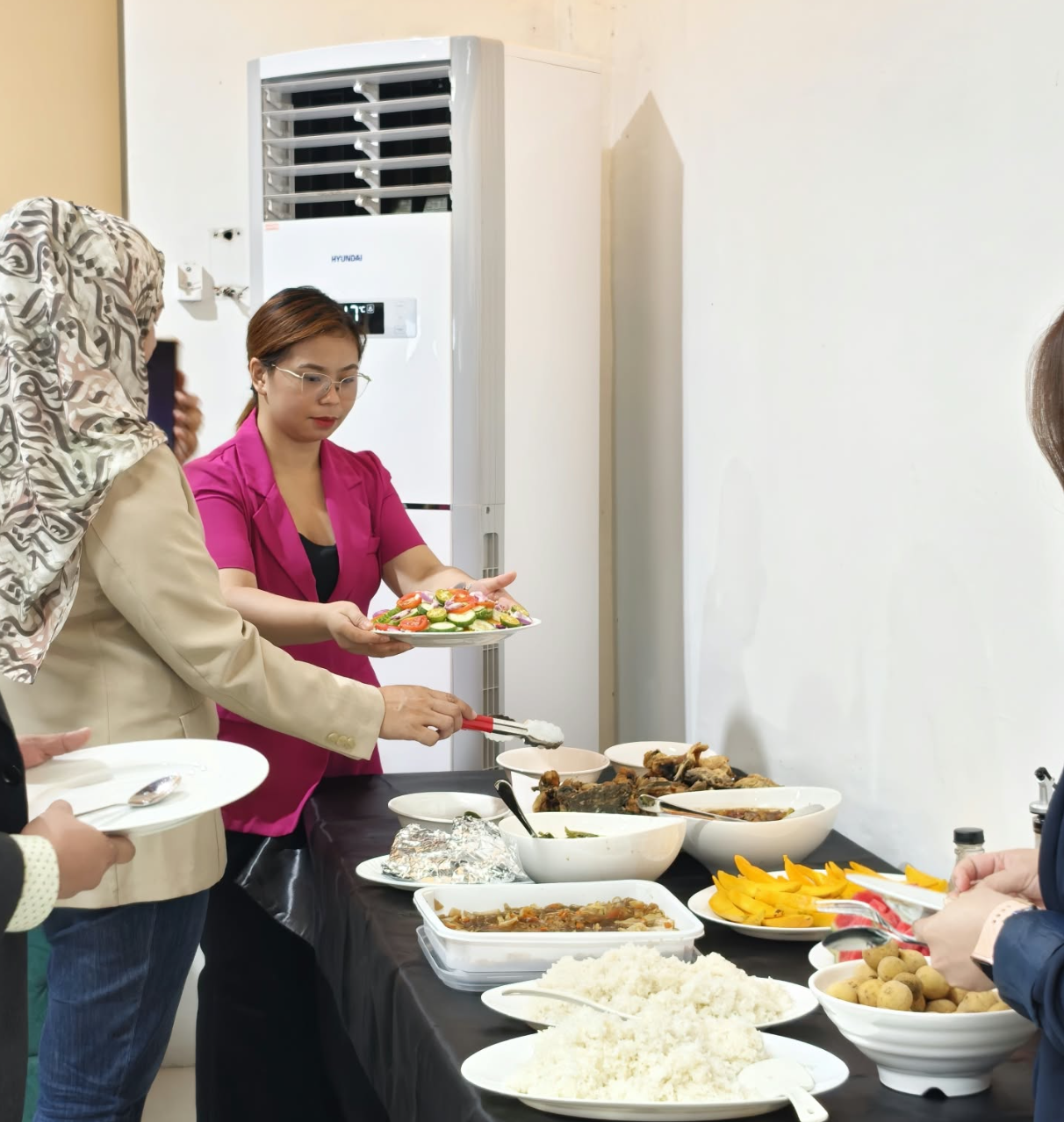
Free Meals at University Events and Office Pantries Support a Hunger-Free Workplace
Mindanao State University–Maguindanao (MSU–Maguindanao) considers the food security of its employees an essential part of its commitment to the welfare of the University community. Its Sustainability Policy directs the University to ensure that "food security and the overall well-being of academics, staff, and students are upheld on the campus" (Article VII, Section 7), a commitment that covers teaching and non-teaching personnel alike.In keeping with this commitment, the University provides free food to its employees during official meetings, seminars, and other University-related events. Faculty and staff who take part in these activities are served food at no cost, ensuring that personnel remain nourished and productive throughout their official engagements, including those that extend through mealtimes.Employees help themselves to a free meal of rice, fish, vegetables, and fresh fruit served during Office meetings.Beyond these activities, offices across the University maintain pantries that give employees access to food during the workday. These pantries allow faculty and staff to have something to eat without leaving the campus, supporting their well-being as they carry out their daily responsibilities.Faculty and staff gather as bananas, mangoes, boiled corn, and other dishes are laid out for free in the College of Education faculty lounge, giving employees ready access to food during the workday.These measures are complemented by affordable meals in the campus canteens, which keep nourishing food within reach of employees on ordinary workdays. Together, free food during institutional activities, office pantries, and low-cost canteen meals help prevent hunger among University personnel.Moving forward, the University aims to sustain the provision of free food during official activities and the upkeep of office pantries as part of its broader effort to promote employee well-being, so that no member of its workforce goes hungry while serving the University community.
October 23, 2025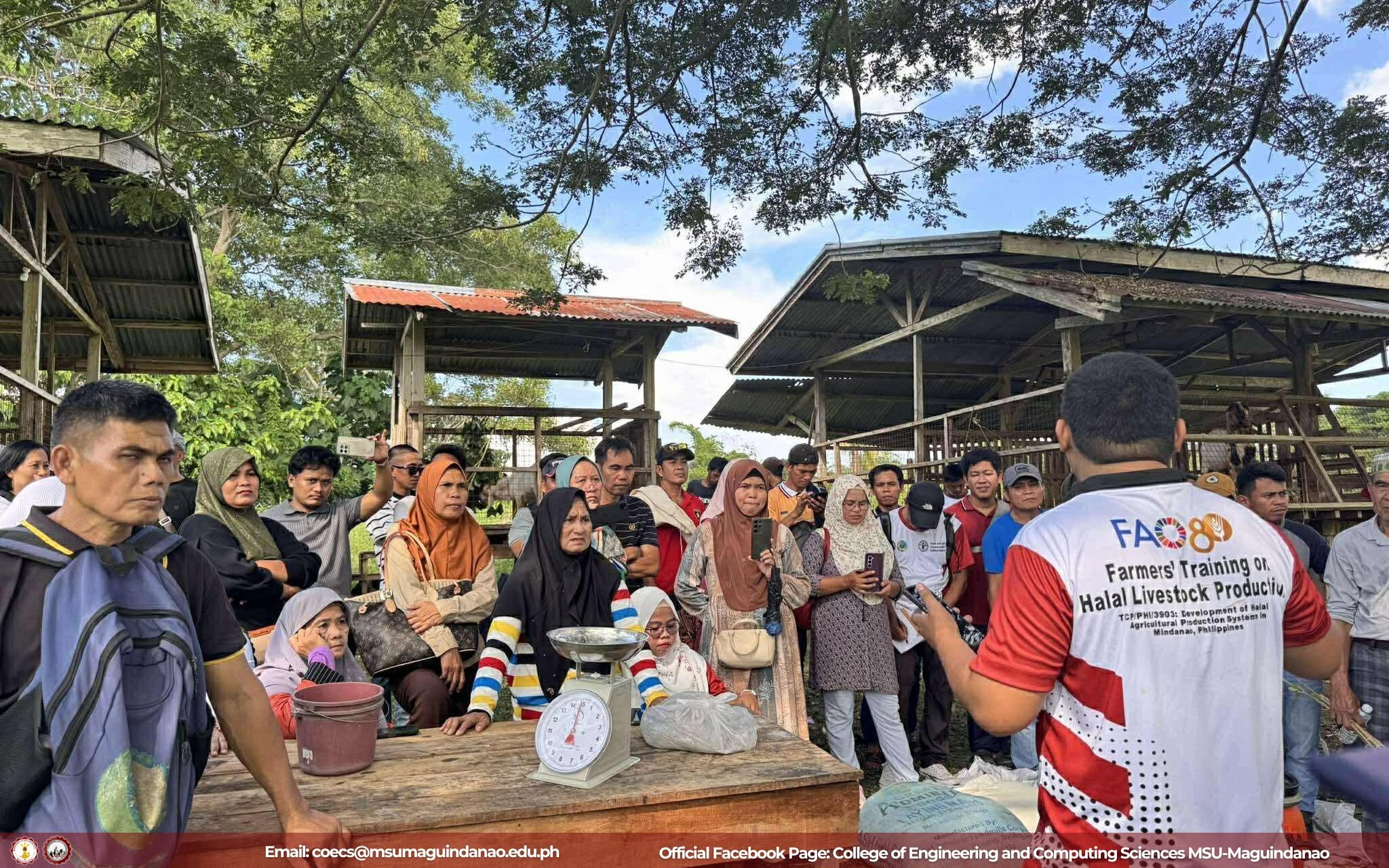
MSU-Maguindanao, FAO, and MAFAR Train Farmers in Halal Livestock Production in Dalican
DALICAN, Datu Odin Sinsuat, Maguindanao del Norte - Mindanao State University-Maguindanao (MSU-Maguindanao) opened a five-day Farmers' Training on Halal Livestock Production on October 2, 2025, jointly implemented by its College of Agriculture and College of Engineering and Computing Sciences, in partnership with the Food and Agriculture Organization of the United Nations (FAO) and the Ministry of Agriculture, Fisheries, and Agrarian Reform (MAFAR).Lecture session With FarmersThe training, held under the TCP/PHI/3903 Project on the Development of Halal Agricultural Production Systems in Mindanao, Phase II, combined lectures and hands-on practice in Halal herd management, biosecurity, feed formulation, and disease prevention, culminating in a Shariah-compliant slaughtering demonstration led by MSU-Maguindanao faculty and MAFAR agricultural specialists.Meat parts cutting demonstrationHealthier herds and safer, Halal-compliant meat production are the training's core aim, contributing to efforts to end hunger and ensure access to safe, nutritious, and sufficient food, while helping farmers in Bangsamoro communities increase their productivity and compete in Mindanao's expanding Halal market.The training reinforces MSU-Maguindanao's continuing role as a bridge between farmers, government agencies, and international development partners, with FAO and MAFAR support expected to sustain further rounds of training and certification for Halal producers across the region.
October 22, 2025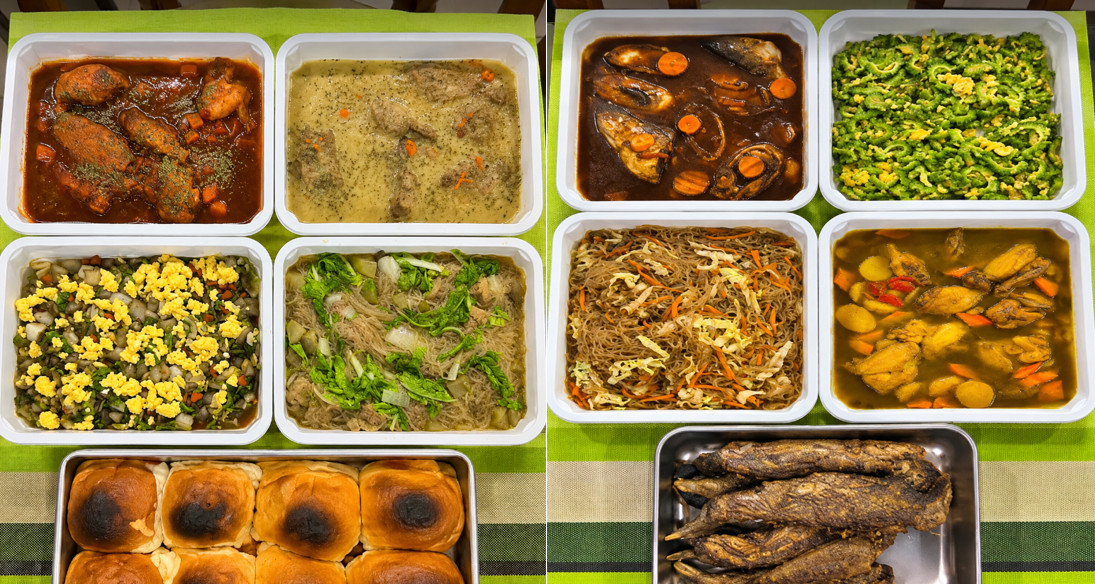
Campus Canteens Bring More Locally Grown Vegetable Dishes to the Table
Canteen stalls at Mindanao State University–Maguindanao (MSU–Maguindanao) serve vegetable dishes every day alongside meat and fish meals, so anyone on campus who prefers plant-based food always has something to choose. All food sold on campus is halal, in keeping with a campus community that is predominantly Muslim. The University's Sustainability Policy calls for campus food options "that have minimal impact on the environment" and directs the University to "promote the consumption of local and sustainably harvested food" (Article VII, Section 7).Vegetarian dishes on the daily menu include pinakbet, ginataang gulay, chop suey, sautéed eggplant, string beans, okra, and squash, stewed vegetables, and fresh salads. Chicken adobo, beef steak, fish dishes, and egg meals, along with native snacks such as banana cue and cassava balls, complete the selection.Vegetable dishes such as ampalaya with egg and sotanghon with pechay are served alongside chicken and fish viands at a campus canteen.Surrounded by farming communities, the campus sits close to the rice, vegetables, root crops, and legumes that fill these dishes. Concessionaires buy much of their produce from local growers in nearby barangays such as Makir and Dados and from the Dalican Public Market, where farmers from surrounding communities sell their harvest. Many of these vegetables are grown without synthetic pesticides or chemical fertilizers, so the dishes served on campus are both fresh and safe to eat. Plant-based meals made from these crops carry a smaller environmental footprint than meat-heavy ones, and keeping them affordable makes the sustainable choice an easy one for students on tight budgets.Moving forward, the University aims to work with its canteen concessionaires on clearly labeling vegetarian dishes at every stall and on linking them with farmer cooperatives assisted by the University, so that more of the produce served on campus comes straight from local growers.Article VII, Section 7 of the MSU–Maguindanao Sustainability Policy, which calls for campus food options with minimal impact on the environment and promotes the consumption of local and sustainably harvested food.
October 22, 2025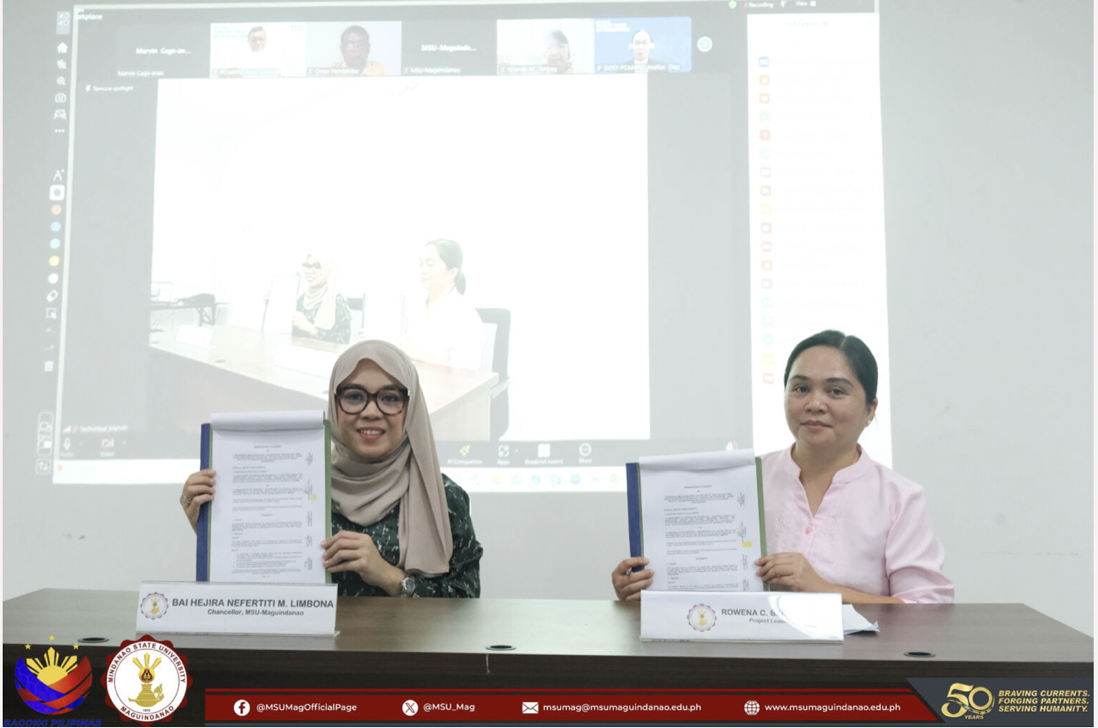
MSU-Maguindanao, DOST-PCAARRD Seal ₱5-Million Agreement for Climate-Resilient Agroforestry Project in Datu Blah Sinsuat
TAMONTAKA, Maguindanao del Norte — Mindanao State University-Maguindanao (MSU-Maguindanao) formalized a partnership with the Technology Transfer and Promotion Division (TTPD) of the Department of Science and Technology–Philippine Council for Agriculture, Aquatic and Natural Resources Research and Development (DOST-PCAARRD) through a virtual Memorandum of Agreement (MOA) signing held at Simeon Datumanong Hall, Institute of Management, Tamontaka, Maguindanao del Norte.MSU-Maguindanao Chancellor Bai Hejira Nefertiti M. Limbona and CFES Dean Dr. Rowena C. Benavides during the virtual MOA signingThe agreement formally launched “Enhancing Climate Resilience through Native and Fruit Tree-Based Agroforestry Technology: A Science and Technology-Based Initiative for Emergencies and Hazards,” a two-year-and-six-month project running until December 2026 in Datu Blah Sinsuat, Maguindanao, backed by ₱5 million in funding from DOST-PCAARRD.Led by Dr. Rowena C. Benavides, Dean of the College of Forestry and Environmental Studies (CFES), the project aims to rehabilitate 10 hectares of degraded land, establish two community nurseries, and produce native and fruit tree seedlings to advance climate-resilient agroforestry. This initiative is expected to provide farmers, land owners, and vulnerable communities in DBS access to additional food source. Through the establishment of productive agroforestry systems, the project contributes to efforts to end hunger and ensure access to sufficient, safe, and nutritious food throughout the year, while strengthening communities’ capacity to adapt to climate-related challenges.The initiative further reflects the University’s broader commitment to advancing food security and sustainable livelihoods among communities in the Bangsamoro. It reinforces MSU-Maguindanao’s continuing role as a research, innovation, and community development partner in the Bangsamoro Autonomous Region in Muslim Mindanao (BARMM), particularly in supporting vulnerable communities through climate-resilient and sustainable agricultural practices.
October 19, 2025