SDG17
Partnerships for the Goals
Strengthen the means of implementation and revitalize the Global Partnership for Sustainable Development.
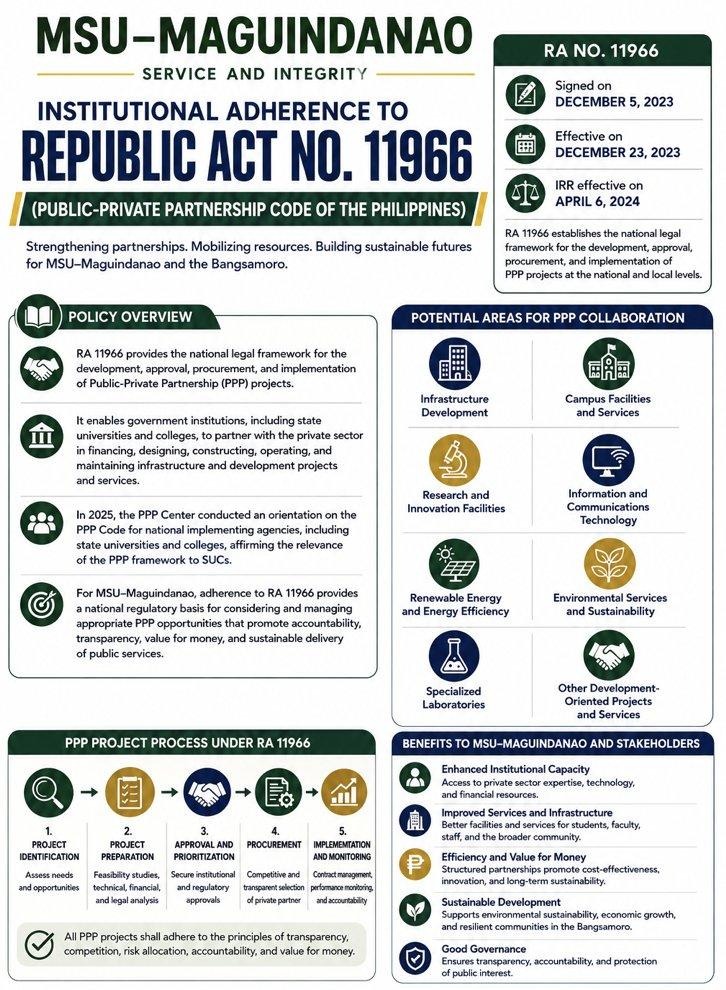
Institutional Adherence to Republic Act No. 11966
Mindanao State University–Maguindanao adheres to Republic Act No. 11966, the Public-Private Partnership (PPP) Code of the Philippines, as its framework for partnerships with the private sector. Signed on December 5, 2023, with its Implementing Rules and Regulations in effect since April 6, 2024, the law governs the development, approval, procurement, and implementation of PPP projects by government institutions, including state universities and college.Mindanao State University–Maguindanao institutional material on its adherence to Republic Act No. 11966, outlining potential areas for public-private collaboration and the PPP project processBefore pursuing a proposed private-sector partnership, University leadership and the offices responsible for planning and development, finance and administration, legal affairs, procurement, physical facilities, and research and innovation determine whether it qualifies as a PPP under the Code. Qualifying proposals undergo feasibility, technical, financial, legal, and environmental assessment before approval and remain under University oversight through implementation. Priority areas include campus infrastructure, research and innovation facilities, information and communications technology, renewable energy, and specialized laboratories.The University encourages effective public-private partnerships that draw on the experience and resourcing strategies of its partners and comply with the Code’s requirements for transparency, accountability, and value for money in the use of public resources. Such partnerships can expand quality, reliable, and sustainable infrastructure for teaching and research in the Bangsamoro. Public-Private Partnership Center of the Philippines reference page for Republic Act No. 11966 and its Implementing Rules and Regulations.Mindanao State University–Maguindanao is committed to applying the Code to future infrastructure, technology, and research partnerships and strengthening the capacity of its offices to manage them
December 31, 2025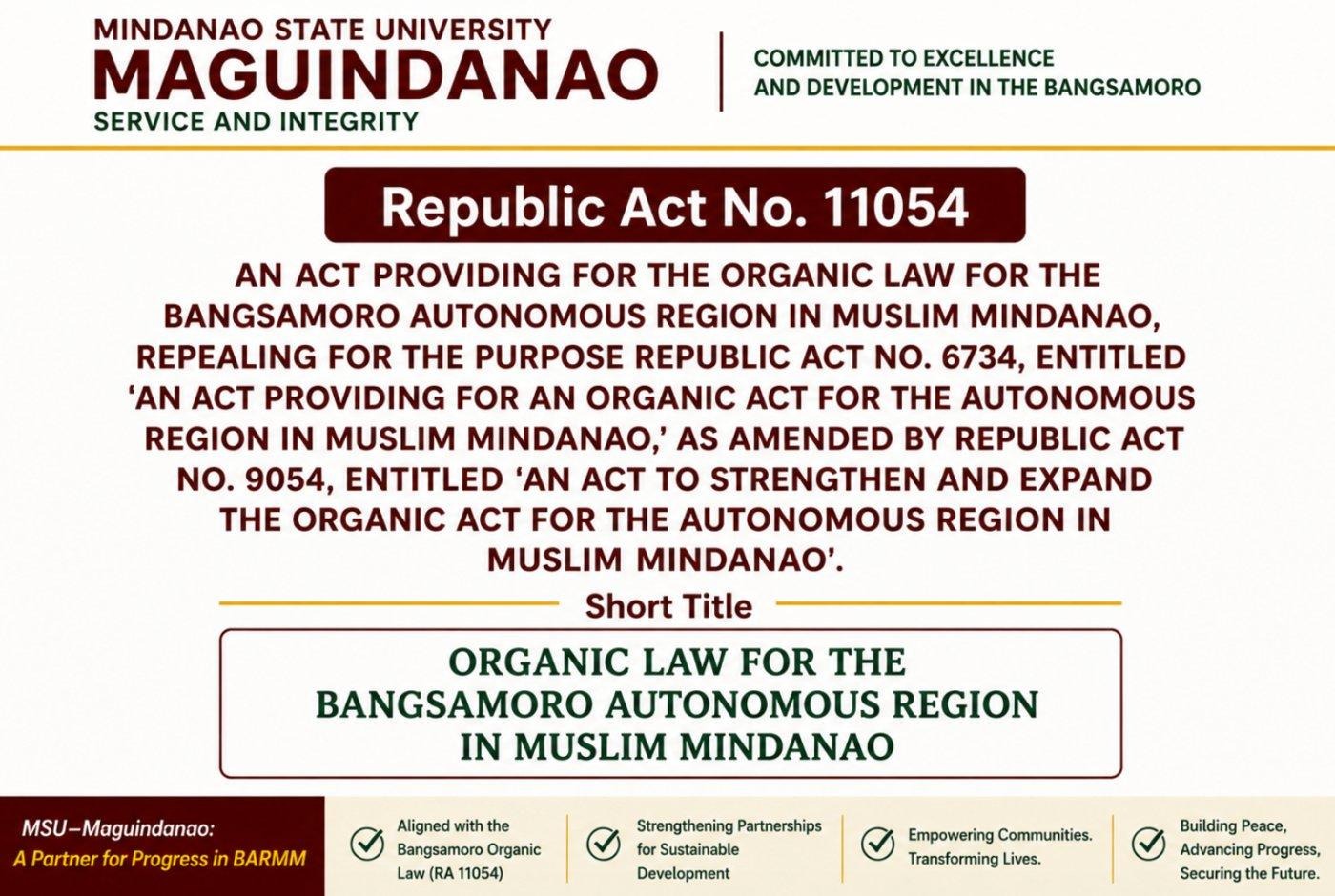
Institutional Alignment with Republic Act No. 11054 (Bangsamoro Organic Law)
Mindanao State University–Maguindanao upholds Republic Act No. 11054, the Organic Law for the Bangsamoro Autonomous Region in Muslim Mindanao, as a guiding framework for its instruction, research, extension, and partnerships. The law directs the National Government to continue to support, enhance, and strengthen the Mindanao State University System (Article IX, Section 16) and calls on the Bangsamoro Government to give priority to science, research, and technology education (Article IX, Section 21).Mindanao State University–Maguindanao institutional material on its alignment with Republic Act No. 11054, presenting the University as a partner for progress in BARMM.The University puts this commitment into practice through formal partnerships and joint work with national and regional institutions. In 2025, it turned over livelihood projects to ten cooperatives in Camps Omar, Abubakar, and Badre with the Office of the Presidential Adviser on Peace, Reconciliation and Unity in support of the Bangsamoro peace process; presented research-based policy recommendations to five Bangsamoro local governments through the MinSuPala–IRDC consortium; coordinated with the Ministry of Environment, Natural Resources and Energy on the 1,894-hectare South Upi Watershed Forest Reserve; and evaluated a regional assistance program with the Bangsamoro Planning and Development Authority.The University’s commitment to the Bangsamoro Organic Law strengthens public and civil society partnerships and promotes greater policy coherence between national and regional governments, contributing to more responsive, inclusive, and participatory decision-making in the region.Mindanao State University–Maguindanao will continue to align its programs and research priorities with the Bangsamoro Organic Law and expand its partnerships with BARMM ministries, local governments, and Indigenous Peoples communitie
December 31, 2025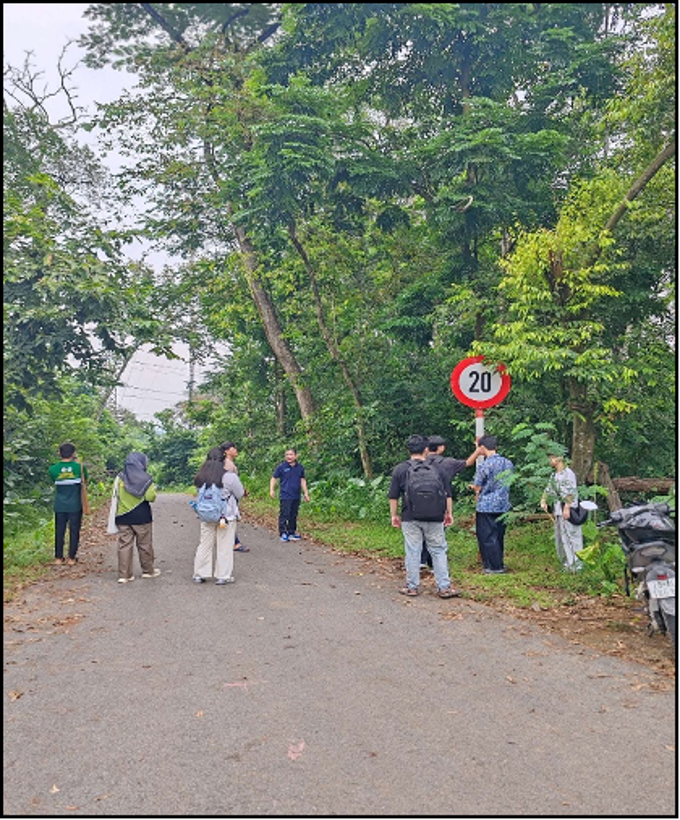
Collaboration with International Universities to Review Comparative Approaches and Develop Research-Based Best Practices for Sustainable Development
Five hundred Maguindanao residents surveyed with partners in Greece, 280 seaweed consumers interviewed with researchers in Türkiye and Malaysia, and biodiversity measurements shared at an international conference the University co-hosted show how Mindanao State University–Maguindanao participates in international collaboration on gathering and measuring data for sustainable development. Through joint research, international conferences, and exchange, its researchers collect field data in the Bangsamoro with international partners, measure it with shared methods, and make it available to the international scientific community.International Research CollaborationWith the Democritus University of Thrace in Greece, Peter Jan D. de Vera of MSU–Maguindanao measured how much the public values protecting the endangered long-tailed macaque, a primate that lives close to farms and settlements in Maguindanao. Conservation programs need to know whether residents will support protection, and how much they value it, before agencies can design and fund it. Working with Isshi Rayna Bel E. Paquingan and John Paul A. Catipay of Notre Dame University and Vasileios J. Kontsiotis and Vasilios Liordos of the Greek university, he surveyed 500 Maguindanao residents with approval from the MSU–Maguindanao Ethics Research Committee, asking how much each would be willing to pay every year to protect the species. The study, published in Environments (Vol. 12, Issue 12, Art. No. 467, 2025) with its dataset openly available, found an average willingness to pay of PHP 46.90 a year, or about PHP 10.5 million a year across the study area.A second collaboration, with researchers in Türkiye and Malaysia, gathered data on food and coastal livelihoods. Seaweed farming supports many families in Tawi-Tawi, but little had been recorded about how much seaweed local people eat and which species they use. Jonald C. Bornales of the College of Fisheries joined a 19-member team led by Albaris B. Tahiluddin that documented seaweed consumption in seven Tawi-Tawi municipalities: Bongao, Panglima Sugala, Simunul, Sitangkai, Sibutu, Tandubas, and South Ubian. Working under ethics approval OVCRE-ERC-004-2024-18 from the MSU–Maguindanao Research Ethics Committee, the team held 280 interviews and seven focus group discussions. It found that about 99 percent of respondents eat seaweed and identified 13 edible species (Phycology, Vol. 5, Issue 2, Art. No. 25, June 2025).The University also builds the skills to gather such data. Under a Memorandum of Understanding with the Vietnam National University of Forestry, the College of Forestry and Environmental Studies sent four BS Forestry students to Hanoi from August 11, 2025, when they were formally received by the university’s coordinators for international students, to October 5, 2025, for training in Natural Resources Ecology and Measurement and in Global Change Ecology: Impacts and Mitigation, learning field methods for ecological assessment that they can apply to forests in the Bangsamoro.BS Forestry students take part in a hands-on field activity during their exchange at the Vietnam National University of Forestry, Hanoi, August to October 2025.Co-hosting of Research ConferenceThe University also shares its measurements internationally. On July 23, 2025, it co-hosted the 4th Biennial Conference on Tropical Biodiversity with the Faculty of Forestry of Hasanuddin University in Indonesia, Tomsk Polytechnic University in Russia, Universiti Teknologi MARA in Malaysia, and the University of North Sumatra, held in Makassar and online. Ten University faculty researchers presented 13 studies, with field measurements of birds, epiphytes, tree species diversity, aboveground biomass and carbon stocks, the wood properties of native and fruit trees, and soil and water quality, along with assessments of land-use change, forest management for climate change, public attitudes toward conserving the Philippine brown deer, and residents’ willingness to pay for protecting two watersheds. The presenters were Sandra Samaon Akmad, Cindy Poclis, Kristine Joy Rendon, Adelene Lababo, Datulabi Untong Jr., Jayric Villareal, Mercedita Laurie, Peter Jan De Vera, Rolly James F. Cheng, and Rowena C. Benavides. One of these studies, a land use and land cover analysis of Datu Odin Sinsuat co-authored with researchers affiliated with Nanjing Forestry University in China, was published in IOP Conference Series: Earth and Environmental Science (Vol. 1553, 2025).MSU–Maguindanao faculty present biodiversity at the 4th Biennial Conference on Tropical Biodiversity, July 23, 2025.
December 29, 2025Progress and Info
Strengthen the means of implementation and revitalize the Global Partnership for Sustainable Development.
Partnerships for the Goals