SDG15
Life on Land
Protect, restore and promote sustainable use of terrestrial ecosystems, sustainably manage forests, combat desertification, and halt and reverse land degradation and halt biodiversity loss.
Collaboration with International Universities to Review Comparative Approaches and Develop Research-Based Best Practices for Sustainable Development
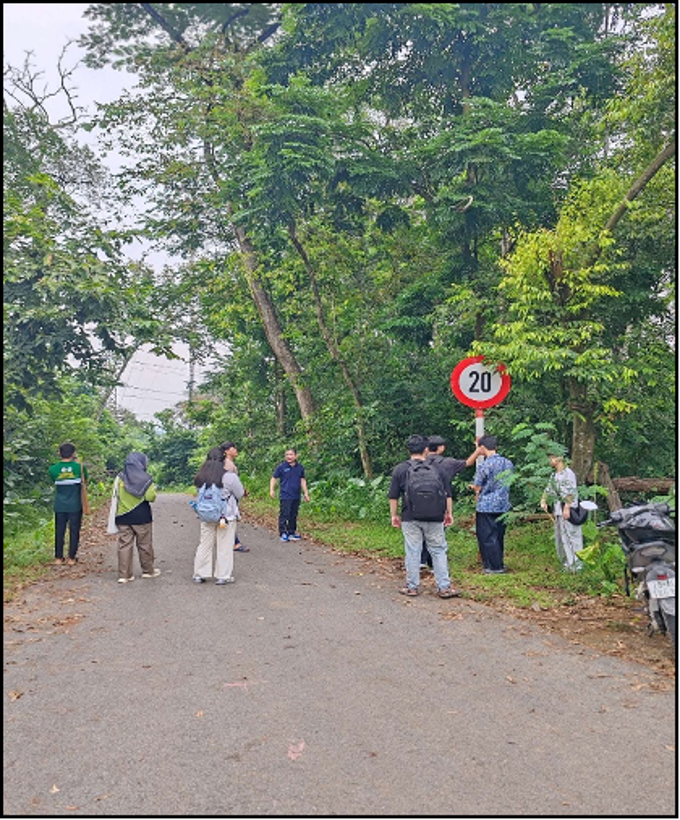
Five hundred Maguindanao residents surveyed with partners in Greece, 280 seaweed consumers interviewed with researchers in Türkiye and Malaysia, and biodiversity measurements shared at an international conference the University co-hosted show how Mindanao State University–Maguindanao participates in international collaboration on gathering and measuring data for sustainable development. Through joint research, international conferences, and exchange, its researchers collect field data in the Bangsamoro with international partners, measure it with shared methods, and make it available to the international scientific community.International Research CollaborationWith the Democritus University of Thrace in Greece, Peter Jan D. de Vera of MSU–Maguindanao measured how much the public values protecting the endangered long-tailed macaque, a primate that lives close to farms and settlements in Maguindanao. Conservation programs need to know whether residents will support protection, and how much they value it, before agencies can design and fund it. Working with Isshi Rayna Bel E. Paquingan and John Paul A. Catipay of Notre Dame University and Vasileios J. Kontsiotis and Vasilios Liordos of the Greek university, he surveyed 500 Maguindanao residents with approval from the MSU–Maguindanao Ethics Research Committee, asking how much each would be willing to pay every year to protect the species. The study, published in Environments (Vol. 12, Issue 12, Art. No. 467, 2025) with its dataset openly available, found an average willingness to pay of PHP 46.90 a year, or about PHP 10.5 million a year across the study area.A second collaboration, with researchers in Türkiye and Malaysia, gathered data on food and coastal livelihoods. Seaweed farming supports many families in Tawi-Tawi, but little had been recorded about how much seaweed local people eat and which species they use. Jonald C. Bornales of the College of Fisheries joined a 19-member team led by Albaris B. Tahiluddin that documented seaweed consumption in seven Tawi-Tawi municipalities: Bongao, Panglima Sugala, Simunul, Sitangkai, Sibutu, Tandubas, and South Ubian. Working under ethics approval OVCRE-ERC-004-2024-18 from the MSU–Maguindanao Research Ethics Committee, the team held 280 interviews and seven focus group discussions. It found that about 99 percent of respondents eat seaweed and identified 13 edible species (Phycology, Vol. 5, Issue 2, Art. No. 25, June 2025).The University also builds the skills to gather such data. Under a Memorandum of Understanding with the Vietnam National University of Forestry, the College of Forestry and Environmental Studies sent four BS Forestry students to Hanoi from August 11, 2025, when they were formally received by the university’s coordinators for international students, to October 5, 2025, for training in Natural Resources Ecology and Measurement and in Global Change Ecology: Impacts and Mitigation, learning field methods for ecological assessment that they can apply to forests in the Bangsamoro.BS Forestry students take part in a hands-on field activity during their exchange at the Vietnam National University of Forestry, Hanoi, August to October 2025.Co-hosting of Research ConferenceThe University also shares its measurements internationally. On July 23, 2025, it co-hosted the 4th Biennial Conference on Tropical Biodiversity with the Faculty of Forestry of Hasanuddin University in Indonesia, Tomsk Polytechnic University in Russia, Universiti Teknologi MARA in Malaysia, and the University of North Sumatra, held in Makassar and online. Ten University faculty researchers presented 13 studies, with field measurements of birds, epiphytes, tree species diversity, aboveground biomass and carbon stocks, the wood properties of native and fruit trees, and soil and water quality, along with assessments of land-use change, forest management for climate change, public attitudes toward conserving the Philippine brown deer, and residents’ willingness to pay for protecting two watersheds. The presenters were Sandra Samaon Akmad, Cindy Poclis, Kristine Joy Rendon, Adelene Lababo, Datulabi Untong Jr., Jayric Villareal, Mercedita Laurie, Peter Jan De Vera, Rolly James F. Cheng, and Rowena C. Benavides. One of these studies, a land use and land cover analysis of Datu Odin Sinsuat co-authored with researchers affiliated with Nanjing Forestry University in China, was published in IOP Conference Series: Earth and Environmental Science (Vol. 1553, 2025).MSU–Maguindanao faculty present biodiversity at the 4th Biennial Conference on Tropical Biodiversity, July 23, 2025.
December 29, 2025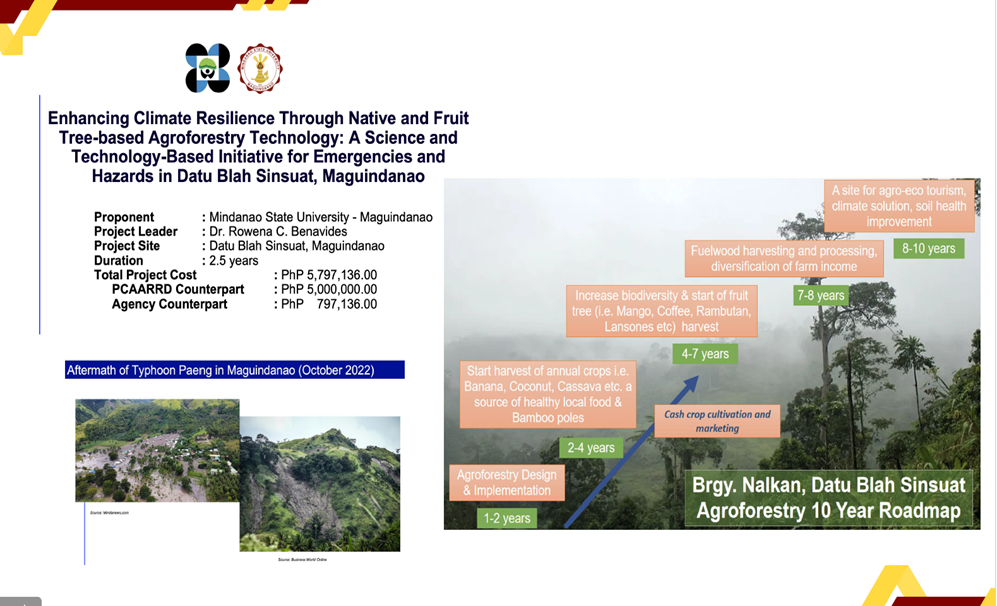
MSU-Maguindanao Champions Sustainable Land Management for Future Agro-Ecotourism Development
The College of Forestry and Environmental Studies (CFES) of Mindanao State University–Maguindanao is implementing the project "Enhancing Climate Resilience through Native Tree and Fruit Tree-Based Agroforestry Technology: A Science and Technology-Based Initiative for Emergencies and Hazards in Datu Blah Sinsuat, Maguindanao." Funded with ₱5 million (approximately US$87,111) by the Department of Science and Technology–Philippine Council for Agriculture, Aquatic and Natural Resources Research and Development (DOST-PCAARRD), in partnership with the University of the Philippines Los Baños–Institute of Agroforestry (UPLB-IAF), the project aims to rehabilitate 10 hectares of degraded upland areas and produce 50,000 seedlings, consisting of 20,000 native trees and 30,000 fruit trees. These interventions aim to restore vegetation cover, improve soil and water conservation, reduce erosion, and strengthen the project site's ecological resilience in Barangay Nalkan, Datu Blah Sinsuat, Maguindanao del Norte.The Project Site - Barangay Nalkan, Datu Blah SInsuat, Maguindanao del Norte Agroforestry 10-Year Road MapThrough the project, 2 nurseries for propagating and maintaining native and fruit tree seedlings have been established and developed, which have already produced 52,000 seedlings, exceeding the initial target of 50,000 by 2,000 seedlings. These comprise 22,000 native tree seedlings and 30,000 fruit tree seedlings, providing sufficient planting materials for the planned agroforestry establishment and rehabilitation of the target area.As part of its long-term vision, the project aims to transform the rehabilitated landscape into an agro-ecotourism site within 8 to 10 years. Through sustained agroforestry development, restoration of native vegetation, and the cultivation of fruit-bearing trees, the site is envisioned to serve as a destination for nature-based tourism, environmental education, and community learning on sustainable land management. This long-term initiative also seeks to demonstrate how science-based agroforestry can support biodiversity conservation, climate resilience, and sustainable livelihood opportunities for local communities while laying the foundation for responsible tourism development.
December 21, 2025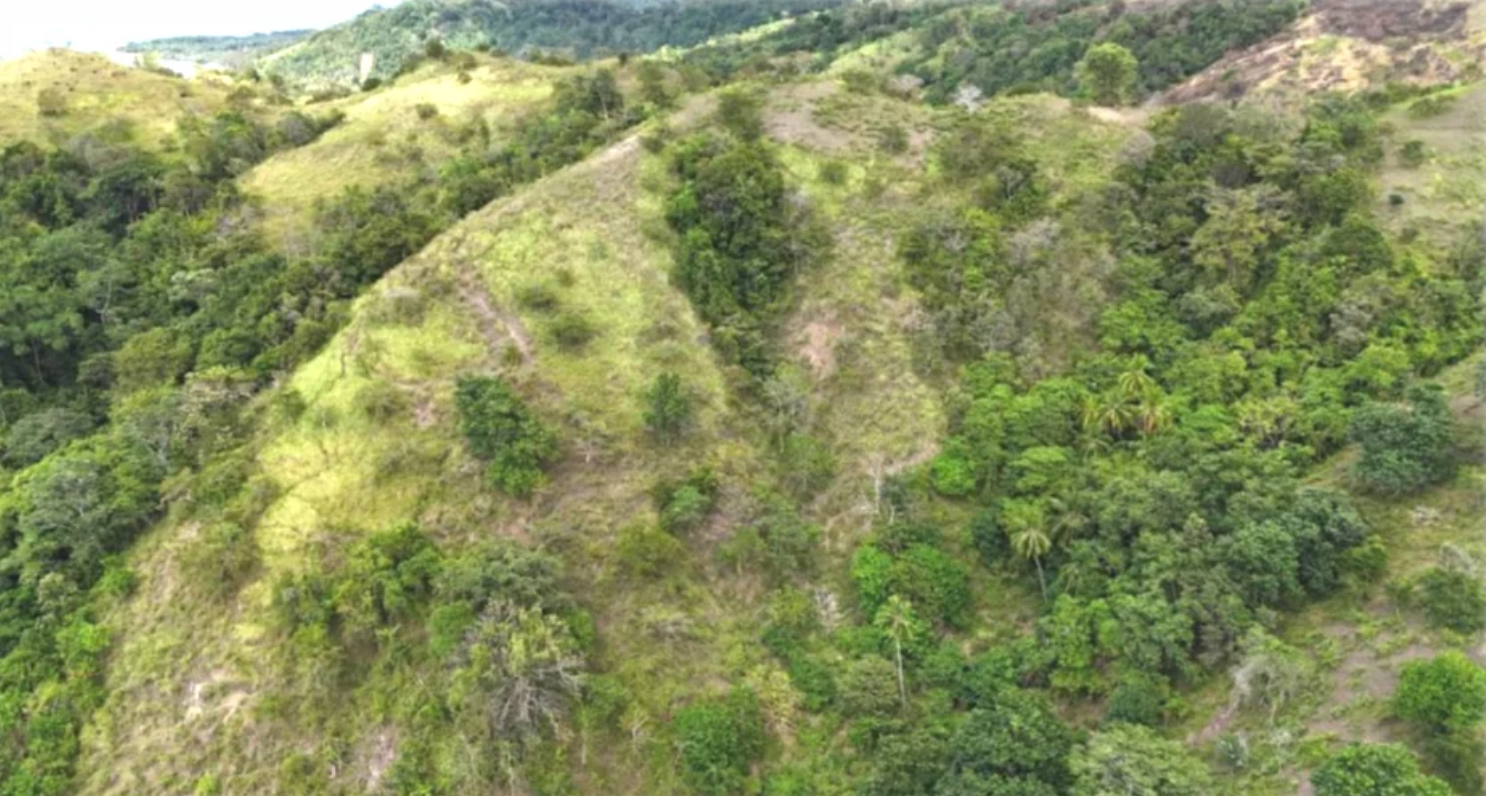
The College of Forestry and Environmental Studies Implements Ecosystem Rehabilitation and Biodiversity Conservation Through Native and Fruit Tree-Based Agroforestry in Datu Blah Sinsuat, Maguindanao del Norte
Aerial view of the project site for “Enhancing Climate Resilience through Native Tree and Fruit Tree-Based Agroforestry Technology: A Science and Technology-Based Initiative for Emergencies and Hazards in Datu Blah Sinsuat, Maguindanao"The College of Forestry and Environmental Studies (CFES) of Mindanao State University–Maguindanao is implementing the 2.5-year project "Enhancing Climate Resilience through Native Tree and Fruit Tree-Based Agroforestry Technology: A Science and Technology-Based Initiative for Emergencies and Hazards in Datu Blah Sinsuat, Maguindanao." With a project funding of ₱5 million (approximately US$87,111) from the Department of Science and Technology–Philippine Council for Agriculture, Aquatic and Natural Resources Research and Development (DOST-PCAARRD), and in partnership with the University of the Philippines Los Baños–Institute of Agroforestry (UPLB-IAF), the project aims to rehabilitate 10 hectares of degraded upland areas and produce 50,000 seedlings, consisting of 20,000 native trees and 30,000 fruit trees. These interventions aim to restore vegetation cover, improve soil and water conservation, reduce erosion, and strengthen the project site's ecological resilience in Barangay Nalkan, Datu Blah Sinsuat, Maguindanao del Norte.To support the agroforestry establishment, the University developed nurseries for propagating and maintaining native and fruit tree seedlings. The nurseries has produced 52,000 seedlings, exceeding the initial target of 50,000 by 2,000 seedlings. These comprise 22,000 native tree seedlings and 30,000 fruit tree seedlings, providing sufficient planting materials for the planned agroforestry establishment and rehabilitation of the target area.Project Leader Dr. Rowena C. Benavides of MSU-Maguindanao during the ceremonial tree planting for the project, “Enhancing Climate Resilience through Native and Fruit Tree-Based Agroforestry Technology,” held on February 19, 2026, in Barangay Nalkan, Datu Blah Sinsuat, Maguindanao del Norte.The project team, in close coordination with the funding and local partners, will continue implementing the project until 2026, through additional planting activities, site maintenance, and community engagement to complete the 10-hectare rehabilitation target. The outcomes of these interventions, particularly seedling survival, vegetation establishment, and improvements in soil and habitat conditions, will also be regularly monitored by the University. The initiative aims to support long-term ecosystem restoration, strengthen climate resilience, and promote local biodiversity conservation.
December 21, 2025Progress and Info
Protect, restore and promote sustainable use of terrestrial ecosystems, sustainably manage forests, combat desertification, and halt and reverse land degradation and halt biodiversity loss.
Life on Land